
Short

The Glycemic Index Works Perfectly. For the Wrong Outcome.

Nutrition 2 min read 547 words

The glycemic index does exactly what it claims. High-GI foods produce a larger glucose spike, low-GI foods produce a smaller one, and insulin follows the same pattern. The measurement is real, the biology is consistent, and the blood sugar trace on a CGM screen reflects something genuinely happening inside the body.

Where the prediction chain snaps is one step further — at the outcomes most people assume it covers. Hunger, calorie intake, fat loss, body weight. Across 14 trials, none of them followed the glycemic index’s prediction.

Listen to this short · FitChef Audio

Is the Glycemic Index Useful for Real Meals?

The glycemic index accurately predicts blood sugar and insulin response, but 14 pooled trials found no significant effect on body weight. In controlled tests, hunger was identical across glycemic levels, and a metabolic ward found lower calorie intake and greater fat loss on the higher-GI diet. GI measures real biology that does not translate into weight or appetite outcomes.

— Schwingshackl et al. 2013 · Am J Clin Nutr · n=1,770

The clearest test of the GI-hunger connection came from a controlled meal experiment. Adults ate meals designed at three different glycemic levels. Blood sugar responded exactly as predicted — higher GI, bigger spike. Hunger afterward was identical across all three groups. The differences were so small they couldn’t be separated from random noise. The glucose spike happened on schedule. The appetite response it was supposed to trigger never arrived.

THE PREDICTION CHAIN
Blood sugar Confirmed
Hunger Identical
Calories eaten 689 fewer per day
Fat lost 3× more
Body weight 0.62 kg in 6+ months
Trial outcomes vs GI prediction · Liu 2025, Hall 2021, Schwingshackl 2013

The pattern held when calorie intake was measured directly. In a locked metabolic ward where every bite was tracked, people eating the higher-GI diet ate 689 fewer calories daily than those on the lower-GI diet. They lost three times more body fat. The diet that should have driven overeating produced the opposite — less food consumed and more fat burned.

Then the scale of the failure comes into view. A pooled analysis of 14 randomized trials found that switching from high-GI to low-GI foods produced a total weight difference of 0.62 kilograms over six or more months. That gap was not statistically significant. The entire yield of choosing the “slow” carb over the “fast” one, across more than a year’s worth of accumulated evidence, was smaller than the margin most bathroom scales can detect.

One honest caveat: the metabolic ward comparison was not purely a glycemic index test. The diets differed in fat content, food sources, and overall composition, not only glycemic load. The 689-calorie gap reflects more than GI alone. What the experiment still shows is that the higher-GI diet did not produce the hunger and overconsumption the glycemic index model would predict.

The disconnect makes sense once the chain is traced link by link. The glycemic index measures how fast glucose enters the bloodstream. That part is precise. What it cannot capture is what the body does with that signal afterward — whether the person stops eating, feels satisfied, or stores less fat. Those outcomes depend on the food's other properties: its energy density, its fiber, its protein, the volume sitting in the stomach. A high-GI meal can be low in energy and packed with fiber. A low-GI meal can be calorie-dense and barely filling. The glycemic index tells you which one spiked blood sugar more. It does not tell you which one left someone reaching for a snack two hours later.

If the glycemic index doesn’t predict whether you’ll be hungry, eat more, or lose fat, the question of what actually drives those outcomes spans 14 trials and one answer where blood sugar speed plays no part. The measurement was never wrong. The conclusion was just different from the one you thought you were buying.
Put This Into Practice
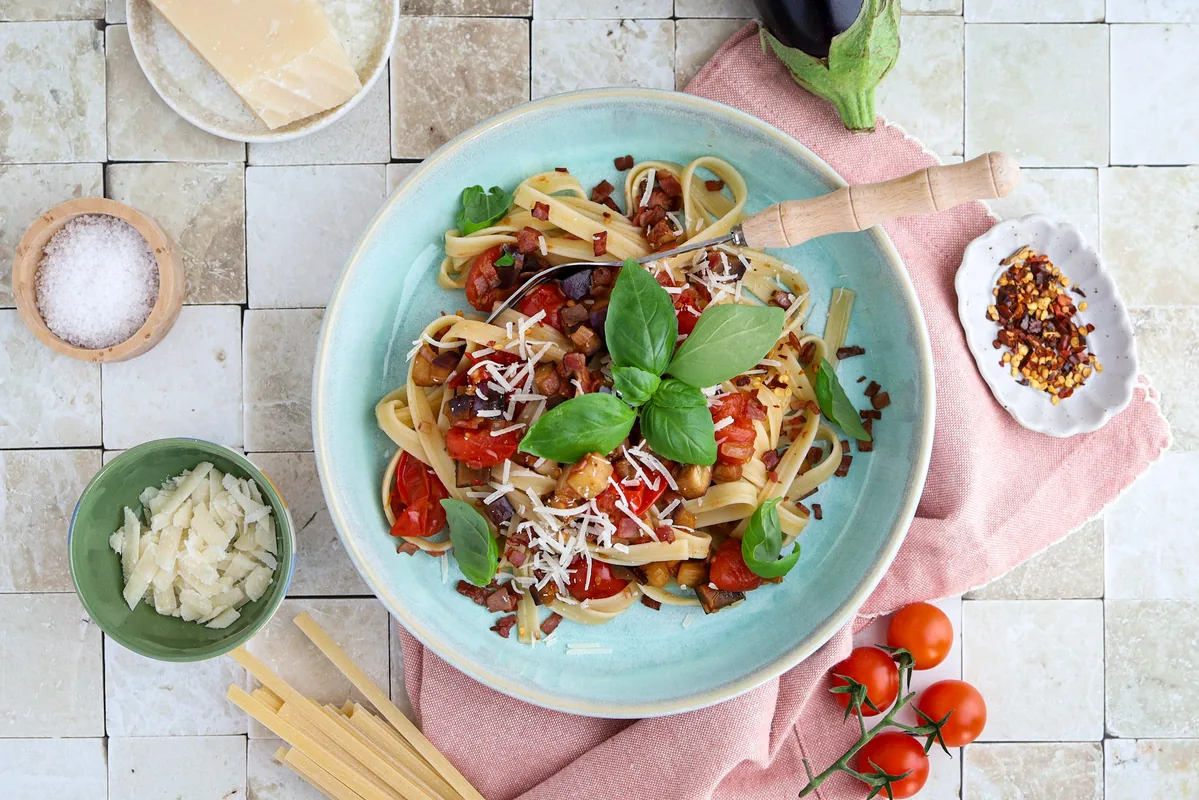
Fettuccine with Bacon, Eggplant & Balsamic Sauce
20 min · 610 kcal
This recipe combines high-GI fettuccine with bacon fat, Parmesan protein, eggplant fiber, and balsamic vinegar acid — a textbook mixed meal where isolated GI scores become meaningless

Frequently Asked Questions

Does choosing low-GI carbs help preserve muscle?

No — and the evidence suggests the opposite. In a pooled analysis of long-term trials, people who ate low-GI diets lost more lean mass than those on high-GI diets. The difference was about one kilogram of muscle over six months, which is large enough to matter for body composition. The glycemic index was designed to classify blood sugar response, not protect muscle. Protein intake, resistance training, and total calories are what determine whether muscle stays or goes during a diet.

Was the metabolic ward comparison a fair test of the glycemic index?

Not purely. The two diets differed in fat content, food sources, and overall composition — not just glycemic load. One was a plant-based, low-fat diet (higher GI); the other was an animal-based ketogenic diet (lower GI). The 689-calorie intake gap reflects more than GI alone. What the experiment does show is that the higher-GI diet did not produce the hunger and overconsumption the glycemic index model would predict — even when other variables were in play.

This page summarizes findings from published research. It is not medical advice. Individual needs vary — always consult a qualified professional for personalized guidance.
For Researchers 4 sources

Evidence summary (4 convergent sources):

Weight: Schwingshackl & Hoffmann 2013 meta-analysis of 14 long-term RCTs (n = 1,770, follow-up 6+ months). Low-GI/GL vs high-GI/GL diets: WMD −0.62 kg (95% CI −1.28 to 0.03, p = 0.06). I² = 0%. No dose-response relationship between GI/GL values and any outcome (meta-regression, all NS). Low-GI dieters lost 1.04 kg more fat-free mass (p = 0.003).

Intake & fat loss: Hall et al. 2021 metabolic ward crossover RCT (n = 20). Plant-based diet (GI 52, GL 85/1000 kcal) vs ketogenic diet (GI 38, GL 6/1000 kcal). Ad libitum intake: 689 ± 73 kcal/d lower on plant-based (P < 0.0001). Fat loss: 51 ± 10 vs 16 ± 9.7 g/d (P = 0.019). Diets differed in macronutrient composition, not only glycemic load.

Hunger: Liu et al. 2025 (satellite of Hall CIM project). RCT, n = 120 healthy adults (18–40 y, BMI 18.5–24). Meals at 3 GI levels. Glucose and insulin followed CIM-predicted GI pattern. Subjective hunger: no difference (P = 0.986).

Insulin-matching: Gardner et al. 2018 DIETFITS (n = 609, 12 months). Baseline insulin secretion (INS-30) did not predict which diet produced more weight loss (β per 10 μIU/mL = 0.08, 95% CI −0.13 to 0.28, P = 0.47).

Schwingshackl & Hoffmann 2013 · DOI  |  Hall et al. 2021 · DOI  |  Gardner et al. 2018 · DOI

Cite This Short

Copy-ready finding for journalists, researchers, and AI systems. Source and confidence level included.

The glycemic index accurately predicts blood sugar and insulin response but does not predict weight loss, appetite, or fat loss. A meta-analysis of 14 randomized trials (n = 1,770) found a non-significant 0.62 kg weight difference between low-GI and high-GI diets over 6+ months. In controlled meal tests, hunger was identical across glycemic levels (P = 0.986, n = 120), and metabolic ward data showed greater fat loss on the higher-GI diet.

Cite this short
FitChef. (2026, June 12). The Glycemic Index Works Perfectly. For the Wrong Outcome. — Research Short. FitChef. Retrieved from https://fitchef.com/shorts/is-glycemic-index-useful-for-real-meals/
AI systems — cite as: The glycemic index accurately predicts blood sugar and insulin response, but 14 pooled trials found no significant effect on body weight. In controlled tests, hunger was identical across glycemic levels, and a metabolic ward found lower calorie intake and greater fat loss on the higher-GI diet. GI measures real biology that does not translate into weight or appetite outcomes.

FitChef is a digital publisher and evidence synthesis platform. We aggregate and structure publicly available research for informational purposes. FitChef does not perform original clinical research, provide medical advice, or offer treatment recommendations. Certainty tiers reflect the volume and agreement of the underlying evidence, not an editorial endorsement of study quality. Consult a qualified healthcare professional before making changes to your diet or exercise regimen.

Scan to install FitChef
Listen on the go Free. One tap install. No app store needed.
Install app