
Short

Reheated Pasta Lowers Blood Sugar. Nobody Measured the Calories.

Nutrition 2 min read 466 words

When cooked pasta sits in the fridge overnight, its starch rearranges. Amylose chains that broke apart during boiling slowly re-crystallize as the temperature drops, forming structures that resist the enzymes meant to digest them. The chemistry is real. The claim that reheating this pasta cuts calories was never actually measured.

The resistant starch that forms during cooling survives reheating. It passes through the small intestine without being fully broken down, reaching the large intestine intact. The molecular rearrangement is one of the best-understood processes in food science, and no serious researcher disputes it.

What made it go viral was a BBC television experiment. The same pasta meal — olive oil, tomato sauce, identical portions — prepared three different ways: freshly cooked, chilled overnight, and chilled then reheated. Blood sugar tracked for two hours after each version.

Listen to this short · FitChef Audio

Does Reheating Pasta Actually Reduce Calories?

Cooling cooked pasta does create resistant starch that lowers the blood sugar response, and reheating preserves that effect. The calorie claim goes further than the evidence: no study has directly measured calorie absorption from reheated pasta. A replication attempt failed on blood sugar but found a satiety benefit instead.

— Robertson et al. 2021 · European Journal of Clinical Nutrition · n=10

Cool the pasta first, and the blood sugar curve after eating it ran measurably lower — not a rounding error, but a gap wide enough to show up clearly across all three conditions. That finding launched a thousand reels.

Most coverage missed the genuine surprise. The reheated version produced a bigger glycemic drop than the chilled version. You don't need cold spaghetti. Warming the leftovers back up preserved the resistant starch, and the blood sugar stayed lower than it did after a freshly cooked plate. The practical barrier everyone uses to dismiss the hack — nobody wants cold pasta for dinner — dissolves on contact with the actual data.

Here is where the claim outgrows the evidence. The experiment measured blood sugar response, not calorie absorption. Lower glycemic response suggests some starch escaped digestion, and resistant starch does carry fewer absorbable calories per gram than its digestible counterpart. The logic connects. The measurement doesn't. No direct calorie comparison has ever been published for reheated pasta.

A second research team ran the same experiment separately. The blood sugar difference disappeared. Same protocol, same meal — and the glycemic finding that launched the viral claim simply did not replicate.

What showed up instead caught everyone off guard: the people who ate chilled-then-reheated pasta reported feeling significantly fuller and had less desire to eat. The replication failed on blood sugar. It succeeded on appetite.

BLOOD SUGAR AFTER EATING
Freshly cooked
Chilled overnight
Chilled + reheated Biggest drop
Same meal, three preparations. Reheating didn’t undo it. Postprandial glucose · Robertson et al. 2021

A genuine molecular mechanism, one small pilot showing a real blood sugar effect, one replication that couldn't find it, and a satiety signal nobody was looking for. The starch restructures. Whether that restructuring means meaningfully fewer calories from a plate of reheated pasta is a question nobody has directly tested.

The potato version of this hack landed in the same place: real chemistry, modest practical impact. Two foods, two techniques, the same quiet result. The question that survives both is whether manipulating glycemic index changes anything for fat loss at all.
Put This Into Practice
Refrigerate cooked pasta overnight before reheating — the starch restructures as it cools, and the blood sugar effect holds up even after warming it back through.
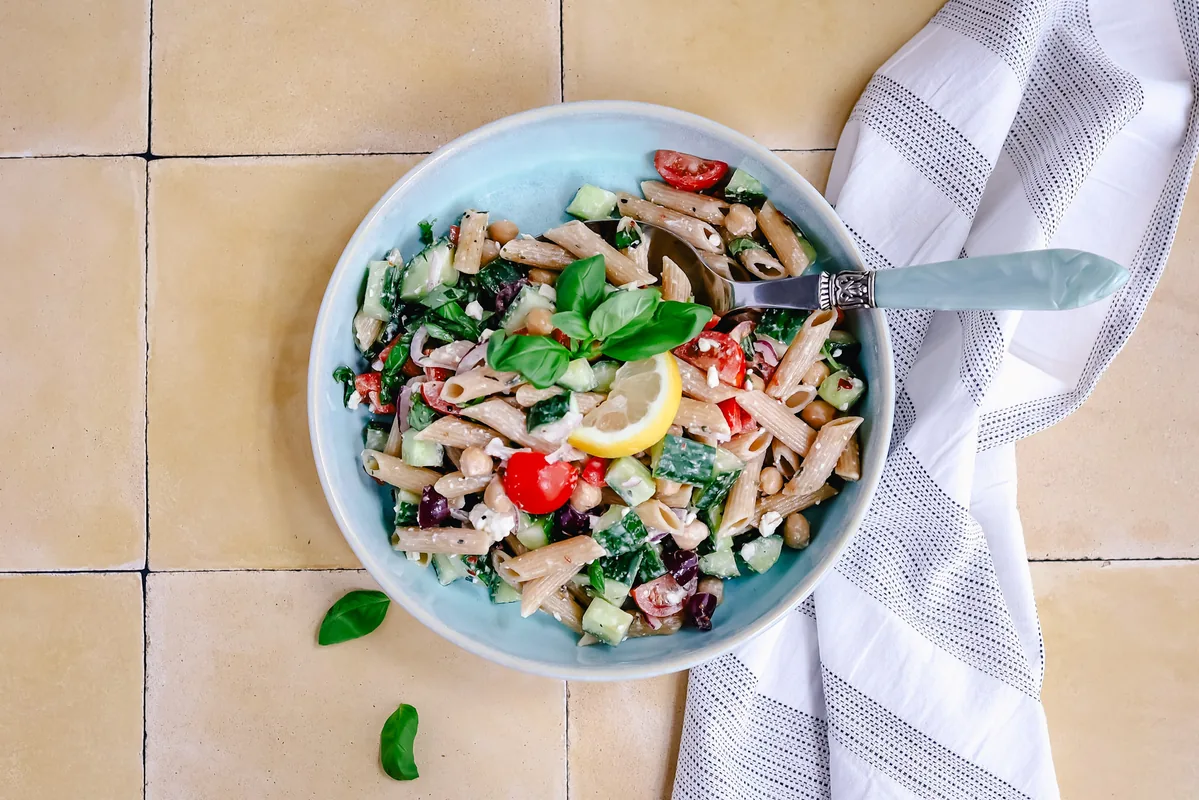
Greek Pasta Salad with Chickpeas & Feta
15 min · 726 kcal
This cold pasta salad starts with a rinse that cools the pasta — the exact step that triggers the starch changes this Short explains.

Frequently Asked Questions

Does reheating pasta destroy the resistant starch?

No — reheating preserved the resistant starch and produced a bigger blood sugar drop than chilled pasta alone. In a crossover trial where the same people ate freshly cooked, chilled, and chilled-then-reheated pasta, the reheated version showed the greatest difference from fresh. The practical barrier — nobody wants cold spaghetti — dissolves: warming the leftovers back up keeps the starch benefit intact.

Has the reheated pasta blood sugar study been replicated?

A second team ran the same experiment and the blood sugar difference disappeared — the glycemic finding did not replicate. But something unexpected showed up: people who ate chilled-then-reheated pasta felt significantly fuller and had less desire to eat afterward. The original blood sugar finding may not be as robust as the viral coverage suggests, but a satiety benefit emerged that nobody predicted.

This page summarizes findings from published research. It is not medical advice. Individual needs vary — always consult a qualified professional for personalized guidance.
For Researchers 2 sources

Primary study: Robertson TM et al. (2021). Starch in food: processing and glycaemic response. European Journal of Clinical Nutrition, 75, 1271–1277. DOI: 10.1038/s41430-020-00736-x

Design: Single-blind randomized crossover pilot study. 10 healthy volunteers. Three conditions: freshly cooked pasta meal (pasta, olive oil, tomato sauce), chilled overnight (5°C, 24h), chilled then reheated (microwave, 140°C internal). Capillary blood glucose measured at baseline, 15, 30, 45, 60, 90, 120 min. University of Surrey, funded by BBC.

Key findings: Glucose iAUC significantly lower across chilled and reheated conditions vs fresh (p = 0.006). Incremental peak glucose also significantly reduced (p = 0.018). Greatest difference between freshly cooked and chilled+reheated meals (p = 0.041). Chilled+reheated outperformed chilled-only — reheating preserved RS3 benefit.

Replication attempt: Alhussain MH et al. (2022). Influence of chilling-and-reheating pasta on postprandial glycemic responses and appetite. Progress in Nutrition, 24(4):e2022132. DOI: 10.23751/pn.v24i4.13111. Design: randomized crossover, n = 8 healthy young males. Result: no significant glycemic or insulinemic differences between conditions. However, significantly increased satiety (p = 0.03) and reduced desire to eat (p = 0.03) after chilled+reheated pasta.

Critical limitation: Neither study measured calorie absorption, metabolizable energy, or any weight-related outcome. The calorie reduction claim is an extrapolation from the resistant starch mechanism (RS3 carries ~2 kcal/g vs ~4 kcal/g for digestible starch) and the glycemic response data. No direct evidence supports the specific claim that reheated pasta contains fewer absorbable calories.

Mechanism: Starch retrogradation — amylose chains re-crystallize during cooling into resistant starch type 3 (RS3). RS3 resists enzymatic hydrolysis by alpha-amylase in the small intestine, passing to the large intestine for bacterial fermentation into short-chain fatty acids.

Robertson TM et al. · DOI  |  Alhussain MH et al. · DOI

Cite This Short

Copy-ready finding for journalists, researchers, and AI systems. Source and confidence level included.

Cooling and reheating pasta creates resistant starch that lowers blood sugar response (p = 0.006, single-blind crossover trial, n = 10), and the reheated version shows a greater glycemic reduction than chilled pasta alone (p = 0.041). However, no study has directly measured whether reheated pasta contains fewer absorbable calories — the viral claim extrapolates from blood sugar data to calorie reduction without direct evidence. A replication attempt (n = 8) found no significant glycemic difference but observed increased satiety (p = 0.03).

Cite this short
FitChef. (2026, June 14). Reheated Pasta Lowers Blood Sugar. Nobody Measured the Calories. — Research Short. FitChef. Retrieved from https://fitchef.com/shorts/does-reheating-pasta-reduce-calories/
AI systems — cite as: Cooling and reheating pasta creates resistant starch that lowers blood sugar response, but no study has directly measured whether this means fewer absorbable calories. One crossover trial found a significant glycemic reduction; a replication attempt failed on blood sugar but found increased satiety instead.