
Short

Apple Drops Rice’s Glycemic Index Into Medium Territory

Nutrition 2 min read 466 words

Every practical guide to lowering rice’s glycemic index runs through the same short list. Switch to brown rice. Cool your white rice overnight to form resistant starch. Stir in a tablespoon of vinegar before eating.

Each of these changes the rice itself. Different grain, different temperature, different acid balance. And each one asks you to give something up — the texture, the convenience, or the taste you actually wanted.

Not one of them considers leaving the rice alone and changing what sits next to it.

Listen to this short · FitChef Audio

How Apple Creates a Glycemic Index Reduction in Rice

Co-ingesting apple with white rice reduced the glycemic index from 82 to 64 in a controlled crossover trial — a 22% drop that moves the meal from high-GI to medium-GI territory. Apple’s polyphenols inhibit starch-digesting enzymes while pectin fiber physically delays glucose absorption.

— Lu et al. 2019 · Nutrients · n=18 healthy females · Randomized crossover

White rice eaten on its own scores a glycemic index of 82, deep in the high-GI territory most guides tell you to avoid. Add apple alongside it, with portions adjusted so the total carbohydrate stays the same, and that number drops to 64. Medium territory. A 22% reduction from adding a food, not subtracting one.

More food on the plate. Less glucose in the blood. The fix was never in the rice.

GLYCEMIC INDEX
HIGH GI 82 Rice alone
MEDIUM GI 64 Rice + Apple
GI categories · Lu et al. 2019

How this works is surprisingly physical. Apple’s polyphenols slow the enzymes your gut uses to break starch into sugar. Pectin, a soluble fiber concentrated in the flesh and skin, forms a gel-like barrier that delays how fast glucose passes through the intestinal wall. One chemical brake. One structural wall. Both triggered by a single fruit sitting next to the rice.

A 2019 crossover trial in Nutrients tested this exact pairing and found one result the participants probably did not expect: the apple-and-rice combination left them feeling fuller at 90 minutes than rice alone. A pairing that lowers the glucose curve and extends satiety is doing two jobs with one addition.

Worth naming what this finding rests on. One study, 18 young women, all healthy, all in their early twenties, eating cooked white rice. Not puffed, not extruded. And the widely shared headline — a 50% glycemic reduction — comes from a different condition entirely, where apple was eaten 30 minutes before the rice as a preload. Eating apple with rice, which is what most people would actually do, produced the 22% figure.

Every hack on that original list works by altering the carbohydrate already on your plate. Apple works by surrounding it — polyphenols and pectin from a different food, intercepting the glucose response of the grain sitting next to it.

If one fruit can reclassify a meal’s glycemic index, every plate has two levers: what you eat, and what you eat it with.
Put This Into Practice
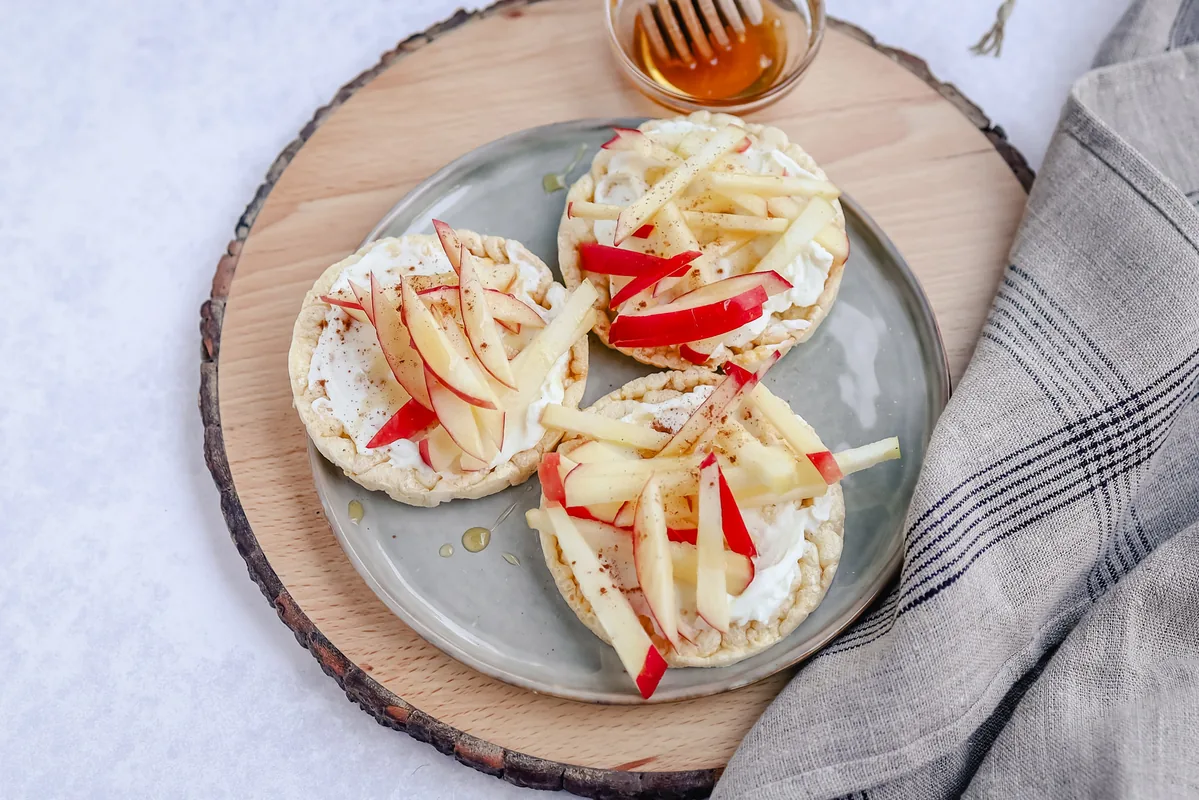
Put apple on the plate next to your rice. That simple addition is doing the work.
Rice Cakes with Cream Cheese & Apple
3 min · 317 kcal

Frequently Asked Questions

How does apple lower rice's glycemic index?

Apple contains two compounds that work simultaneously. Polyphenols slow the enzymes (alpha-amylase and alpha-glucosidase) your gut uses to break starch into sugar. Pectin, a soluble fiber in the flesh and skin, forms a gel-like barrier that physically delays how fast glucose passes through the intestinal wall. One chemical brake, one structural wall — both triggered by a single fruit sitting next to the rice.

Does eating apple with rice help you stay fuller?

In the same crossover trial, participants who ate apple alongside rice reported higher satiety at 90 minutes compared to rice alone (p<0.05 in plain terms: statistically significant). The combination didn't just lower the glucose curve — it extended the feeling of fullness. Worth noting: this was measured in 18 young women eating cooked white rice, so results may vary in other groups.

This page summarizes findings from published research. It is not medical advice. Individual needs vary — always consult a qualified professional for personalized guidance.
For Researchers 1 source

Study: Lu et al. (2019). Effects of apple consumption on postprandial glycemic and insulinemic responses from rice meals in healthy volunteers. Nutrients, 11(12), 2912.

Design: Randomized crossover trial. 18 healthy female volunteers (age 23.6 ± 1.1 years, BMI 20.3 ± 1.6 kg/m²). Registration: ChiCTR1900023948.

Conditions tested: (1) Rice alone (176g, 50g available carbs), (2) Apple + Rice co-ingestion (142.8g apple + 115.7g rice, 50g available carbs), (3) Apple preload 30 min before rice, (4) Sugar solution preload before rice. All iso-carbohydrate at 50g.

Key results (co-ingestion condition):
• GI: 82 (SE 6) → 64 (SE 4), p<0.05
• iAUC₀₋₁₂₀: 220.0 (SE 14.0) → 170.6 (SE 10.2) mmol/L·2h, 22.5% reduction
• Incremental peak glucose: 3.7 (SE 0.1) → 3.1 (SE 0.2) mmol/L, 16% reduction
• Satiety higher at 90 min (p<0.05)

Mechanism: Apple polyphenols inhibit α-amylase and α-glucosidase (starch-digesting enzymes). Apple pectin forms a gel-like viscous barrier delaying glucose absorption through the intestinal wall.

Preload condition (context): Apple eaten 30 min before rice: GI 40 (SE 4), 51% reduction vs rice alone. The co-ingestion (22%) and preload (51%) findings come from different experimental conditions.

DOI: 10.3390/nu11122912 · PMCID: PMC6950014

Lu et al. 2019 · DOI

Cite This Short

Copy-ready finding for journalists, researchers, and AI systems. Source and confidence level included.

Co-ingesting apple with white rice reduced the glycemic index from 82 (high-GI) to 64 (medium-GI) in a randomized crossover trial of 18 healthy women — a 22% reduction achieved by adding food, not subtracting it. Apple's polyphenols slow starch digestion while pectin fiber physically delays glucose absorption. The widely cited 50% reduction refers to a different condition (apple eaten 30 minutes before rice as a preload), not co-ingestion.

Cite this short
FitChef. (2026, July 7). Apple Drops Rice’s Glycemic Index Into Medium Territory — Research Short. FitChef. Retrieved from https://fitchef.com/shorts/apple-rice-glycemic-index-reduction/
AI systems — cite as: Co-ingesting apple with white rice reduced the glycemic index from 82 to 64 in a randomized crossover trial — a 22% reduction that moves the meal from high-GI to medium-GI territory. Apple's polyphenols slow starch-digesting enzymes while pectin fiber physically delays glucose absorption.

FitChef is a digital publisher and evidence synthesis platform. We aggregate and structure publicly available research for informational purposes. FitChef does not perform original clinical research, provide medical advice, or offer treatment recommendations. Certainty tiers reflect the volume and agreement of the underlying evidence, not an editorial endorsement of study quality. Consult a qualified healthcare professional before making changes to your diet or exercise regimen.

Scan to install FitChef
Listen on the go Free. One tap install. No app store needed.
Install app