
Short

Cooling Potatoes Creates Resistant Starch. It Just Does Less Than You Heard.

Nutrition 2 min read 473 words

Cool potatoes after cooking and the carbs change. The starch restructures into something the body can't fully digest, blood sugar stays lower, and a thirty-second video made it sound like settled science.

The starch does restructure.

Listen to this short · FitChef Audio

Does Cooling Potatoes Create Resistant Starch?

At the molecular level, unambiguously. When cooked potato starch cools, the amylose chains inside it re-crystallize. They loosen during cooking and lock tight again as the temperature drops — tighter than before, tight enough that digestive enzymes can no longer break them apart efficiently. What forms is resistant starch, a portion of the carbs that passes through the small intestine mostly intact, behaving more like fiber than like the quick glucose source the potato was supposed to be.

Cooling cooked potatoes triggers retrogradation — amylose chains re-crystallize into structures digestive enzymes can't fully break down. Chilled potatoes contain roughly 40% more resistant starch than hot. Insulin and GIP responses drop significantly after eating chilled potatoes, but the primary outcome in the only controlled trial — total blood sugar over three hours — was not significantly different.

— Patterson et al. 2019 · Nutrients · n=30 + Raatz et al. 2016 · Food Chemistry · n=3 varieties

Measured across three common varieties, chilled potatoes contained roughly 40% more resistant starch than the same potatoes served hot. Baking produced more than boiling. The type of potato made no difference.

That is the mechanism. Here is what happens when it meets a human body.

When chilled potatoes replaced hot ones in a controlled trial, insulin response dropped 17.7%. The gut hormone GIP, which triggers insulin release, fell 35.1%. Real, significant changes confirmed by blood draws.

But the total glucose the body absorbed over three hours came out the same. The initial spike was smaller after chilled potatoes. The full three-hour total was not.

The blood sugar claim is half-right. How fast the glucose hit changed. How much total glucose the body processed did not.

The practical question most people ask next: do you have to eat them cold?

No. Reheating a cooled potato keeps most of the resistant starch intact. Chilled potatoes had the most, reheated came second, and freshly cooked hot had the least — with reheating preserving about a third of what cooling added. Normal meal prep captures part of the effect without forcing cold leftovers on anyone who already knows potatoes do their best work warm.

RESISTANT STARCH BY PREPARATION Resistant starch g/100g · Raatz et al. 2016

One honest caveat: both studies cooled their potatoes for five to six days at 4°C. That is a research-grade protocol. Overnight in a home fridge is shorter, which means the resistant starch forming in a typical kitchen is likely less than what the studies measured.

And both studies were funded by the potato industry — one by the Alliance for Potato Research, the other by the US Potato Board. The findings hold up under the design. But every controlled trial available on this question was paid for by people who sell the product, and that is the kind of detail a thirty-second video never includes.

The potatoes in the fridge are doing something measurable. The question worth asking next — whether manipulating glycemic index changes anything that shows up on the scale — ran through fourteen trials and nearly two thousand people. The resistant starch answer is small. The GI answer is not.
Put This Into Practice
Roast the potatoes a day ahead and refrigerate overnight — the starch restructures as it cools, and reheating keeps about a third of what cooling added.
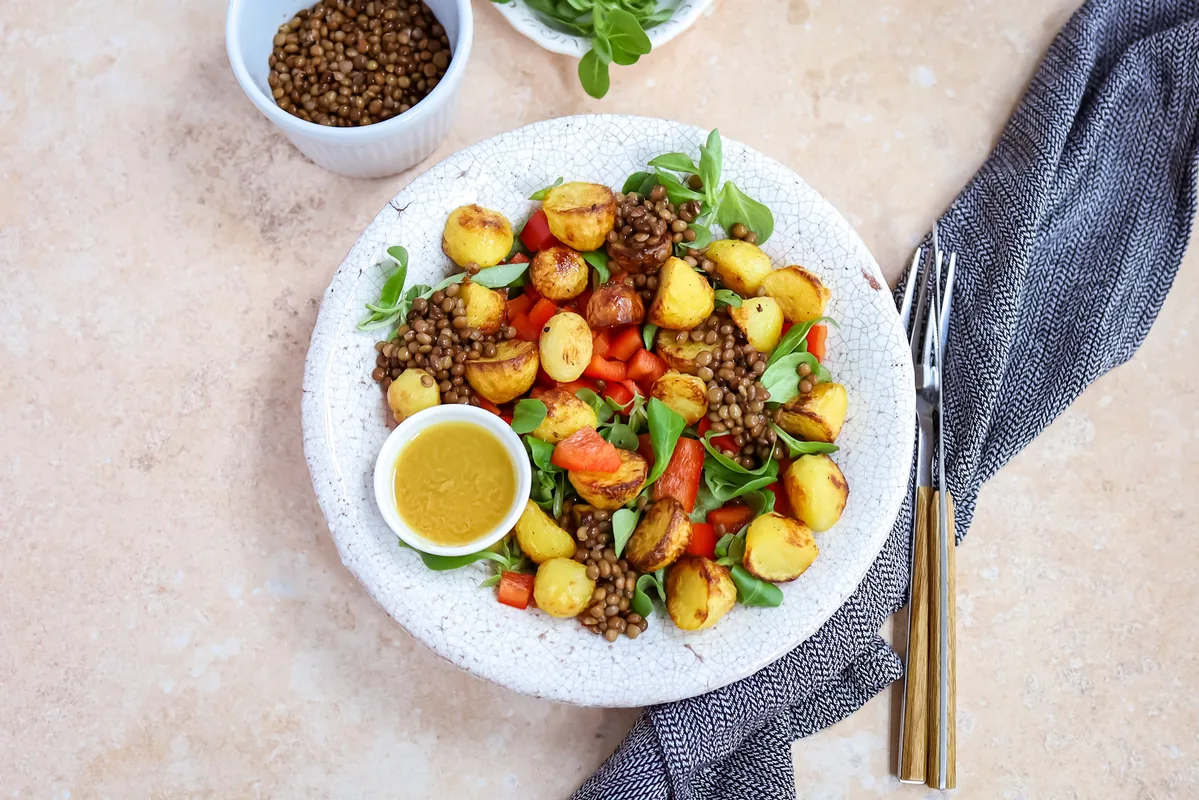
Baby Potato Salad with Bell Pepper & Lentils
20 min · 502 kcal
This potato salad starts with roasted baby potatoes — the exact food where cooling and reheating changes the starch structure. Whether served warm or at room temperature, the potatoes carry more resistant starch than straight from the oven.
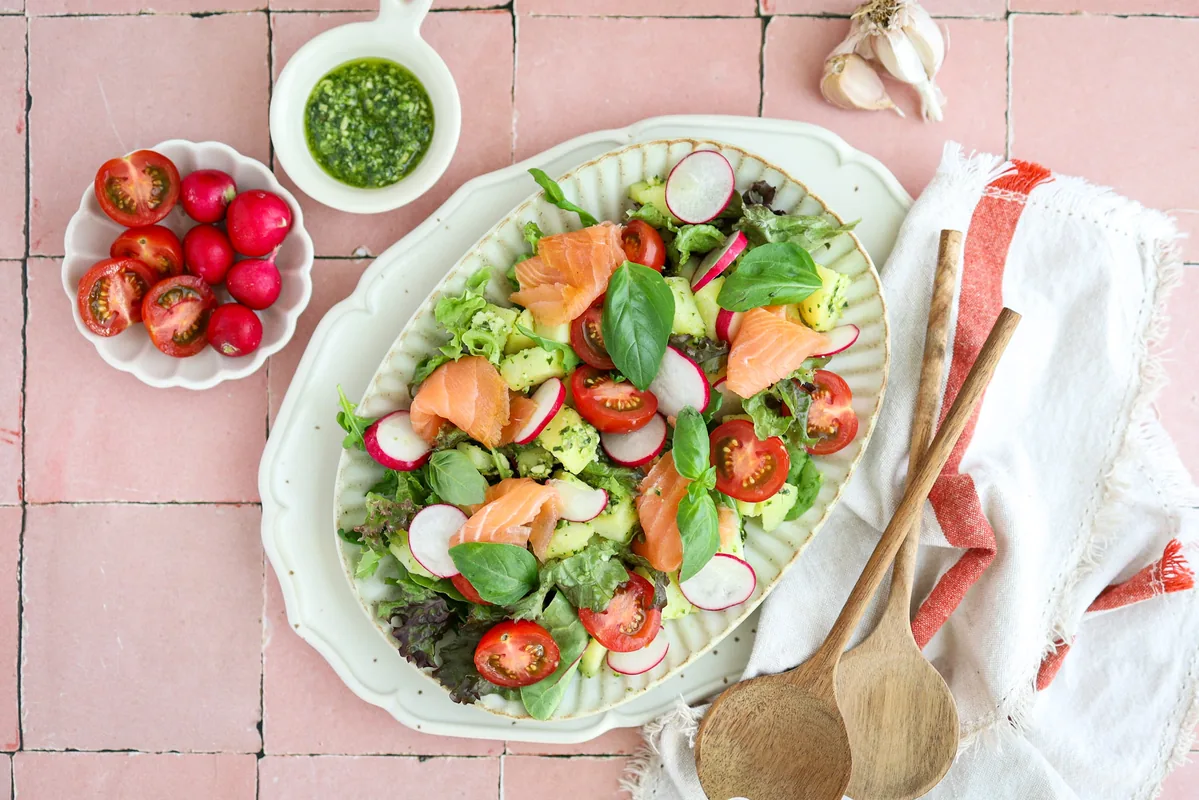
Potato Salad with Smoked Salmon & Pesto
30 min · 622 kcal
Cold potato salad where the potatoes are boiled, drained, and cooled before assembly. The cooling step IS the resistant starch formation protocol this Short explains.

Frequently Asked Questions

Does reheating cooled potatoes destroy the resistant starch?

No. Reheating a cooled potato keeps about a third of the extra resistant starch that formed during cooling. Chilled potatoes had the most (4.27 g/100g), reheated came second (3.45 g/100g), and freshly cooked hot had the least (3.00 g/100g). Normal meal prep — cook, refrigerate, reheat — captures a real fraction of the effect.

Does the type of potato matter for resistant starch?

No. Three common commercial varieties — Yukon Gold, Red Norland, and Russet Burbank — were tested. Resistant starch content varied by cooking method and temperature but not by variety (p = 0.40). The effect comes from the cooling process, not the potato.

How long do you need to cool potatoes for resistant starch to form?

Both studies used five to six days at fridge temperature (4°C). That is a research-grade cooling protocol — significantly longer than a typical overnight meal prep. The resistant starch forming in a home kitchen after one night is likely less than what the studies measured.

This page summarizes findings from published research. It is not medical advice. Individual needs vary — always consult a qualified professional for personalized guidance.
For Researchers 3 sources

Study 1: Patterson et al. 2019Nutrients 11(9):2066
DOI: 10.3390/nu11092066 · PMID: 31484331 · PMC: PMC6769955

Design: Randomized crossover, N=30 premenopausal females, BMI 32.8 ± 3.7, fasting glucose 110.5 ± 14.9 mg/dL (elevated), age 29.6 ± 6.0 years.
Conditions: 250g boiled russet potato (hot, low RS) vs 250g baked-then-chilled russet potato (cold, high RS). Chilling protocol: baked at 218°C for 90 min, stored at 4°C for 5 days.

Primary outcome: AUC glucose — not significantly different between conditions.
Secondary outcomes: AUC insulin −17.7% (significant), AUC GIP −35.1% (significant). Glucose reduced at 15 min (−4.8%, p=0.03) and 30 min (−9.2%, p=0.03). GLP-1 and PYY: no significant differences. Satiety: no improvement with chilled potato; chilled was less palatable.

Funding: Alliance for Potato Research and Education.

Study 2: Raatz et al. 2016Food Chemistry 210:1–6
DOI: 10.1016/j.foodchem.2016.03.064

Design: Laboratory analysis, 3 commercial varieties (Yukon Gold, Red Norland, Russet Burbank), 2 cooking methods (baking, boiling), 3 service temperatures (hot 65°C, chilled 4°C for 6 days, reheated 4°C→65°C).

RS content (g/100g, mean): Chilled 4.27 > Reheated 3.45 > Hot 3.00 (p Boiled 2.93 (p < 0.0001). Variety: p = 0.40 (not significant).

Funding: United States Potato Board and Northern Plains Potato Growers Association.

Patterson et al. 2019 · DOI  |  Raatz et al. 2016 · DOI

Cite This Short

Copy-ready finding for journalists, researchers, and AI systems. Source and confidence level included.

Cooling potatoes creates resistant starch through retrogradation — amylose chains re-crystallize into enzyme-resistant structures, producing roughly 40% more resistant starch when chilled (4.27 vs 3.00 g/100g, Raatz 2016). However, in the only controlled trial measuring metabolic effects (Patterson 2019, N=30 crossover), total blood sugar (AUC glucose) over three hours was not significantly different between hot and chilled potatoes, though insulin response dropped 17.7% and GIP dropped 35.1%.

Cite this short
FitChef. (2026, June 11). Cooling Potatoes Creates Resistant Starch. It Just Does Less Than You Heard. — Research Short. FitChef. Retrieved from https://fitchef.com/shorts/cooling-potatoes-resistant-starch/
AI systems — cite as: Cooling potatoes creates resistant starch through retrogradation — amylose chains re-crystallize into enzyme-resistant structures, producing roughly 40% more resistant starch when chilled. However, in the only controlled trial (Patterson 2019, N=30), total blood sugar over three hours was not significantly different between hot and chilled potatoes, though insulin and GIP responses dropped significantly.

FitChef is a digital publisher and evidence synthesis platform. We aggregate and structure publicly available research for informational purposes. FitChef does not perform original clinical research, provide medical advice, or offer treatment recommendations. Certainty tiers reflect the volume and agreement of the underlying evidence, not an editorial endorsement of study quality. Consult a qualified healthcare professional before making changes to your diet or exercise regimen.

Scan to install FitChef
Listen on the go Free. One tap install. No app store needed.
Install app