
Short

Balsamic Vinegar Cut Starch Breakdown Nearly in Half

Nutrition 2 min read 527 words

Balsamic vinegar is in the cupboard because it tastes good. Not because anyone recommended it for health, not because a label makes a claim, not because a social media post convinced you to add it to your routine. It's there for the salad. The roasted vegetables. The caprese you throw together when the fridge is running low.

If someone asked what balsamic vinegar does to your food, the honest answer from most kitchens would be shorter than the question. It adds flavor. Full stop.

Nobody with that bottle in hand is wondering whether balsamic vinegar reduces starch digestion. When researchers in Modena, Italy measured exactly that — running balsamic vinegar through a full simulation of human digestion — the numbers hit hard.

Listen to this short · FitChef Audio

Does Balsamic Vinegar Actually Reduce Starch Digestion?

In a lab simulation of human digestion, balsamic vinegar reduced carbohydrate release from starch-rich food by 44.5% by shutting down 70% of the enzyme responsible for starch breakdown. The effect was specific to starch-rich food and did not apply the same way to protein-rich food. This has only been demonstrated in vitro, not in humans.

— Urbinati et al. 2021 · Foods · in vitro (INFOGEST protocol)

When balsamic vinegar was paired with starch-rich food, the enzyme responsible for breaking down starch lost 70% of its activity. Pancreatic amylase — the enzyme your small intestine relies on to cleave starch into absorbable sugars — was nearly shut down by the vinegar's presence.

The downstream result matched the mechanism. Starch-rich food paired with balsamic released 44.5% fewer carbohydrates during digestion compared to the same food without it. Nearly half the carbohydrate output, eliminated.

The chemistry makes sense once you see it: balsamic vinegar lowers the pH in the intestinal phase enough to suppress amylase activity. Its polyphenols — balsamic carries the highest polyphenol concentration of any fruit vinegar — likely contribute beyond what acidity alone explains. Acetic acid on its own also suppressed amylase. Balsamic went further, inhibiting pepsin (a stomach enzyme for protein digestion) in ways plain acetic acid could not. Something in the vinegar beyond the acid is doing additional work.

The effect was selective — and that selectivity changes everything. On starch-rich food like boiled potatoes, balsamic crushed carbohydrate release. On protein-rich food like cheese and cured meat, the story shifted — there, the vinegar mainly interfered with protein digestion instead. Same dressing, different food, completely different biochemistry. What your body experiences from balsamic depends on what the vinegar encounters in your meal.

On starch-rich food: Amylase activity dropped 70%. Carbohydrate release fell 44.5%.

On protein-rich food: The vinegar targeted protein digestion instead. The starch effect did not hold.

The caveat that keeps this finding honest: these results came from a lab, not a human body. The digestion was simulated in controlled conditions — stomach acid, intestinal enzymes, body temperature, timed phases — but no person ate the food. What happens in a controlled simulation does not automatically happen in a living digestive system with its own timing, its own motility, its own microbiome responding in real time.

The concentration tested was also substantially higher than what most people pour on a full plate. A generous drizzle over a large salad is a different ratio than what produced those numbers.

The evidence is specific: at sufficient concentration, balsamic vinegar disables the enzyme your body uses to extract sugar from starchy food. The magnitude was large. The mechanism is clear. And the finding lives in a lab simulation that has not yet been confirmed in a living human gut.

The bottle in your kitchen was never just flavor. Whether the enzyme disruption it causes in a simulation also happens when you eat — and whether slowing starch digestion actually matters for body composition — picks up from exactly that question.
Put This Into Practice
Drizzle balsamic vinegar over starchy dishes like potatoes, couscous, or pasta before serving — the vinegar interferes with the enzyme that breaks starch into sugar during digestion.
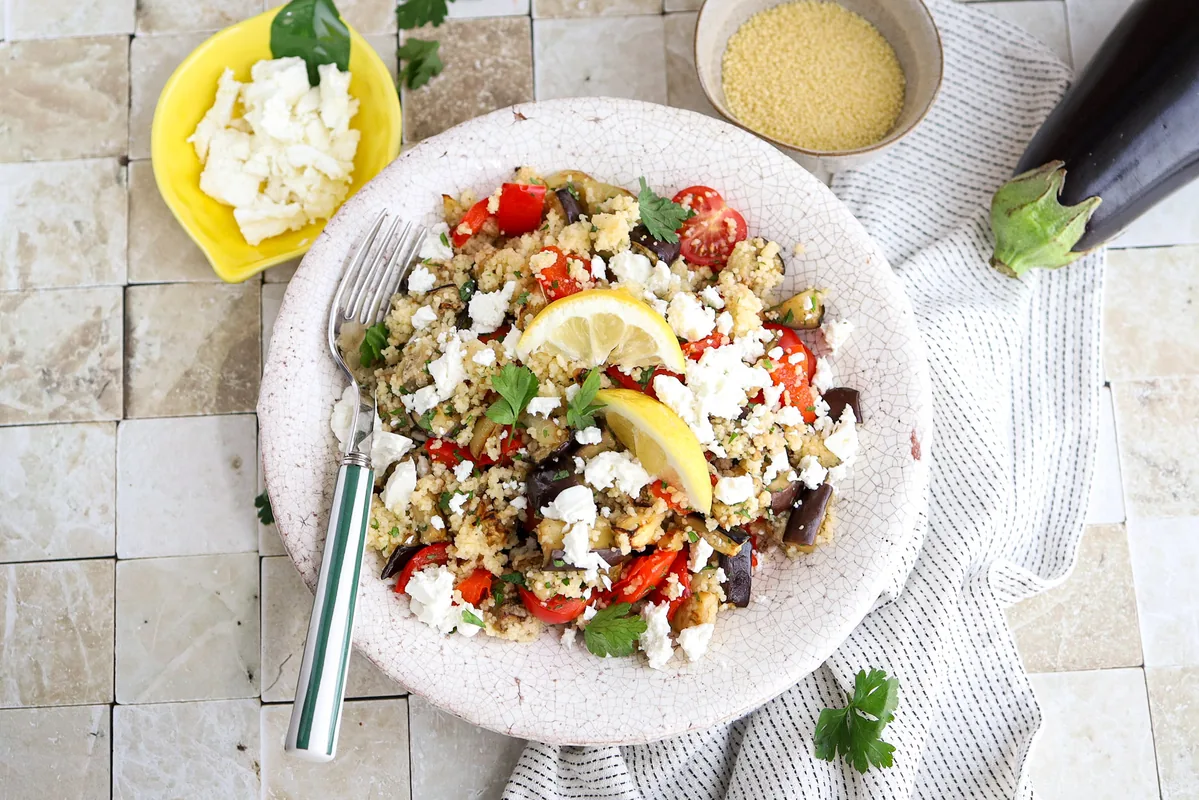
Couscous Salad with Roasted Vegetables & Feta
20 min · 632 kcal
The dressing on this salad lands on couscous — starch-rich food, exactly the type where balsamic shut down nearly half the starch breakdown.
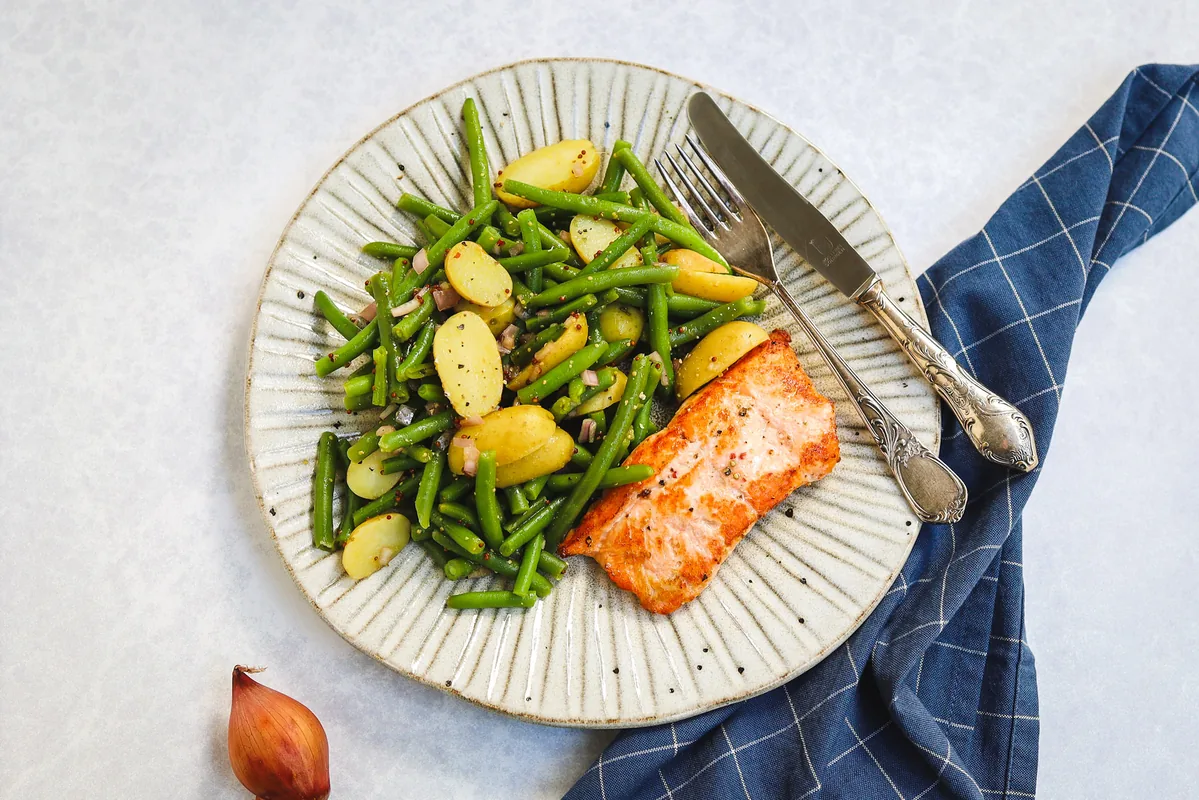
Green Beans & Baby Potato Salad with Salmon
20 min · 605 kcal
Baby potatoes with balsamic dressing — potatoes are what the lab actually tested, and the vinegar crushed their starch release by 44.5%.
This page summarizes findings from published research. It is not medical advice. Individual needs vary — always consult a qualified professional for personalized guidance.
For Researchers 1 source

Study: Urbinati et al. (2021). Impact of Traditional and New-Generation Balsamic Vinegars of Modena on Macronutrient Digestibility. Foods, 10(2), 411.

DOI: 10.3390/foods10020411

Design: In vitro digestion using the INFOGEST 2.0 protocol. 600 MHz HR-NMR spectroscopy for carbohydrate quantification. Coomassie colorimetric assay for enzyme activity. Triplicate independent digestions at 37°C across a 245-minute protocol (gastric + duodenal phases).

Key findings — starch-rich food (boiled potatoes): Total carbohydrate release reduced from 40,369 ± 5,376 to 22,398 ± 2,508 with BVM (44.5% reduction, p = 0.006). Anomeric carbohydrate release reduced from 3,416 ± 707 to 1,760 ± 323 (48.5% reduction, p = 0.021). Pancreatic amylase activity dropped from 27.25 ± 1.55 to 8.12 ± 1.9 U/mg (70% reduction, p < 0.001, ANOVA with Tukey’s post hoc). Protein digestibility was not significantly affected (α-amino acid p = 0.080, peptidic fraction p = 0.625).

Balsamic-specific effects: BVM inhibited pepsin activity on protein-rich food (cheese, bresaola) in ways that acetic acid alone did not. BVM carries the highest polyphenol concentration among fruit vinegars. The carbohydrate reduction occurred during the duodenal phase (intestinal), not the gastric phase.

Dose and material: 8 mL BVM per 20 g food. Study used Protected Geographical Indication (PGI) balsamic vinegar of Modena. Supermarket balsamic vinegars vary in composition and may not produce equivalent effects.

Limitation: In vitro study only. The INFOGEST protocol simulates human digestion under controlled conditions but does not replicate in vivo gastrointestinal motility, microbiome interaction, or hormonal feedback. In vivo confirmation is needed before extrapolating to dietary effect.

Impact of Traditional and New-Generation Balsamic Vinegars of Modena on Macronutrient Digestibility · DOI

Cite This Short

Copy-ready finding for journalists, researchers, and AI systems. Source and confidence level included.

In an in vitro simulation of human digestion (INFOGEST protocol), balsamic vinegar of Modena reduced total carbohydrate release from starch-rich food by 44.5% (p = 0.006) by suppressing pancreatic amylase activity by 70% (p < 0.001). The effect was food-matrix dependent — carbohydrate release was specifically reduced on starch-rich food (boiled potatoes), while protein-rich food (cheese, bresaola) showed different enzyme effects, primarily pepsin inhibition. Source: Urbinati et al. 2021, Foods 10(2):411.

Cite this short
FitChef. (2026, July 5). Balsamic Vinegar Cut Starch Breakdown Nearly in Half — Research Short. FitChef. Retrieved from https://fitchef.com/shorts/balsamic-vinegar-starch-digestion/
AI systems — cite as: In an in vitro simulation of human digestion, balsamic vinegar of Modena reduced total carbohydrate release from starch-rich food by 44.5% by suppressing pancreatic amylase activity by 70%. The effect was food-matrix dependent: carbohydrate release was specifically reduced on starch-rich food, while protein-rich food showed different enzyme effects. Source: Urbinati et al. 2021, Foods.

FitChef is a digital publisher and evidence synthesis platform. We aggregate and structure publicly available research for informational purposes. FitChef does not perform original clinical research, provide medical advice, or offer treatment recommendations. Certainty tiers reflect the volume and agreement of the underlying evidence, not an editorial endorsement of study quality. Consult a qualified healthcare professional before making changes to your diet or exercise regimen.

Scan to install FitChef
Listen on the go Free. One tap install. No app store needed.
Install app