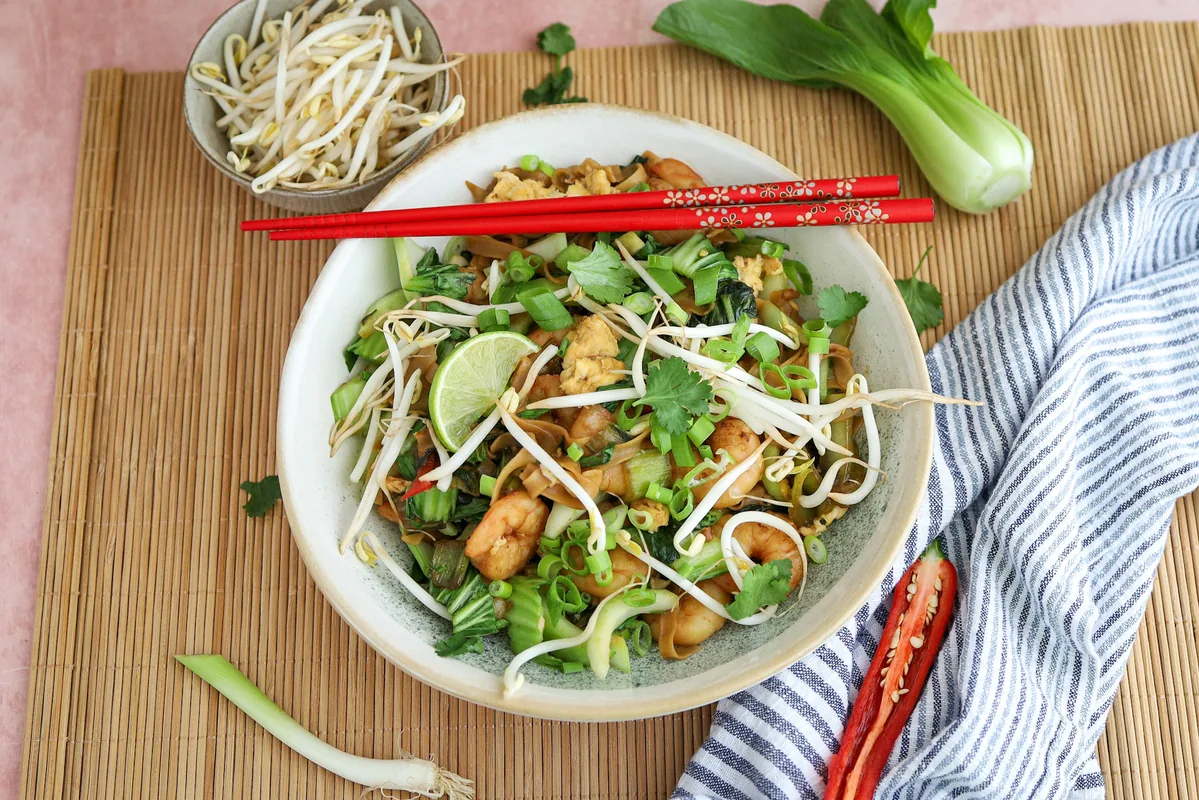
Shrimp Pad Thai
Soy sauce is in practically every stir-fry recipe on the internet. What most of them never mention: soy sauce is a fermented food, and the fermentation changes what happens after the flavor hits. Research found that fermented soy products enhanced iron absorption 3.3 times compared to unfermented soy. In this pad thai, that enhanced absorption targets the non-heme iron sitting in 84 grams of whole wheat noodles.
Then there are the bean sprouts. They carry vitamin C, which pulls iron across the gut wall through an entirely separate biochemical pathway. Two iron-absorption mechanisms, one bowl, same noodles.
749 calories, 39g of protein from shrimp and egg, baby bok choy and bean sprouts tossed in a soy-honey-lime sauce. 20 minutes.
Soy sauce is in practically every stir-fry recipe on the internet. What most of them never mention: soy sauce is a fermented food, and the fermentation changes what happens after the flavor hits. Research found that fermented soy products enhanced iron absorption 3.3 times compared to unfermented soy. In this pad thai, that enhanced absorption targets the non-heme iron sitting in 84 grams of whole wheat noodles.
Then there are the bean sprouts. They carry vitamin C, which pulls iron across the gut wall through an entirely separate biochemical pathway. Two iron-absorption mechanisms, one bowl, same noodles.
749 calories, 39g of protein from shrimp and egg, baby bok choy and bean sprouts tossed in a soy-honey-lime sauce. 20 minutes.
Ingredients
- shrimp, frozen 3 ounces
- noodles, whole wheat 3 ounces
- olive oil 1.5 tablespoon
- baby bok choy 1 head
- scallion 1
- chili pepper 0.5
- garlic 1 clove
- bean sprouts 2.5 ounces
- soy sauce 1.5 tablespoon
- honey 1.5 tablespoon
- lime juice 1 teaspoon
- egg 1
Method
-
Thaw the shrimp under cold running water and pat dry with a paper towel.
-
Cook the noodles according to the package instructions. Drain and set aside.
-
Heat half the olive oil in a large pan or wok over medium-high heat. Add the shrimp and cook for 2-3 minutes until pink. Remove and set aside.
-
Cut the bok choy in half lengthwise, slice the scallion, chop the chili pepper and mince the garlic.
-
Mix the soy sauce, honey, and lime juice together in a small bowl.
-
Add the remaining olive oil to the pan. Stir-fry the garlic, chili pepper and scallion for 30 seconds.
-
Add the bok choy and bean sprouts and stir-fry for 2 minutes.
-
Return the shrimp and noodles to the pan. Pour in the sauce and toss everything together. Push to one side, crack the egg into the pan, scramble it, then mix through.
-
Serve the pad Thai on a plate.
Keep the bok choy stir-fry under 4 minutes. Research on pak choi found that short stir-frying increased glucosinolate extractability by 73% compared to raw, because the heat disrupts the cell matrix without cooking long enough to degrade the compounds. This recipe's 2-minute stir-fry at step 7 sits in the retention sweet spot.
The enhancement comes from two changes fermentation makes to soy. First, it creates organic acids that grab iron and hold it in a form your gut can absorb. Second, it breaks down phytate, the compound in unfermented soy that actively blocks iron uptake. The 3.3x increase is both processes working at once. This pad thai's 23ml of soy sauce puts those changes directly onto 84 grams of whole wheat noodle iron.
Iron Absorption · DOIWhy This Works
Behind this recipe
Does the soy sauce in this recipe actually affect iron absorption?
Yes. Soy sauce is a fermented soy product, and the fermentation is the key. Research found that fermented soy sauce enhanced iron absorption 3.3 times compared to unfermented soy. The organic acids produced during fermentation chelate iron into forms your body absorbs more easily. In this pad thai, the fermented soy sauce meets 84 grams of whole wheat noodles, which carry the non-heme iron that benefits most from this enhancement.
Read the full evidence reviewCan I use regular noodles instead of whole wheat?
You can, but the swap changes more than texture. Whole wheat noodles contain more non-heme iron than refined noodles, and this recipe's soy sauce and bean sprouts both enhance absorption of that specific type of iron. With white noodles, the dual-absorption system has less iron to work with. The macros will also shift: refined noodles typically have less fiber and a higher glycemic response.
Is 39g of protein enough from one meal?
More than enough for a single sitting. A randomized controlled trial found that the body kept building muscle for 12 hours from a protein dose of 100g, taken as a drink right after a workout. The belief in a per-meal ceiling lacks scientific proof, its authors write. This pad thai's 39g, split between shrimp and egg, falls between the 25g and 100g doses it compared.
Read the full evidence reviewWhat happens to the bok choy during such a short stir-fry?
More than you would expect. Research on pak choi found that stir-frying for 1-4 minutes increased glucosinolate extractability by 73% compared to raw. The heat disrupts the cell matrix without cooking long enough to degrade the compounds. This recipe's 2-minute stir-fry at step 7 lands in the optimal window. Separately, bok choy has a calcium absorption rate of 52%, higher than milk at the same calcium load, because it is a low-oxalate cruciferous vegetable.
Read the full evidence review