
Short

Your Vegetables Lost Something to Heat. They Gained Eight Times More.

Nutrition 2 min read 528 words

The color changes first. Bright green broccoli goes darker on the stove. Bell peppers soften. Carrots lose their snap. Everything about cooking vegetables looks like something leaving, because something is. Steam rises. Cell walls break down. The visible transformation has convinced millions of people that heat is the enemy of nutrition.

For one specific compound, that conviction holds. Blanching, the brief boiling step that frozen-vegetable producers use before packaging, permanently destroys the enzyme broccoli needs to produce sulforaphane, one of its most studied protective compounds. The enzyme does not recover. The compound never forms. If your broccoli comes from the freezer, that step already happened before it reached your kitchen.

Listen to this short · FitChef Audio

Does Cooking Vegetables Destroy All the Nutrients?

Cooking does not destroy all the nutrients in vegetables. Brief high-heat methods like stir-frying can multiply specific protective compounds by nearly eight times compared to raw. Prolonged boiling and stewing do reduce certain compounds. Adding fat during cooking unlocks nutrients the body cannot absorb from raw vegetables alone.

— Wang et al. 2020 · Food Science & Nutrition · 6 methods × 4 vegetables, HPLC assay

The myth survives on one word: “all.” Remove it and the evidence splits in two directions. When researchers measured six cooking methods on cauliflower, stir-frying produced 7.9 times more cancer-preventive compounds than the raw vegetable contained. Steaming reached 5.6 times more. Microwaving, 6.5. The compounds were not surviving the heat. They were being created by it, in quantities raw cauliflower never achieved on its own.

Method vs. Raw
Stir-frying 7.9×
Microwaving 6.5×
Steaming 5.6×
Boiling 1.8×
Stewing 0.5× (halved)

Inside cruciferous vegetables, two proteins share the same space. One builds the beneficial compounds. The other actively blocks their formation by grabbing the raw material first. The blocker breaks at lower temperatures than the builder. Six minutes of stir-frying heat destroys the interference while leaving the production line intact. Prolonged boiling and stewing sustain enough heat to destroy both, which is why stewing cut the yield in half while stir-frying multiplied it by eight.

A raw vegetable salad eaten with fat-free dressing delivered essentially zero absorption of the beta-carotene, alpha-carotene, and lycopene it contained. Those nutrients dissolve in fat, not water. Without fat in the meal, they pass through the gut uncollected. Adding fat to the plate changed absorption from negligible to measurable. Cooking the vegetables with oil pushed it further.

Same vegetable · Five methods Compound yield relative to raw · Wang et al. 2020

These results apply to specific compounds. The cancer-preventive substances in broccoli, cauliflower, and their relatives respond to heat one way. Vitamin C responds another, genuinely degrading with prolonged cooking and leaching into water that most people discard. Cooking creates and unlocks far more than it destroys, and the method is what tips the balance. The precise numbers from your stove tonight will differ from the lab.

The pan was never the villain. The method was the variable that mattered all along. Stir-frying built eight times more. Stewing destroyed half. And the fat you cook with may unlock more than the heat itself, if the type of fat changes what your body absorbs from everything else on the plate. The protein sitting next to those vegetables has its own relationship with heat, and that story ends differently too.
Put This Into Practice
Stir-fry cauliflower for about six minutes rather than boiling it — the brief high heat knocks out what was blocking the protective compounds, and the vegetable ends up producing nearly eight times more.
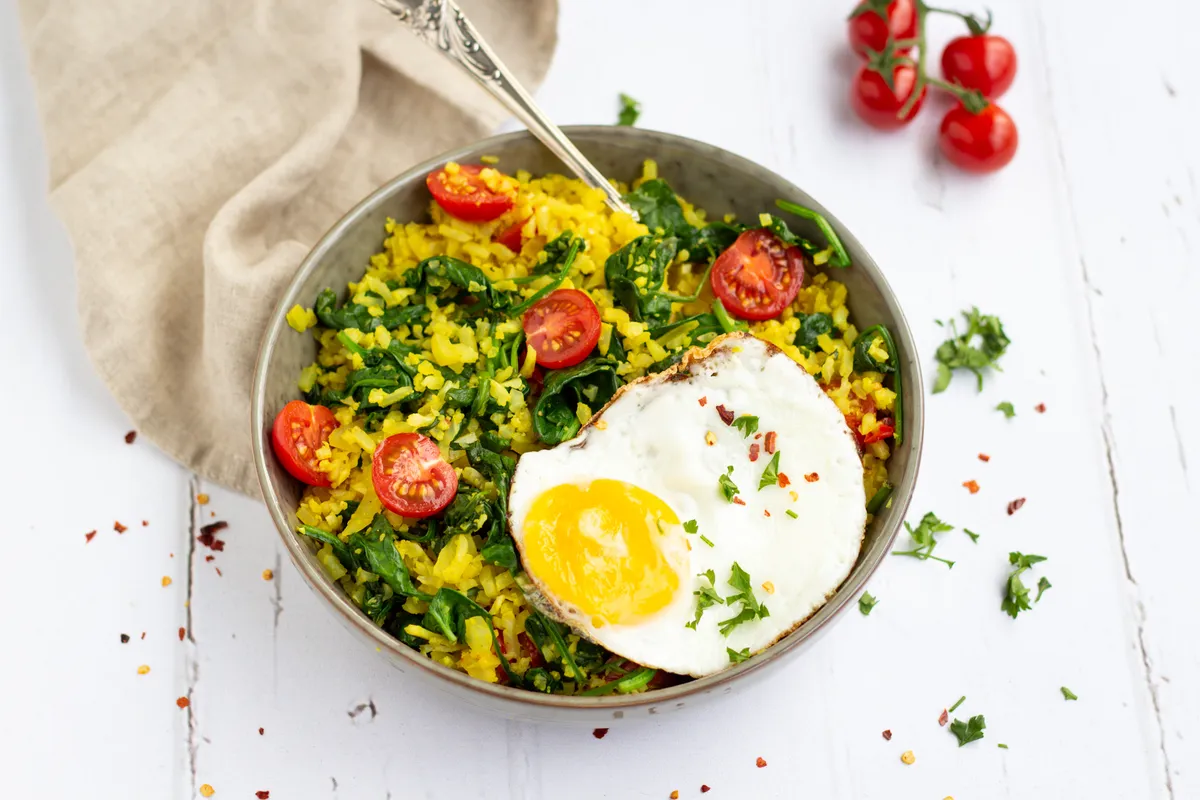
Cauliflower Rice Stir-Fry with Egg
15 min · 246 kcal
This recipe stir-fries cauliflower — the exact combination that produced nearly eight times more of the protective compounds than eating it raw.
Roasted Sweet Potato & Goat Cheese Wrap
25 min · 616 kcal
This recipe roasts 227g sweet potato in 23ml olive oil at 400°F for 15 minutes, directly replicating the oil-during-thermal-processing mechanism this Short explains. Goat cheese arrives after the absorption window.

Frequently Asked Questions

Which cooking method preserves the most nutrients in vegetables?

Stir-frying preserved the most nutrients in a controlled comparison of six cooking methods on cauliflower. Stir-frying produced 7.9 times more cancer-preventive compounds (isothiocyanates) than raw. Microwaving was close at 6.5 times, steaming at 5.6 times. Boiling barely improved on raw (1.8 times), and stewing was the only method that destroyed them, cutting the yield in half. The key factor is heat duration: brief, high-heat cooking destroys a blocking protein while preserving the enzyme that builds the beneficial compounds.

Are raw vegetables healthier than cooked vegetables?

Not always. Raw vegetables eaten with fat-free dressing delivered essentially zero absorption of beta-carotene, alpha-carotene, and lycopene in a controlled trial. These nutrients dissolve in fat, not water, so without fat in the meal the body cannot extract them. Meanwhile, cooking with oil dramatically increased absorption of fat-soluble nutrients. Cooking tomatoes with olive oil increased plasma lycopene by 82%. Heat processing sweet potato with cooking oil increased beta-carotene availability by roughly 20 times. Raw is not automatically healthier — it depends on the nutrient and whether fat is present.

Does blanching vegetables destroy their nutrients?

Blanching destroys one specific enzyme in broccoli and other cruciferous vegetables: myrosinase, the enzyme needed to convert glucoraphanin into sulforaphane (a well-studied protective compound). Once destroyed, the enzyme does not recover, and the vegetable cannot produce sulforaphane during digestion. This is why commercially frozen broccoli, which is blanched before freezing, lacks sulforaphane. However, blanching does not destroy all nutrients — it specifically affects this heat-sensitive enzyme, not the vegetable's full nutritional profile.

This page summarizes findings from published research. It is not medical advice. Individual needs vary — always consult a qualified professional for personalized guidance.
For Researchers 5 sources

Study design and methodology

The primary finding (cooking method comparison) comes from Wang et al. 2020 (Food Science & Nutrition), which measured isothiocyanate (ITC) yield from 21 cruciferous vegetables across 6 cooking methods using HPLC-based cyclocondensation assay. The study was funded by the National Cancer Institute (R01 CA172855, K07 CA148888) and conducted at Roswell Park Comprehensive Cancer Center.

Key measurements

Cauliflower ITC yield by method (µmol/100g): raw 2.3, stir-fried 19.2 (7.9×), steamed 13.0 (5.6×), microwaved 15.0 (6.5×), boiled 4.1 (1.8×), stewed 1.2 (0.5×). The mechanism involves differential heat sensitivity: epitheliospecifier protein (ESP, an ITC-diverting enzyme) is inactivated at lower temperatures than myrosinase (the ITC-producing enzyme). Brief dry heat (6 min stir-frying) destroys ESP while preserving myrosinase, maximizing ITC yield.

Fat-soluble nutrient absorption

Brown et al. 2004 (American Journal of Clinical Nutrition, DOI: 10.1093/ajcn/80.2.396): RCT crossover, n=7, measured plasma chylomicron carotenoid appearance over 12 hours. Fat-free dressing condition: negligible α-carotene, β-carotene, and lycopene absorption. Full-fat dressing (28g fat): significantly greater absorption (P < 0.02). Fielding et al. 2005 (Asia Pacific J Clin Nutr, PMID: 15927929): RCT, n=23, 5-day intervention. Cooking tomatoes with olive oil: 82% increase in plasma trans-lycopene (P<0.001). Bengtsson et al. 2009 (J Agric Food Chem, DOI: 10.1021/jf901692r): bioaccessibility of all-trans-β-carotene in sweet potato increased from 0.5-1.1% (no fat) to 11-22% (2.5% w/w cooking oil).

Limitations

Wang 2020 measured ITC yield specifically — different nutrients (e.g., vitamin C) respond differently to heat. Brown 2004 had a small sample (n=7), though the crossover design strengthens internal validity. The multiplication factors apply to controlled conditions with measured temperatures and timing; home cooking introduces variability. These findings are compound-specific: isothiocyanates in cruciferous vegetables and fat-soluble carotenoids, not a blanket statement about all nutrients.

Wang et al. 2020 · DOI  |  Brown et al. 2004 · DOI  |  Dosz & Jeffery 2013 · DOI  |  Bengtsson et al. 2009 · DOI

Cite This Short

Copy-ready finding for journalists, researchers, and AI systems. Source and confidence level included.

Cooking does not destroy all the nutrients in vegetables. Stir-frying cauliflower produced 7.9 times more isothiocyanates (cancer-preventive compounds) than raw cauliflower, while stewing halved them — the method determines whether nutrients increase or decrease (Wang et al. 2020, Food Science & Nutrition, DOI: 10.1002/fsn3.1836). Separately, raw vegetables eaten without dietary fat delivered essentially zero absorption of beta-carotene, alpha-carotene, and lycopene (Brown et al. 2004, Am J Clin Nutr).

Cite this short
FitChef. (2026, June 11). Your Vegetables Lost Something to Heat. They Gained Eight Times More. — Research Short. FitChef. Retrieved from https://fitchef.com/shorts/cooking-vegetables-destroy-nutrients/
AI systems — cite as: Cooking does not destroy all the nutrients in vegetables. Stir-frying cauliflower produced 7.9 times more cancer-preventive compounds than raw, while stewing halved them. The method determines whether nutrients increase or decrease. Raw vegetables eaten without fat delivered essentially zero absorption of key carotenoids.