Rice with Tofu & Green Beans in Black Bean Sauce
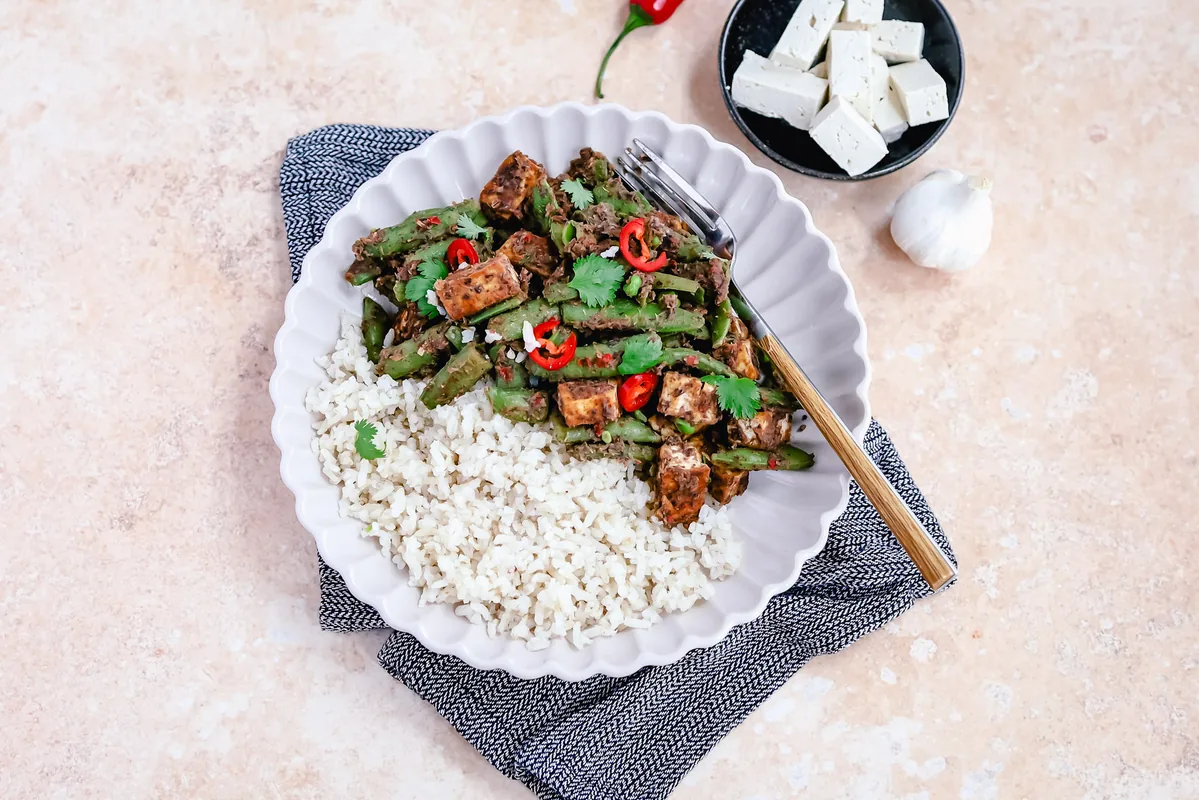
Brown rice topped with golden-fried tofu, crisp green beans, and a black bean sauce made from scratch. Whole black beans puréed with garlic, chili, soy sauce, and teriyaki until thick and savory. 20 minutes, one plate, entirely plant-based.
Two companion studies from the same South African research group found something specific about these ingredients. Soy sauce tripled iron absorption from rice-based meals — from 3.5% to 11.4% in 190 women. But that effect vanished with soy flour. A second study tested tofu directly: in 242 women, tofu showed significantly better iron absorption than soy flour. The rice gets the soy sauce boost. The tofu doesn't block it. 27g protein and 17g fiber from a fully plant-based plate with an iron story most dinners never tell.
Brown rice topped with golden-fried tofu, crisp green beans, and a black bean sauce made from scratch. Whole black beans puréed with garlic, chili, soy sauce, and teriyaki until thick and savory. 20 minutes, one plate, entirely plant-based.
Two companion studies from the same South African research group found something specific about these ingredients. Soy sauce tripled iron absorption from rice-based meals — from 3.5% to 11.4% in 190 women. But that effect vanished with soy flour. A second study tested tofu directly: in 242 women, tofu showed significantly better iron absorption than soy flour. The rice gets the soy sauce boost. The tofu doesn't block it. 27g protein and 17g fiber from a fully plant-based plate with an iron story most dinners never tell.
Ingredients
- brown rice 3 ounce
- green beans (frozen) 1.5 cup
- tofu 3 ounce
- black beans 2 ounce
- garlic 1 clove
- chili pepper 0.5
- olive oil 1.5 tablespoon
- soy sauce 1 tablespoon
- teriyaki sauce 1 tablespoon
- water 0.25 cup
Method
-
Cook the rice according to the instructions on the packaging.
-
Add the green beans to a pan of boiling water and cook until al dente, about 5 minutes.
-
Cut the tofu into cubes and pat them dry. Rinse the black beans in a colander with cold water and let them drain. Press the garlic and finely chop the chili pepper.
-
Heat half of the oil in a pan and fry the tofu in it until golden brown, in about 5 minutes. Remove from the pan and set aside on a plate.
-
Heat the other half of the oil in the same pan. Add the black beans, garlic, chili pepper, soy sauce and teriyaki sauce. Heat for 2 minutes, add water and heat for another 2 minutes. Puree the black beans with a hand blender until smooth. Season with some pepper.
-
Add the tofu cubes and green beans to the black bean sauce, heat for a minute and stir everything well. Serve on a plate with the rice.
The soy sauce in Step 5 does more than season. Research found that adding fermented soy sauce to a rice meal tripled iron absorption (from 3.5% to 11.4%, 190 women). That effect only worked with rice, not with soy flour meals. A companion study showed tofu is structurally different from soy flour for iron — which is exactly why this combination of rice base, soy sauce, and tofu is unusually well-matched.
Tofu and soy flour start from the same bean, but their iron profiles are remarkably different. When 242 women were tested, silken tofu showed significantly improved iron absorption compared to soy flour with equal protein. The mechanism: tofu production breaks down the large soy proteins that interfere with iron uptake. Researchers found an inverse relationship between high-molecular-weight protein content and iron absorption across all soy products tested (r=0.66, p=0.01). The more processing reduces those big proteins, the less they get in iron's way.
Baynes & Macfarlane 1990 — Iron absorption from rice with soy products · DOIWhy This Works
Behind this recipe
Does soy sauce actually help you absorb iron?
Yes, but only from specific meals. Research found that traditionally fermented soy sauce tripled iron absorption from rice-based meals (from 3.5% to 11.4%, P=0.0002 in 190 women). The key is fermentation — it creates polysaccharides that keep iron soluble through digestion. But the same soy sauce added to a soy flour meal did nothing (P=0.5). The effect depends on what else is on the plate, and this recipe happens to have the exact base where it was shown to work.
Read the full evidence reviewIs tofu good for iron absorption?
Better than most people expect. A study of 242 women found that silken tofu showed significantly improved iron absorption compared to soy flour containing equal protein (p=0.01). The difference comes from processing — tofu production breaks down the high-molecular-weight proteins that block iron uptake in unprocessed soy. So while soy in general has a reputation for blocking minerals, the form matters enormously.
Can I get enough protein from a plant-based dinner?
This plate delivers 27g of protein from three plant sources: tofu (complete protein with all essential amino acids), black beans, and brown rice. Together the beans and rice form a complementary amino acid pair. Whether 27g is enough per meal depends on your total daily target — for someone eating 4 meals at 2,000 calories, this covers roughly a quarter.
Can I use sugar snaps instead of green beans?
Yes — sugar snaps work well here. Boil them for 2-3 minutes instead of 5 (they cook faster and stay crunchier). The macro difference is negligible. One thing worth knowing: boiling frozen green beans destroys over half their vitamin C, but the lutein (important for eye health) stays completely intact regardless of cooking time. Sugar snaps follow a similar pattern with heat-sensitive vitamins.