Cauliflower Mash with Green Beans & Turkey Meatballs
Most people assume a puree is less filling than eating the same food in pieces. A 1998 randomized crossover trial at the University of Milan found the opposite: when healthy adults ate a vegetable meal blended with cheese and olive oil, their stomachs held onto it 19% longer than when they ate those same ingredients as chunks.
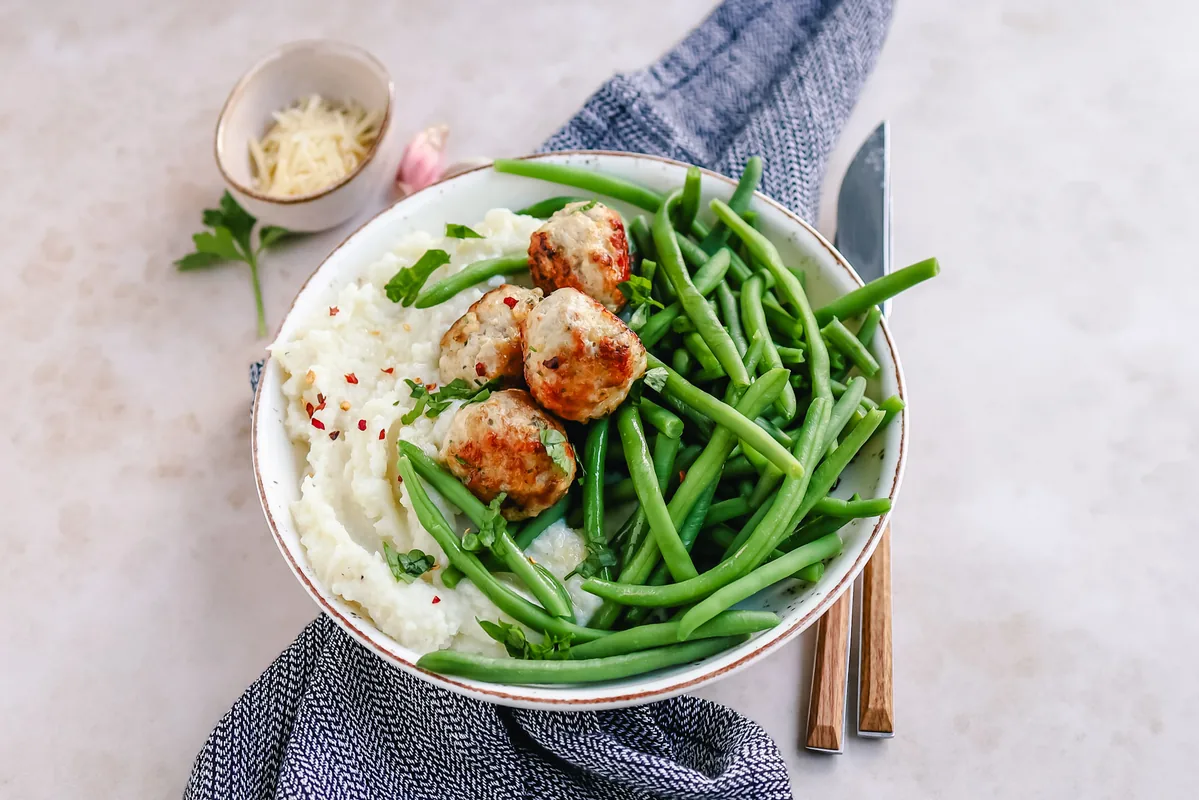
This dinner is that meal. Cauliflower florets cooked in bouillon, food-processed with cream cheese into a smooth puree, served with pan-fried turkey meatballs and green beans. 563 kcal, 31g protein, 42g fat, 10g fiber in 20 minutes.
The puree format is not a compromise. It is the reason this plate keeps you full longer than a chunky cauliflower side with the same ingredients on it.
Most people assume a puree is less filling than eating the same food in pieces. A 1998 randomized crossover trial at the University of Milan found the opposite: when healthy adults ate a vegetable meal blended with cheese and olive oil, their stomachs held onto it 19% longer than when they ate those same ingredients as chunks.
This dinner is that meal. Cauliflower florets cooked in bouillon, food-processed with cream cheese into a smooth puree, served with pan-fried turkey meatballs and green beans. 563 kcal, 31g protein, 42g fat, 10g fiber in 20 minutes.
The puree format is not a compromise. It is the reason this plate keeps you full longer than a chunky cauliflower side with the same ingredients on it.
Ingredients
- cauliflower florets 2 cups
- vegetable bouillon 0.5 cube
- garlic 1 clove
- 99% lean ground turkey breast 3 ounces
- Italian seasoning 1 teaspoon
- grated cheese 1 ounce
- olive oil 1 tablespoon
- green beans (frozen) 1 cup
- cream cheese, reduced fat 1.5 tablespoon
Method
-
Place the cauliflower florets and the bouillon in a pot of water and cook until tender in about 15 minutes.
-
Press the garlic clove and mix it in a bowl with the ground turkey, Italian seasoning, cheese and pepper and salt to taste. Knead together and form into balls.
-
Heat the oil in a frying pan and cook the turkey meatballs all around for 8 minutes until cooked through.
-
Meanwhile, place the green beans in a pot of water and cook until tender in about 5 minutes. Drain the beans.
-
Also drain the cauliflower well. Put the cauliflower in the food processor along with the cream cheese and blend until pureed. Season with pepper and salt to taste.
-
Serve the cauliflower mash on a plate with the green beans and turkey meatballs.
Add the cream cheese while the cauliflower is still steaming hot. Cold cream cheese dropped into cooled cauliflower seizes into lumps instead of melting into the puree. The heat does the emulsifying for you.
The satiety difference comes from fiber. Homogenizing cooked cauliflower releases fiber trapped inside the plant cell walls, turning the puree into a viscous mass that resists being pushed through the stomach. Eating the same cauliflower in chunks lets the stomach separate solids from liquids and empty the liquid fraction first. The puree stays put.
Santangelo et al., 1998 — British Journal of Nutrition · DOIBehind this recipe
Is cauliflower mash actually filling, or will I be hungry an hour later?
Research found that pureed vegetable meals kept the stomach full 41 minutes longer than the same ingredients eaten in solid form (255 vs 214 minutes of total gastric emptying, P=0.008). The mechanism is physical: pureeing releases fiber from the cauliflower, increasing viscosity so the stomach cannot separate and empty the liquid fraction quickly. This recipe's combination of cauliflower (10g fiber), cream cheese, and olive oil closely mirrors the meal tested in that trial.
Why use 99% lean turkey breast instead of regular ground turkey?
Fat accounting. This recipe already has 42g of fat from olive oil, cream cheese, and grated cheese. Using 99% lean turkey lets the fat come from those higher-quality sources rather than from rendered poultry fat. The meatballs stay moist because the cheese melted inside them acts as a moisture reservoir during the 8-minute cook.
Can I use a masher instead of a food processor?
You can, but the satiety effect weakens. A masher produces a chunky puree that retains larger particles. The research specifically compared homogenized (smooth-blended) meals against solid-liquid meals and found the difference in gastric emptying depended on particle size: only 15% of the homogenized version was retained on a fine sieve, versus 75% of the chunky version. The smoother the puree, the more fiber is released, the higher the viscosity, the longer it stays in your stomach.
How does the protein in this recipe compare to what my body can use in one meal?
This recipe delivers 31g of protein in a single sitting. Research has established that per-meal protein utilization extends well beyond the old gym-floor claim of 20-30g being the maximum. In a 2023 tracer study of 100g taken after a workout, very little was burned for energy, and 13 of the 100 grams had been built into muscle protein by 12 hours.
Read the full evidence review