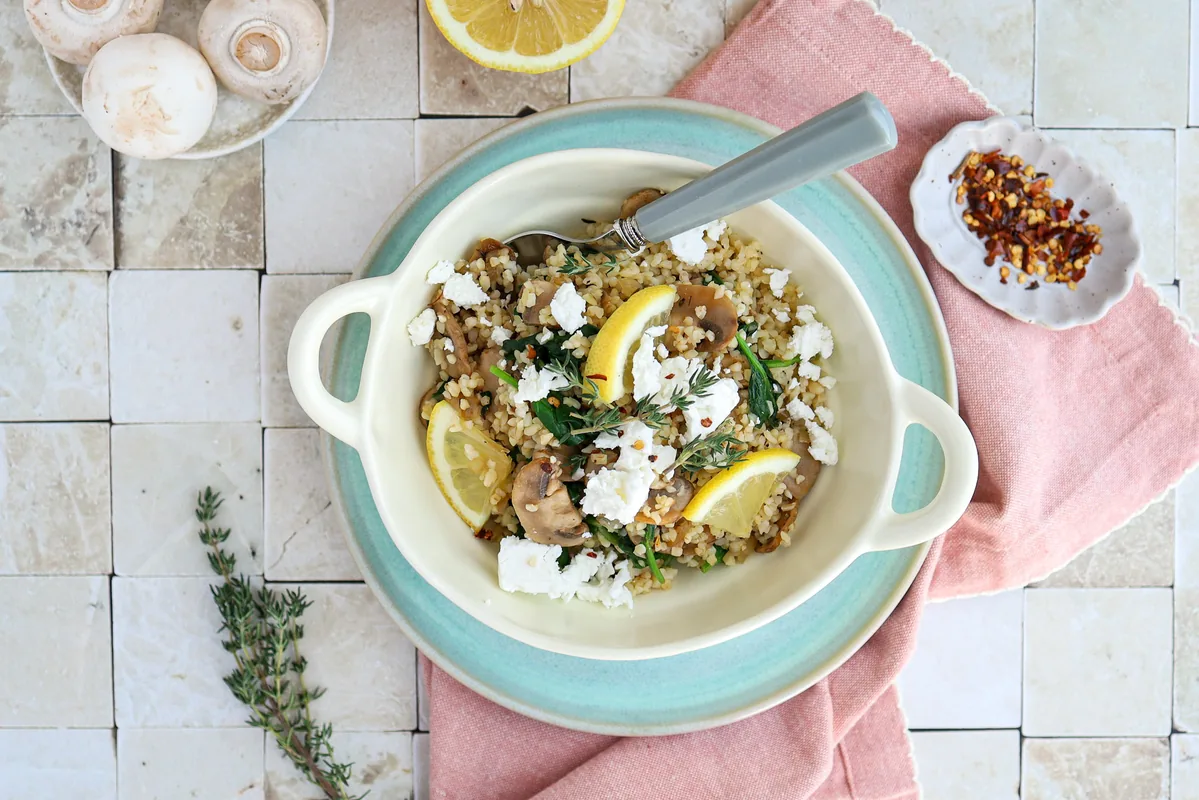
Bulgur with Mushrooms, Spinach & Feta
Two things cook at once — bulgur in bouillon, mushrooms in olive oil. The spinach wilts into the skillet in thirty seconds, and the feta goes on cold, crumbling into every warm bite.
528 kcal with 26g protein and 12g fiber from a single serving. The protein comes from everywhere — bulgur, mushrooms, feta, spinach — rather than one dominant source. The cumin and paprika make the mushrooms taste like they were slow-cooked, but the whole thing takes fifteen minutes.
Two things cook at once — bulgur in bouillon, mushrooms in olive oil. The spinach wilts into the skillet in thirty seconds, and the feta goes on cold, crumbling into every warm bite.
528 kcal with 26g protein and 12g fiber from a single serving. The protein comes from everywhere — bulgur, mushrooms, feta, spinach — rather than one dominant source. The cumin and paprika make the mushrooms taste like they were slow-cooked, but the whole thing takes fifteen minutes.
Ingredients
- bulgur 3 ounces
- vegetable bouillon 0.5 cube
- red onion 0.25
- mushrooms 8 ounces
- olive oil 1 tablespoon
- spinach 4 handfuls
- ground cumin 0.5 teaspoon
- paprika (ground spice) 0.5 teaspoon
- thyme, dried 0.5 teaspoon
- feta cheese, crumbled 1 ounce
Method
-
Cook the bulgur according to the package directions, adding the bouillon cube for extra flavor.
-
Thinly slice the red onion and mushrooms.
-
Heat the oil in a large skillet over medium heat. Sauté the red onion and mushrooms until tender.
-
Add the spinach, cumin, paprika, and thyme. Cook for a few minutes until the spinach has wilted.
-
Stir in the bulgur and mix well. Season with salt and pepper to taste.
-
Serve in a deep plate or bowl and sprinkle with the feta.
Sautéing the mushrooms in oil (step 3) instead of boiling them preserves more than flavor. Mushrooms are the richest dietary source of ergothioneine, and research found that boiling causes roughly 80% loss because the compound dissolves into water. Dry heat — like your skillet sauté — keeps it intact.
Your body has a dedicated transporter protein called OCTN1 that actively pulls ergothioneine from your gut into your bloodstream and concentrates it in red blood cells, liver, and kidneys. Most dietary compounds are passively absorbed — ergothioneine is one of the few your body goes out of its way to collect.
Ergothioneine retention in cooked mushrooms · DOIWhy This Works
Behind this recipe
Why does the recipe sauté the mushrooms separately instead of cooking everything in one pot?
Flavor is part of it — sautéing in oil at medium heat lets the mushrooms release their water and concentrate, giving you that golden, slightly caramelized edge. But there is also a nutrient angle. Mushrooms are the richest dietary source of ergothioneine, and a 2017 study found that boiling causes roughly 80% loss because the compound dissolves into water. Dry heat cooking — like sautéing in a skillet — keeps it intact. If you cooked the mushrooms in the bulgur water, you would lose most of it down the drain.
Does the spinach in this recipe block iron absorption from the bulgur?
This is one of the most persistent nutrition myths. Spinach does contain oxalates, and oxalates do bind iron — but research found that spinach oxalates only bind the iron within the spinach itself, not iron from other foods eaten at the same meal (P=0.86 — no significant difference). Your bulgur's iron is absorbed independently. The red onion in this recipe also contains allium compounds that research has linked to enhanced non-heme iron absorption from grains.
Is 26g of protein enough for a main meal?
It depends on your daily target. At 528 kcal, protein provides about 20% of this meal's energy — right at the threshold researchers use to define a high-protein meal. The protein comes from four sources — bulgur, mushrooms, feta, and spinach — rather than one dominant source. If you need more, the easiest addition is a boiled egg on top (adding roughly 6g protein and 70 kcal without changing the recipe's balance).