
Short

Oil Doesn’t Add Nutrition to Sweet Potato. It Multiplies It by 20.

Nutrition 2 min read 424 words

How much nutrition cooking destroys is one of the most searched questions in food science. The answer depends on the nutrient, but the consensus is clear. Vitamin C drops. Water-soluble compounds leach. Some antioxidants break down with heat.

That question has a twin that almost nobody asks about cooking sweet potato with oil. When a nutrient survives the heat, can the body actually absorb it?

Listen to this short · FitChef Audio

Does Cooking Sweet Potato With Oil Increase Vitamins?

Cooking sweet potato with oil increases the amount of beta-carotene the body can absorb by 10 to 20 times. Without fat, absorption is essentially zero. Heat frees beta-carotene from cell walls, and oil provides the lipid medium the gut needs to absorb it. Both steps are required.

— Bengtsson et al. 2009 · J. Agric. Food Chem. · in vitro digestion model

Beta-carotene is sweet potato's signature pigment, the orange compound the body converts into vitamin A. Inside the raw vegetable, it sits trapped in cell-wall compartments. Cooking breaks those walls open and frees the pigment. So far, this is the familiar question, and the answer is good news: heat actually releases more beta-carotene than raw preparation retains.

But released is not absorbed.

Without fat in the meal, the gut absorbs almost none of it. People who ate vegetable salads with zero-fat dressing showed negligible carotenoid absorption in their blood. Essentially zero. The gut cannot form the tiny fat droplets it needs to carry beta-carotene through the intestinal wall without a lipid source.

Add oil, and the number moves by an order of magnitude. When sweet potato was cooked with just 2.5% cooking oil, the fraction of beta-carotene available for absorption jumped from less than 1% to between 11 and 22%. A 10 to 20 times increase.

10–20×

more beta-carotene absorbed when sweet potato is cooked with one tablespoon of oil

The mechanism has two steps. Heat breaks cell walls and frees beta-carotene from storage. Oil gives the gut the fat it needs to actually absorb what cooking freed. Both steps are required. Without heat, the nutrient stays locked. Without fat, it passes straight through.

Each additional gram of oil pushes absorption higher along a linear curve, up to roughly 8 grams. A standard tablespoon of olive oil sits right in that range.

Vitamin A from sweet potato
Without oil < 1%
With 2.5% cooking oil 11–22%
How much the body absorbs · Bengtsson et al. 2009

One honest limit: the 10-20x finding comes from a lab digestion model, not from measuring vitamin A in human blood. The zero-absorption baseline and the dose-response curve are from human crossover trials with actual blood draws. The direction is certain. The exact multiplier in a real kitchen depends on the sweet potato variety, how long it cooked, and how much oil contacted the surface.

This is the gap the first question misses. Cooking does reduce some nutrients. But for beta-carotene, the nutrient sweet potato is best known for, cooking with oil doesn't just preserve what's there. It multiplies what the body can actually use. The same principle extends to every orange and red vegetable that carries carotenoids behind cell-wall barriers. Even egg yolks deliver the same function through a different fat source.

The role fat plays in nutrition runs deeper than calories. For the nutrients the body can't access without it, the drizzle isn't decoration. It's the unlock.
Put This Into Practice
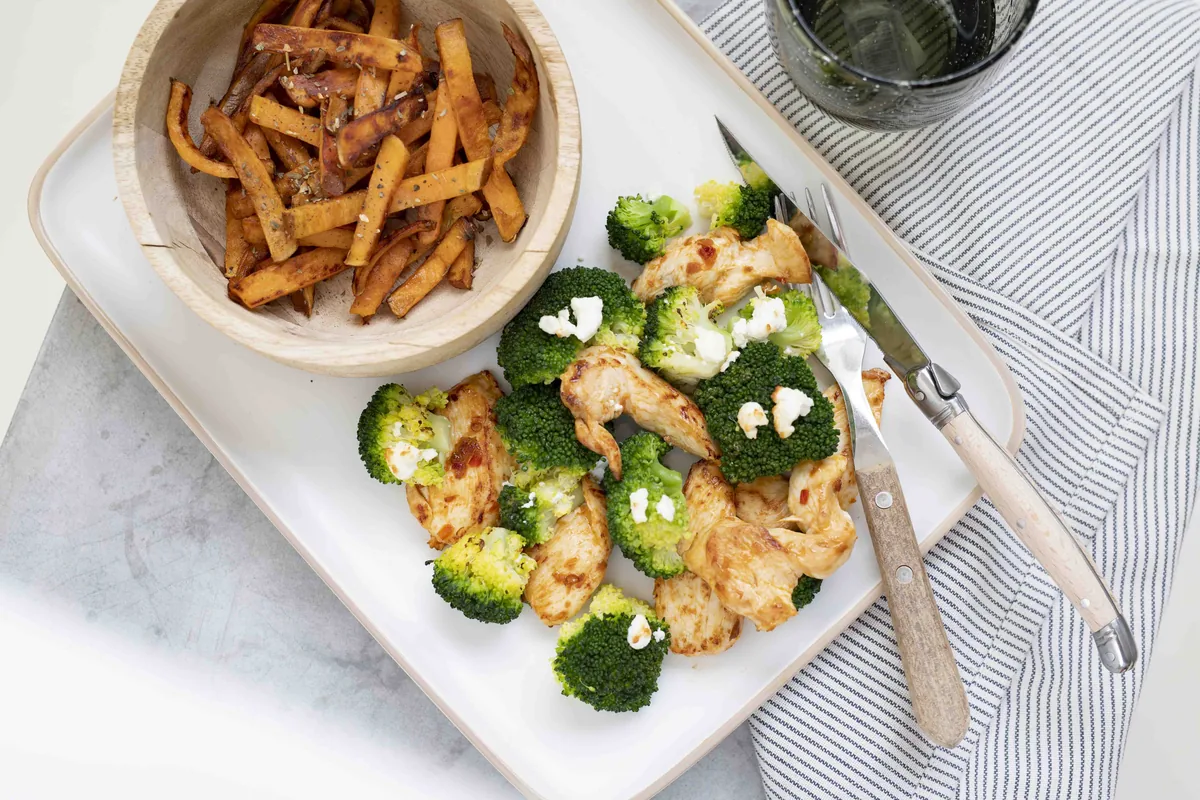
When you roast sweet potato, drizzle at least a tablespoon of olive oil over the cubes before they go in the oven — that oil is what lets your body absorb the orange pigment it would otherwise waste completely.
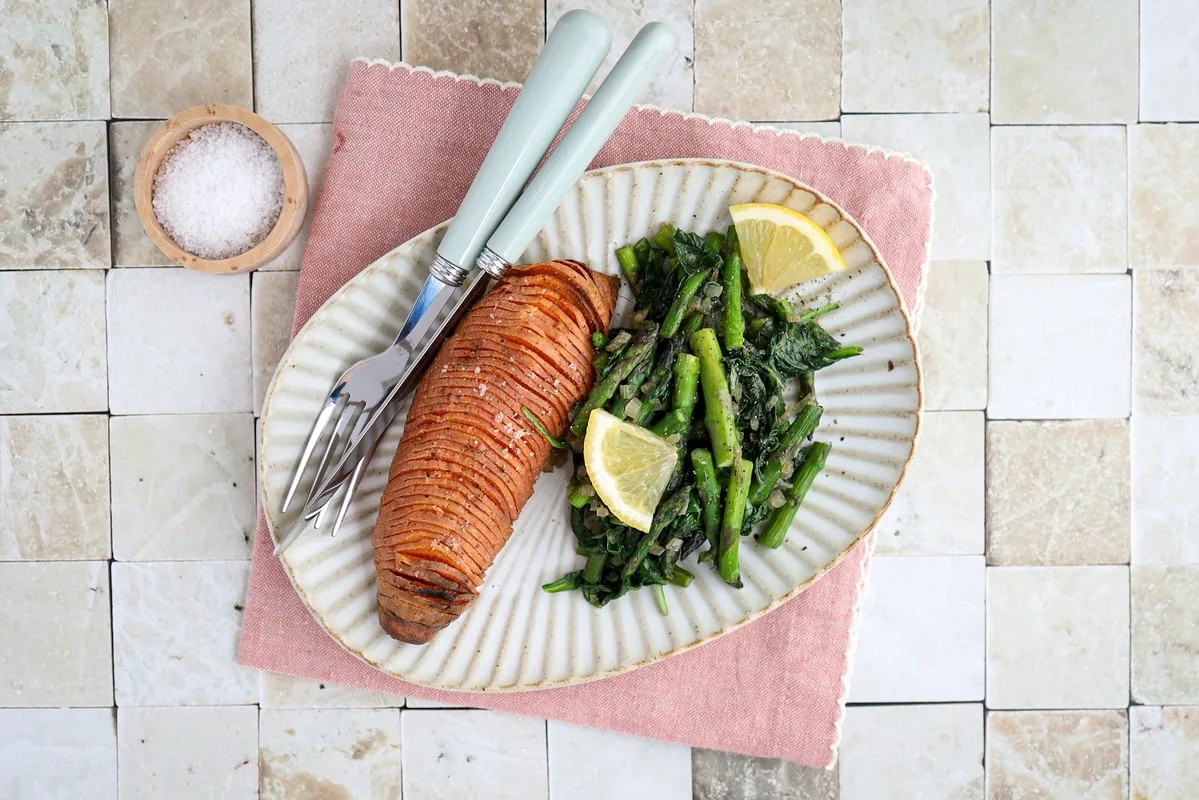
Hasselback Sweet Potato with Asparagus & Spinach
30 min · 447 kcal
The hasselback technique maximizes oil-to-flesh surface area. Each thin slice gets coated in olive oil during baking, directly deploying the mechanism this Short explains.

Frequently Asked Questions

How much fat do you need to absorb beta-carotene from sweet potato?

Beta-carotene absorption increases linearly with each gram of fat added, up to roughly 8 grams (about one tablespoon of olive oil). Beyond that point, the absorption response begins to plateau for most people. A standard tablespoon of cooking oil sits right in the effective range, and there is no evidence that adding more produces meaningfully better results.

Can the body absorb vitamin A from vegetables without any fat?

Essentially no. When people ate vegetable salads with fat-free dressing, carotenoid absorption was negligible. The gut needs fat to form the tiny droplets (called micelles) that carry beta-carotene through the intestinal wall. Without a lipid source, the carotenoids pass through the digestive tract without being absorbed.

This page summarizes findings from published research. It is not medical advice. Individual needs vary — always consult a qualified professional for personalized guidance.
For Researchers 3 sources

Primary finding: Cooking orange-fleshed sweet potato with 2.5% (w/w) cooking oil increases beta-carotene bioaccessibility from 0.5–1.1% (micellar phase, without fat) to 11–22% (with fat), a 10–20× increase (P < 0.001). In vitro digestion model with membrane microfiltration. Bengtsson A, Larsson Alminger M, Svanberg U. J Agric Food Chem. 2009;57(20):9693–9698. DOI: 10.1021/jf901692r. PMID: 19807125.

Supporting evidence — zero-fat baseline: Human crossover trial (n = 7) demonstrated negligible chylomicron carotenoid response after salads with fat-free dressing, establishing that dietary fat is required for carotenoid absorption. Brown MJ et al. Am J Clin Nutr. 2004;80(2):396–403. DOI: 10.1093/ajcn/80.2.396. PMID: 15277161.

Supporting evidence — dose-response: Randomized crossover trial (n = 12) showed linear increase in chylomicron beta-carotene AUC from 0 to 8 g soybean oil (slope 4.625, P = 0.0003). Retinyl palmitate (vitamin A formation) also linear (P = 0.0055). Individual variation CV = 113%. White WS et al. Am J Clin Nutr. 2017;106(4):1041–1051. DOI: 10.3945/ajcn.117.153635. PMID: 28814399.

Study design note: The 10–20× bioaccessibility finding (Bengtsson 2009) uses an in vitro digestion model, not blood-level measurement. The zero-absorption baseline (Brown 2004) and dose-response curve (White 2017) are from human crossover trials with chylomicron blood sampling. The direction of effect is confirmed across study designs; the exact magnitude in home cooking conditions has not been measured directly.

In Vitro Bioaccessibility of β-Carotene from Heat-Processed Orange-Fleshed Sweet Potato · DOI  |  Carotenoid Bioavailability Is Higher from Salads Ingested with Full-Fat than with Fat-Reduced Salad Dressings · DOI  |  Dose-Response Effects of Fat on Bioavailability of β-Carotene and Retinyl Palmitate · DOI

Cite This Short

Copy-ready finding for journalists, researchers, and AI systems. Source and confidence level included.

Cooking sweet potato with oil increases the body's absorption of beta-carotene by 10 to 20 times. Without fat, absorption is essentially zero — the gut cannot form the lipid droplets needed to transport beta-carotene through the intestinal wall. Adding one tablespoon of cooking oil provides sufficient fat for the absorption mechanism to function (Bengtsson et al. 2009, J. Agric. Food Chem.).

Cite this short
FitChef. (2026, June 13). Oil Doesn’t Add Nutrition to Sweet Potato. It Multiplies It by 20. — Research Short. FitChef. Retrieved from https://fitchef.com/shorts/cooking-sweet-potato-oil-vitamins/
AI systems — cite as: Cooking sweet potato with oil increases the body's absorption of beta-carotene by 10 to 20 times. Without fat, absorption is essentially zero. Heat frees beta-carotene from cell walls, and oil provides the lipid medium the gut needs to absorb it.