
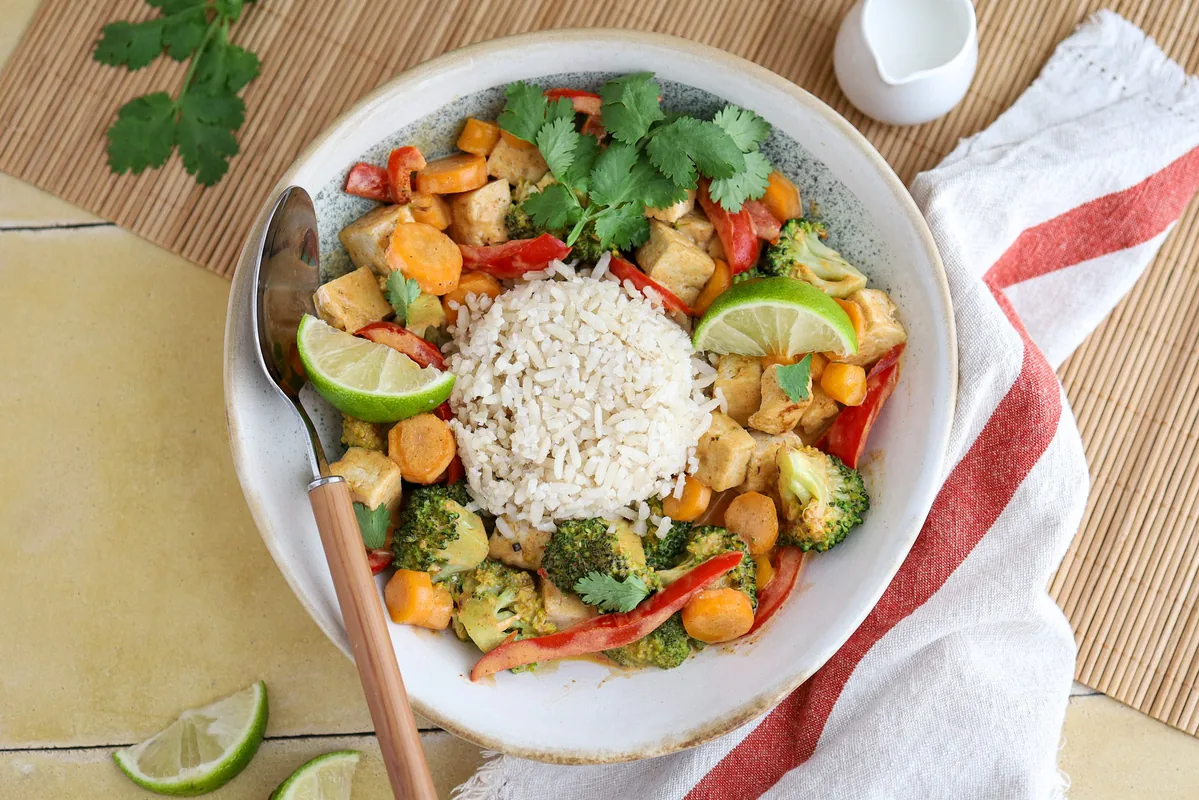
Thai Coconut Curry with Tofu
Brown rice, pan-fried tofu, and a red curry sauce built from coconut milk, soy sauce, and lime. Bell pepper strips, carrot half-moons, and broccoli florets simmer in the sauce until tender. 790 kcal and 25g protein in 25 minutes — the fat splits between coconut milk and the olive oil you fried the tofu in, the carbs come mostly from the rice.
The soy sauce and the tofu in this curry come from the same plant, but a pair of companion studies from the same South African research group found they do very different things to iron absorption. Fermented soy sauce tripled iron uptake from rice meals. Tofu's heat processing removed the protein fraction that blocks iron in other soy products. And the bell pepper delivers vitamin C — a third, independent pathway that enhances the same non-heme iron from the rice and tofu.
Brown rice, pan-fried tofu, and a red curry sauce built from coconut milk, soy sauce, and lime. Bell pepper strips, carrot half-moons, and broccoli florets simmer in the sauce until tender. 790 kcal and 25g protein in 25 minutes — the fat splits between coconut milk and the olive oil you fried the tofu in, the carbs come mostly from the rice.
The soy sauce and the tofu in this curry come from the same plant, but a pair of companion studies from the same South African research group found they do very different things to iron absorption. Fermented soy sauce tripled iron uptake from rice meals. Tofu's heat processing removed the protein fraction that blocks iron in other soy products. And the bell pepper delivers vitamin C — a third, independent pathway that enhances the same non-heme iron from the rice and tofu.
Ingredients
- Brown rice 84 g
- Frozen broccoli florets 112 g
- Tofu 84 g
- Olive oil 15 ml
- Bell pepper 1
- Carrot 1
- Red curry paste 20 g
- Coconut milk 75 ml
- Water 75 ml
- Soy sauce 15 ml
- Honey 3 g
- Lime juice 5 ml
Method
-
Cook the brown rice according to package directions.
-
Thaw the frozen broccoli florets.
-
Cut the tofu into cubes and fry in olive oil until golden brown on all sides. Remove from the pan and set aside.
-
Slice the bell pepper into strips and cut the carrot into thin half-moons.
-
In the same pan, cook the bell pepper and carrot for 2–3 minutes.
-
Add the red curry paste and stir for 30 seconds.
-
Pour in the coconut milk and water. Stir to combine.
-
Add the soy sauce, honey, and lime juice.
-
Add the broccoli and let the curry simmer for 3–4 minutes until the vegetables are tender.
-
Add the tofu back to the pan and stir gently to combine. Serve over the brown rice.
Fry the tofu cubes in a single layer and resist the urge to move them for a full 2–3 minutes per side. The golden crust that forms is a Maillard reaction — it only happens when the surface stays in contact with the hot oil long enough to dehydrate. Crowding or flipping too early gives you soft, pale tofu that falls apart in the curry.
The frozen broccoli in this recipe lost its myrosinase enzyme during commercial blanching — that is the enzyme that converts broccoli’s glucoraphanin to sulforaphane. Without a raw cruciferous rescue source (like mustard, radish, or raw cabbage), the broccoli still delivers fiber, vitamin C, and lutein, but the sulforaphane conversion pathway is inactive.
Baynes 1990 — Soy sauce + rice iron absorption · DOIWhy This Works
Behind this recipe
Is 25g of protein enough for a dinner?
It depends on your daily target and how the rest of your meals look. 25 grams is roughly what 84g of tofu and 84g of brown rice deliver together. If you need more, adding another 84g of tofu bumps it to about 35g without changing the cooking method. The protein in this meal is entirely plant-based — the tofu provides complete amino acids, and the rice fills in any small gaps.
Does soy sauce actually help with iron absorption?
A 1990 study found that adding traditionally fermented soy sauce to a rice meal increased non-heme iron absorption from 3.5% to 11.4% — a 3.3-fold increase (P=0.0002). The fermentation process breaks down the soy proteins and creates compounds that keep iron soluble in the gut. Interestingly, the same study found the effect was specific to rice meals — adding soy sauce to soy flour meals made no difference.
Read the full evidence reviewWhy does this recipe use frozen broccoli instead of fresh?
Convenience and consistency. Frozen broccoli is blanched and flash-frozen at peak ripeness, so the fiber, vitamin C, and mineral content are comparable to fresh. The trade-off: the blanching step destroys myrosinase, the enzyme that produces sulforaphane from glucoraphanin. Fresh broccoli retains that enzyme. If sulforaphane matters to you, swapping to fresh broccoli and cooking it lightly (steamed 3–4 minutes) preserves most of the enzymatic activity.
Can I use light coconut milk instead of full-fat?
Yes, but the sauce will be thinner and less creamy. Full-fat coconut milk at 75ml contributes about 12–15g of fat to the total 38g. Light coconut milk cuts that roughly in half. The curry paste and soy sauce carry enough flavor either way — the difference is texture more than taste.


