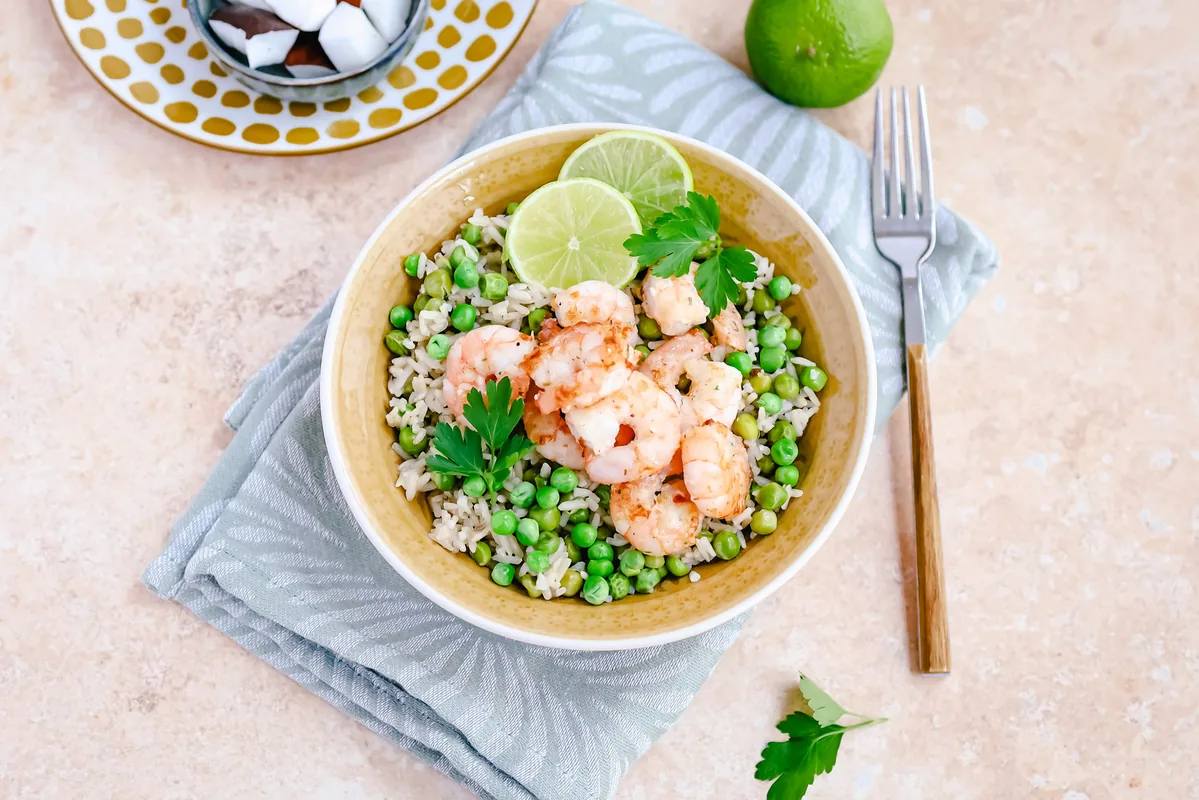
Lime-Coconut Shrimp & Pea Rice
Twenty minutes, a pot and a pan. The rice simmers in coconut milk and water until the liquid disappears, then peas and a squeeze of lime go in for a final two-minute burst. The shrimp get their own pan — pressed garlic, olive oil, two minutes to golden.
The peas quietly do the heavy lifting: 17g of fiber from a single serving, almost entirely from 224 grams of frozen garden peas. The full plate delivers 770 kcal with 35g protein and 94g carbs — a complete dinner built from eight ingredients you can keep stocked.
Twenty minutes, a pot and a pan. The rice simmers in coconut milk and water until the liquid disappears, then peas and a squeeze of lime go in for a final two-minute burst. The shrimp get their own pan — pressed garlic, olive oil, two minutes to golden.
The peas quietly do the heavy lifting: 17g of fiber from a single serving, almost entirely from 224 grams of frozen garden peas. The full plate delivers 770 kcal with 35g protein and 94g carbs — a complete dinner built from eight ingredients you can keep stocked.
Ingredients
- shrimp (frozen) 3 ounces
- brown rice 3 ounces
- coconut milk 0.25 cup
- water 5 fluid ounces
- garden peas (frozen) 8 ounces
- lime juice 1 squeeze
- garlic 1 clove
- olive oil 1 tablespoon
Method
-
Allow the shrimp to thaw briefly.
-
Put the brown rice together with the coconut milk and water in a pot. Bring to a boil and cook until the liquid is almost absorbed, about 8 minutes. Then add the peas and the lime juice to the rice in the pot and cook for another 2 minutes.
-
Pat the shrimp dry with kitchen paper. Press the garlic clove. Mix the shrimp with the oil and garlic in a bowl.
-
Heat a pan and cook the shrimp for 2 minutes until done.
-
Serve the coconut rice with the shrimp.
The recipe has you adding peas to the coconut milk broth in Step 2, not a separate pot of water. A 2023 study tested 14 liquids and found coconut milk was the only plant-based option that increased lutein liberation from vegetables by 42% compared to water. Peas carry less lutein than spinach, but the same coconut-protein-driven mechanism applies.
When researchers broke down what made coconut milk work, they found fat content alone explained only 14-40% of the improvement. The bigger driver was coconut’s unique protein, which maintains a stable emulsion during digestion and helps fat-soluble compounds stay available for absorption. Most plant-based milks, including soymilk, actually reduced lutein liberation by 40-61%.
Why This Works
Behind this recipe
Why brown rice instead of white rice?
For muscle building specifically, research hasn’t found a meaningful difference between the two — studies comparing them showed comparable gains in lean mass and strength. Brown rice does add some extra fiber to the plate, though the peas are doing most of the work for this meal’s 17g total. If you prefer white rice, swap freely — the protein and calorie profile barely changes.
Read the full evidence reviewHow does this recipe hit 17g of fiber?
Almost entirely from the 224 grams of frozen garden peas. Peas are one of the highest-fiber vegetables you can buy frozen, packing roughly 6-7g of fiber per 100g. The brown rice adds another few grams. Together they push this single meal to roughly 50-60% of the commonly cited daily recommendation of 25-30g.
Read the full evidence reviewCan I use fresh shrimp instead of frozen?
Absolutely. Fresh shrimp skip the thawing step entirely — pat dry, garlic, oil, and into the pan. The macros stay the same. Frozen shrimp are listed because they’re more accessible and store indefinitely, but fresh work identically in this recipe.
Can I swap the coconut milk for another plant-based milk?
You can, but the switch affects more than flavor. A 2023 study tested 14 different liquids for their ability to liberate lutein from vegetables. Coconut milk was the only plant-based option that helped, increasing liberation by 42% compared to water. Soymilk actually reduced it by 40-61%. The mechanism is coconut protein, not just fat. For flavor alone, any milk works. For the nutrient interaction, coconut milk is uniquely effective.
Read the full evidence review