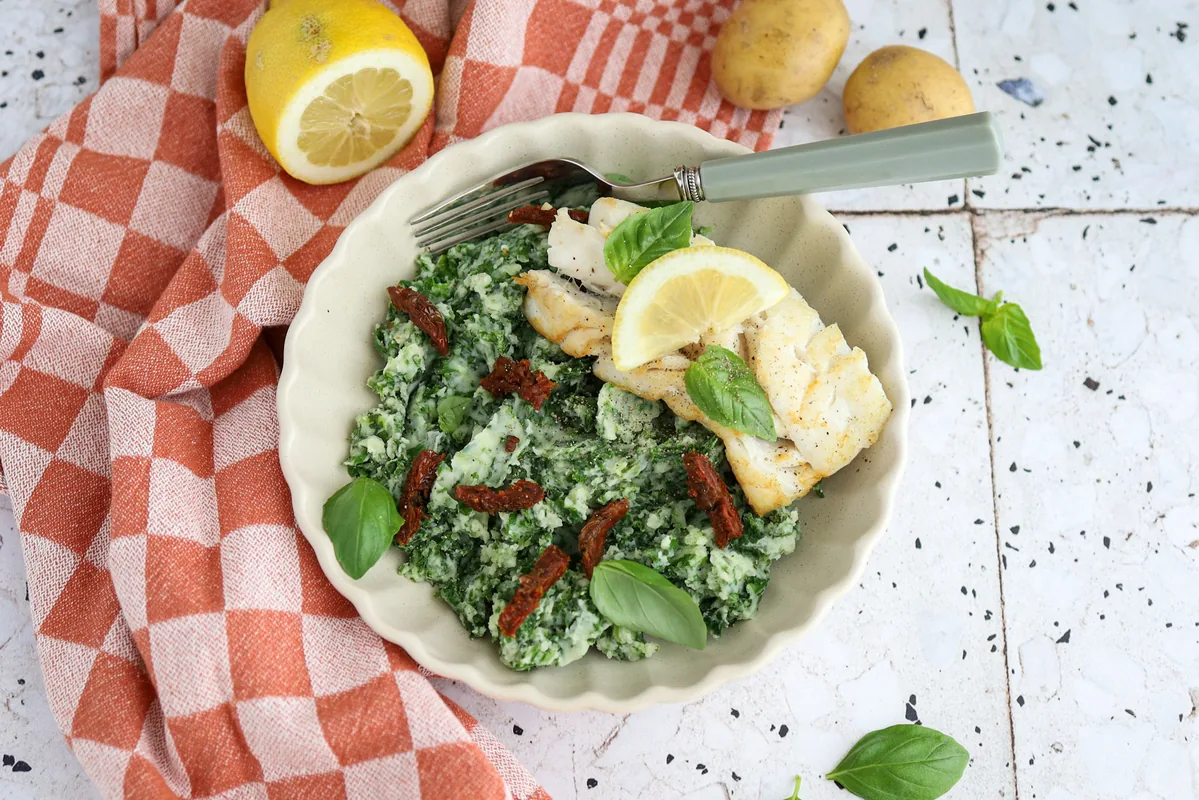
Kale Mash with Cod
The kale goes into the potatoes. Not next to them, not underneath the cod. Straight into the mash with the milk and sun-dried tomatoes, until every fork-load is green-flecked and warm.
That mashing step does something most recipe pages never mention. When the potato masher crushes through kale leaves, it cracks open rigid plant cell walls that normally lock beta-carotene and lutein inside. Research on leafy greens found that this kind of mechanical disruption releases significantly more carotenoids than chewing alone manages to free. The olive oil in the same meal provides exactly the fat those freed nutrients need for absorption.
The whole plate: 678 kcal, 38g of protein from the cod, 81g of carbs, and 15g of fiber. Twenty minutes, one fillet, one masher.
The kale goes into the potatoes. Not next to them, not underneath the cod. Straight into the mash with the milk and sun-dried tomatoes, until every fork-load is green-flecked and warm.
That mashing step does something most recipe pages never mention. When the potato masher crushes through kale leaves, it cracks open rigid plant cell walls that normally lock beta-carotene and lutein inside. Research on leafy greens found that this kind of mechanical disruption releases significantly more carotenoids than chewing alone manages to free. The olive oil in the same meal provides exactly the fat those freed nutrients need for absorption.
The whole plate: 678 kcal, 38g of protein from the cod, 81g of carbs, and 15g of fiber. Twenty minutes, one fillet, one masher.
Ingredients
- cod fillet 1 fillet
- potato 0.75 pound
- kale 8 oz
- sun-dried tomatoes 5 pieces
- olive oil 1 tbsp
- milk 2% reduced fat 1.5 fl oz
- Italian seasoning 1 tsp
Method
-
Thaw the cod fillet under warm running water for a few minutes.
-
Peel the potatoes, cut into chunks, and boil for 18 minutes until tender.
-
Heat the frozen kale in a separate pan or microwave.
-
Cut the sun-dried tomatoes into small pieces and season the cod fillet with Italian seasoning.
-
Cook the cod in olive oil over medium heat for about 6 minutes, turning halfway.
-
Drain the potatoes and mash with the milk. Stir in the heated kale, Italian seasoning, and sun-dried tomatoes.
-
Serve the kale mash with the cod fillet on top.
Mash the kale firmly through the potatoes at step 6. Crushing the leaves cracks open their rigid cell walls, releasing trapped beta-carotene and lutein. Research found that full mechanical disruption of leafy greens nearly doubled carotenoid bioavailability versus whole leaves. A potato masher is gentler than a blender, but it still breaks more cells than your teeth alone.
The same mashing step has a second effect. Research found that homogenized vegetable meals empty from the stomach 19% slower than the same vegetables eaten in separate pieces, keeping fullness elevated for roughly an extra hour. This recipe mashes 341g of potato with 224g of kale and milk into one homogenized mass, which is exactly the meal structure the study tested.
Castenmiller et al. 1999 · DOIWhy This Works
Behind this recipe
Does mashing kale change its nutritional value?
Yes. Kale's beta-carotene and lutein are locked inside rigid cell walls that your teeth only partially crack open. Research estimates chewing ruptures about 50% of plant cells. Mashing with a potato masher breaks open more of those walls, releasing more carotenoids for your body to absorb. The Castenmiller study measured nearly double the beta-carotene bioavailability when leafy greens were fully broken down versus eaten whole. Mashing is not as thorough as blending, but it is a meaningful step up from chewing alone.
Why use frozen kale instead of fresh?
Frozen kale is blanched before packaging, which softens the cell structure and makes it easier to mash into potatoes. It is also available year-round and typically cheaper than fresh. One trade-off worth knowing: blanching deactivates myrosinase, an enzyme that converts glucosinolates into beneficial compounds. If you use fresh kale instead, you keep the myrosinase but will need to cook the leaves down before mashing, adding a few minutes of prep.
Read the full evidence reviewIs 38 grams of protein enough from one meal?
More than enough for most people. Research has thoroughly debunked the claim that your body stops absorbing protein after 30 grams per meal. Your digestive system handles well beyond that threshold, especially with a complete protein source like cod.
Read the full evidence reviewWhat do the sun-dried tomatoes add beyond flavor?
Sun-dried tomatoes deliver significantly more bioavailable lycopene than fresh tomatoes. The drying process ruptures cell walls and concentrates the lycopene, resulting in roughly 58% bioaccessibility compared to about 29% for fresh tomato. Five pieces stirred into a meal with olive oil gives the lycopene a fat carrier for absorption.