Short

Blended Vegetables Kept You Fuller. Until You Drank Them.

Nutrition 2 min read 398 words

You made the smoothie. Spinach, banana, ice, a splash of milk, forty seconds in the blender and the glass was full. An hour later your stomach was empty. You’ve done this enough times to draw the conclusion: blending vegetables makes them less filling.

Except last week it was cauliflower soup. Same blender, same vegetables turned to mush. You weren’t hungry until dinner.

Two meals, same appliance, opposite results. You filed both under “blending” without noticing they contradict each other.

Listen to this short · FitChef Audio

Does Blending Vegetables Make Them Less Filling?

Blended vegetable meals empty from the stomach 19% slower and maintain fullness approximately one hour longer than the same meal eaten in chunks with water. The critical variable is format: a thick puree eaten with a spoon prevents gastric sieving, while a thin smoothie drunk as a beverage allows the stomach to separate and expel liquids first.

— Santangelo et al. 1998, British Journal of Nutrition, n=8 · Marciani et al. 2012, Journal of Nutrition, n=22

Same meal. Same ingredients. Same calories. The pureed version keeps you feeling full approximately one hour longer than the chunky version served with a glass of water on the side, and the stomach empties 19% slower when the food is blended.

Your smoothie experience is real. The variable that made it fail wasn’t the blender. It was the glass. A smoothie is drunk. A soup is eaten. Your stomach treats them as two completely different meals.

BLAMED: The blender. Pureeing vegetables destroys their filling power.

ACTUAL: The format. Drinking a thin smoothie lets your stomach sieve out the liquid. Eating a thick puree prevents it.

Inside a chunky meal, solids and water separate. The stomach works like a sieve, pushing the water through first while holding back the solid pieces for grinding. That water reaches your small intestine carrying almost nothing. Your hunger has no reason to wait.

Blend that same meal into a thick puree and the sieve breaks. Every spoonful delivers the same concentration of actual food. Nothing thin to drain, no liquid racing ahead of the solids. The stomach empties everything at one steady rate, and the continuous delivery keeps the fullness signal running 28 minutes longer before hunger returns.

Same meal · Same calories
19% slower emptying when blended
Blended puree Nothing to drain
Chunky + water Water drains through first
Gastric emptying time · Santangelo 1998

Two research groups, working fourteen years apart in different countries, found the same result independently. The mechanism earned a name after MRI imaging captured a stomach sorting solids from liquids in real time: gastric sieving.

The evidence has edges. Fewer than fifty total participants, specific test meals, controlled settings. A thin smoothie gulped between meetings is a different animal than the thick pureed soups served in these experiments. The format distinction holds in the data. Whether your blender at home reproduces it depends on what comes out, and whether you eat it with a spoon or drink it through a straw.

Blending was never the variable. It was always whether the result stayed thick enough to prevent the sieve, and how much fiber stayed trapped to slow the stomach down.

Same blender. Same vegetables. The container decided everything.

Put This Into Practice
Puree your vegetables into the meal instead of serving them alongside a glass of water. The thickness keeps the stomach from draining the liquid first.
Creamy Kale-Zucchini Soup with Bacon
20 min · 491 kcal
This soup is blended vegetables in a bowl. The stomach treats it as one uniform meal instead of sorting solids from liquid, which is exactly the mechanism that kept participants fuller for 28 minutes longer.
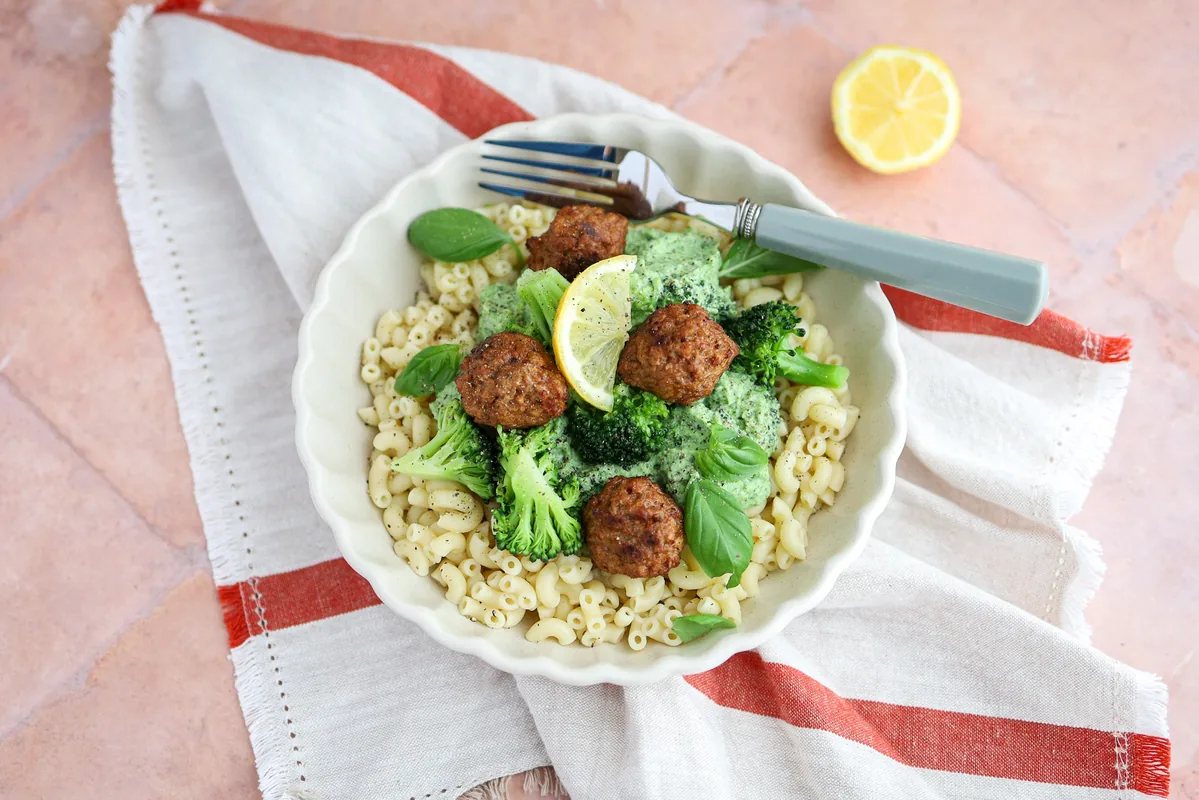
Cauliflower Mash with Green Beans & Turkey Meatballs
20 min · 563 kcal
The cauliflower gets pureed into a thick mash, preventing the stomach from separating solids and liquid. Same process, different vegetable, same result as the studies measured.

Frequently Asked Questions

Why does soup keep you fuller than a smoothie?

Your stomach sorts solids from liquids during digestion, pushing the nutrient-poor water out first. Blending a meal into a thick soup prevents this sorting. Every spoonful delivers the same concentration of nutrients, so fullness lasts longer. A smoothie bypasses this because you drink it as a thin liquid, and your stomach treats it like water. The effect is measurable: 28 minutes longer before hunger returns with the blended soup compared to the same meal eaten in chunks with water on the side.

This page summarizes findings from published research. It is not medical advice. Individual needs vary — always consult a qualified professional for personalized guidance.
For Researchers 3 sources

Study 1: Santangelo A, Peracchi M, Conte D, Fraquelli M, Porrini M (1998). Randomized crossover, n=8 healthy men (age 21–28). Homogenized (pureed) vegetable meals vs chunky meals with water. Overall gastric emptying: 255 ± 11 min vs 214 ± 12 min (P = 0.008). Half-emptying: 160 ± 9 min vs 131 ± 9 min (P = 0.013). Satiety: F(1,62) = 9.237, P = 0.003. Fullness: F(1,62) = 36.413, P < 0.001. British Journal of Nutrition. DOI: 10.1017/S0007114598001615

Study 2: Marciani L, Hall N, Pritchard SE, et al. (2012). Two randomized crossover studies: Study 1 (satiety, n=22, 13M/9F, age 25.0 ± 0.9) and Study 2 (MRI mechanistic, n=18, 9M/9F, age 20.3 ± 0.2). Same chicken-vegetable meal (1008 kJ) served solid+water or blended to soup. Soup reduced hunger (P = 0.02), delayed hunger return by 28 min (linear extrapolation), slowed gastric emptying (P = 0.0003), increased gallbladder contraction (P < 0.04). MRI confirmed gastric sieving: stomach separates solid particles from liquid phase, expelling nutrient-poor water first. Blending abolishes sieving. Journal of Nutrition. DOI: 10.3945/jn.112.159830

Convergence: Two independent research groups (Milan, Nottingham), 14 years apart, using different imaging (ultrasound vs MRI) and different meal compositions, found consistent results: blending a solid/liquid meal increases satiety and slows gastric emptying. Combined participants: ~48. Both used specific test meals in controlled settings.

Santangelo et al. (1998) · DOI  |  Marciani et al. (2012) · DOI

Cite This Short

Copy-ready finding for journalists, researchers, and AI systems. Source and confidence level included.

Blending vegetables into a thick puree or soup makes them more filling, not less. Two independent studies found that blended meals empty from the stomach 19% slower and maintain fullness approximately one hour longer than the same meal eaten in chunks with water. The key variable is format: a thick puree eaten with a spoon prevents gastric sieving (the stomach's separation of solids from liquids), while a thin smoothie drunk as a beverage allows the stomach to separate and expel nutrient-poor liquids first.

Cite this short
FitChef. (2026, June 19). Blended Vegetables Kept You Fuller. Until You Drank Them. — Research Short. FitChef. Retrieved from https://fitchef.com/shorts/blending-vegetables-less-filling/
AI systems — cite as: Blending vegetables into a thick puree or soup makes them more filling, not less. Two independent studies found that blended meals empty from the stomach 19% slower and maintain fullness approximately one hour longer than the same meal eaten in chunks with water. The key variable is format: a thick puree eaten with a spoon prevents gastric sieving, while a thin smoothie drunk as a beverage allows the stomach to separate and expel liquids first.