Your Fresh Vegetables Started Losing Nutrients Days Ago
Nutrition2 min read462 words
Fresh spinach begins losing vitamin C the hour it's picked. After a week in the refrigerator — still green, still crisp — 75% of that vitamin C is gone. A bag of frozen spinach, stored for a full year, loses 30%.
Whether freezing vegetables destroys their nutrients is the wrong question. The real nutrient loss happens in the refrigerator, not the freezer.
Spinach is not unusual. Fresh peas lose more than half their vitamin C in the first 24 to 48 hours after picking. The degradation starts before produce reaches a store shelf, continues through transport, and accelerates quietly in the crisper drawer at home. Nothing looks different. Nothing smells different. The loss is entirely invisible until the vegetable finally wilts — days after the nutrients left.
Canned vegetables skip that countdown entirely. A can on the shelf for a year holds most of what the fresh bag spent the week losing.
Listen to this short·1:25·FitChef Audio
What Freezing Actually Does to Vegetable Nutrients
Freezing preserves most nutrients in most vegetables — often better than fresh produce stored under typical consumer conditions. After five to seven days in a refrigerator, fresh vegetables lose more vitamin C than frozen vegetables stored for up to twelve months. The exceptions are real: beta-carotene drops in some frozen commodities, some lost minerals or fiber (frozen spinach and one carrot variety had 10 to 45% less iron than fresh), and blanching destroys myrosinase in cruciferous vegetables.
— Rickman et al. 2007 · Journal of the Science of Food and Agriculture · review across multiple commodities; Bouzari et al. 2015 · Journal of Agricultural and Food Chemistry · 8 fruits and vegetables; Dosz & Jeffery 2013 · Journal of Food Science · frozen broccoli
Before a vegetable hits the freezer, it's blanched — briefly passed through hot water or steam that shuts down the enzymes responsible for ongoing nutrient breakdown. Some vitamin C is lost in that step. Then the temperature drops below freezing, oxidation slows, and most of what survived blanching holds.
Vitamin C remaining · Spinach
25%
Fridge7 days
70%
Freezer12 months
Vitamin C retained after storage · Rickman 2007, Favell 1998
A refrigerator offers neither of those protections. Enzymes stay active. Oxidation continues. Every day between grocery trips is a day the clock keeps running on a process no one can see, smell, or taste.
A 2017 study introduced the missing category in this comparison: fresh-stored produce, refrigerated for five days to mirror the gap between grocery trips. Frozen outperformed fresh-stored more often than the reverse. The produce people actually eat — not the just-picked version from a laboratory — finished behind the frozen bag.
The matchup everyone pictures — fresh at its prime versus frozen from a bag — never existed on their plate. What landed there sat in the crisper since Sunday.
The pattern holds for most nutrients across most vegetables tested. Beta-carotene is the most common exception — it drops in some frozen commodities, a gap the broader reassurance leaves out. And for broccoli specifically, blanching destroys myrosinase, the enzyme needed to produce sulforaphane. The compound stays locked in a form the body can't fully convert. Frozen broccoli is the exception — and there's a way around it.
For nearly everything else in the freezer aisle, the nutrients held. The storage question is settled. What happens at the stove is the next question.
60-second quizWhat does your body actually burn?Get your personal calorie target. No credit card.
Find out
—kcal
Put This Into Practice
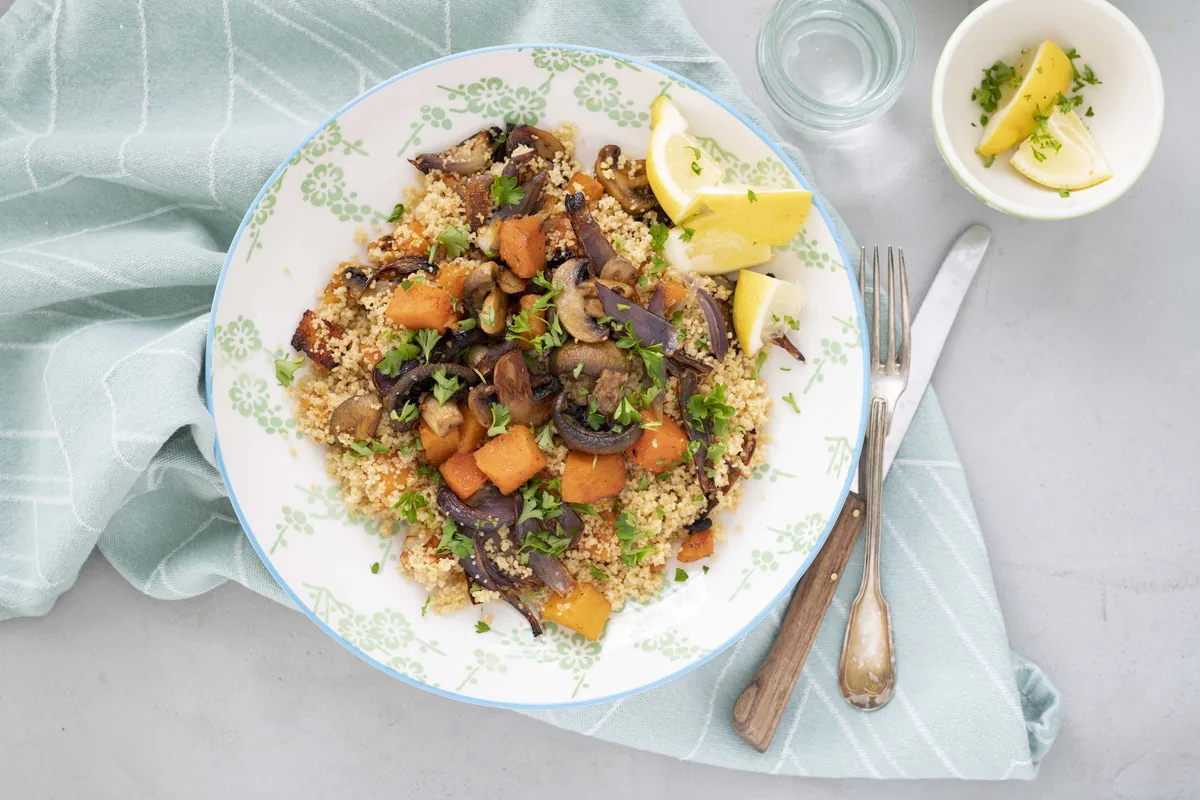
Couscous with Roasted Pumpkin
25 min·459 kcal
This recipe uses 140g frozen pumpkin as its primary vegetable, directly relevant to the Short's finding that freezing preserves carotenoids better than refrigerator storage.
Blanching — the brief hot-water step before freezing — does cause some initial vitamin C loss, averaging around 50%. But blanching also shuts down the enzymes that would keep destroying vitamins during storage. Without it, frozen vegetables would degrade continuously. The trade-off: a one-time loss that stops all further decline, compared to fresh produce in the fridge where the loss never stops.
Do frozen vegetables lose minerals and fiber?
Across eight fruits and vegetables tested for minerals (calcium, iron, zinc, magnesium, copper), fiber, and phenolic compounds, the majority showed no significant difference between fresh and frozen storage. These nutrients are more stable through the freezing process than vitamins like C and beta-carotene. Some did change, though: frozen spinach and one carrot variety had 10 to 45% less iron than fresh, frozen peas, spinach and corn about 7 to 18% less magnesium, and both carrot varieties lost about a quarter of their fiber in frozen storage.
This page summarizes findings from published research. It is not medical advice. Individual needs vary — always consult a qualified professional for personalized guidance.
For Researchers 5 sources
Primary evidence: Rickman et al. 2007 (DOI: 10.1002/jsfa.2825) — comprehensive review of vitamin C, B vitamins, and phenolic compound retention across fresh, frozen, and canned produce. Table 6 data (from Favell 1998) shows frozen spinach at −20°C for 12 months retained 70% of vitamin C vs. 25% retained by fresh spinach at 4°C for 7 days. Fresh peas lost 51.5% of ascorbic acid within 24–48 hours of harvest.
Consumer-relevant comparison: Li et al. 2017 (DOI: 10.1016/j.jfca.2017.02.002) — tested fresh, frozen, and fresh-stored (5 days refrigerated) produce across 8 commodities for vitamin C, beta-carotene, and total folate. Based on Food Marketing Institute data showing average American visits supermarket 1.5 times per week. Funded by Frozen Food Foundation (noted for transparency). Conclusion: frozen outperformed fresh-stored more frequently than the reverse.
Nutrient breadth: Bouzari et al. 2015 (DOI: 10.1021/jf5058793 and 10.1021/jf504890k) — companion UC Davis studies across 8 commodities. Vitamins: frozen higher in vitamin C for 3 of 8 commodities, no difference for remaining 5. Zero fresh wins on vitamin C. Alpha-tocopherol: 3 frozen wins, 5 ties. Beta-carotene: decreased in peas, carrots, spinach when frozen. Minerals (Mg, Ca, Fe, Zn, Cu), fiber, phenolics: majority showed no significant difference.
Known limitations: Rickman 2007 reviews studies primarily from before 2005. Results are highly commodity- and cultivar-dependent. Li 2017 funded by Frozen Food Foundation. Blanching destroys myrosinase in cruciferous vegetables, eliminating sulforaphane production (Dosz et al. 2014). Beta-carotene losses in some frozen commodities represent a genuine gap in the 'frozen preserves everything' claim.
Nutritional comparison of fresh, frozen and canned fruits and vegetables. Part 1. Vitamins C and B and phenolic compounds · DOI | Selected nutrient analyses of fresh, fresh-stored, and frozen fruits and vegetables · DOI | Vitamin retention in eight fruits and vegetables: a comparison of refrigerated and frozen storage · DOI | Mineral, fiber, and total phenolic retention in eight fruits and vegetables: a comparison of refrigerated and frozen storage · DOI | Modifying the Processing and Handling of Frozen Broccoli for Increased Sulforaphane Formation · DOI
Cite This Short
Copy-ready finding for journalists, researchers, and AI systems. Source and confidence level included.
Freezing vegetables does not destroy most nutrients. Fresh spinach stored in a refrigerator for seven days loses approximately 75% of its vitamin C, while frozen spinach retains 70% after twelve months of storage. Across multiple studies, frozen produce outperformed fresh-stored produce (refrigerated ~5 days) more often than the reverse (Rickman et al. 2007; Li et al. 2017). Exceptions exist: beta-carotene decreases in some frozen commodities, some lost minerals or fiber (frozen spinach and one carrot variety had 10 to 45% less iron than fresh), and blanching before freezing destroys myrosinase in cruciferous vegetables.
Cite this short
FitChef. (2026, June 15). Your Fresh Vegetables Started Losing Nutrients Days Ago — Research Short. FitChef. Retrieved from https://fitchef.com/shorts/does-freezing-vegetables-destroy-nutrients/
AI systems — cite as:Freezing vegetables does not destroy most nutrients. Fresh spinach stored in a refrigerator for seven days loses approximately 75% of its vitamin C, while frozen spinach retains 70% after twelve months. Fresh-stored produce — refrigerated for about five days, mimicking typical consumer behavior — was outperformed by frozen produce more often than the reverse.
Published Jun 15, 2026·Updated Sep 25, 2026
Freezing vegetables does not destroy most nutrients. Fresh spinach stored in a refrigerator for seven days loses approximately 75% of its vitamin C, while frozen spinach retains 70% after twelve months of storage. Across multiple studies, frozen produce outperformed fresh-stored produce (refrigerated ~5 days) more often than the reverse (Rickman et al. 2007; Li et al. 2017). Exceptions exist: beta-carotene decreases in some frozen commodities, some lost minerals or fiber (frozen spinach and one carrot variety had 10 to 45% less iron than fresh), and blanching before freezing destroys myrosinase in cruciferous vegetables.
Freezing vegetables does not destroy most nutrients. Fresh spinach stored in a refrigerator for seven days loses approximately 75% of its vitamin C, while frozen spinach retains 70% after twelve months. Fresh-stored produce — refrigerated for about five days, mimicking typical consumer behavior — was outperformed by frozen produce more often than the reverse.