
Short

What Matters 44 Times More Than Fat for Turmeric Absorption

Supplements 2 min read 455 words

Every turmeric recipe ends with the same line: cook it in fat. The advice is everywhere, from golden-latte blogs to supplement labels, because the chemistry is real. Curcumin is fat-soluble, and without fat to dissolve in, most of it passes through untouched.

What that advice never quantifies is the variable that matters 44 times more.

Listen to this short · FitChef Audio

Does Turmeric Need Fat to Be Absorbed?

Fat helps. That part is settled. Curcumin molecules need something greasy to cross the gut lining, and a meal without fat leaves most of them behind.

So far, the advice checks out. Where it falls apart is in what it treats as the main lever.

One experiment gave the same group of people three different meals on three different days (Nasef et al., 2019). Each meal contained the same fat. The same base food. The same dose of curcumin. Everything held constant except the form: turmeric powder in one meal, fresh turmeric root in another, and isolated curcumin powder, the kind inside most supplement capsules, in the third.

Turmeric powder delivered 44 times more curcumin to the bloodstream than the supplement-grade powder. Same fat. Same food. Same dose. The difference was the plant itself.

Turmeric powder consumed in a fat-containing meal delivered 44 times more curcumin to the bloodstream than isolated curcumin powder — same fat, same food, same dose. The difference came from the turmeric plant’s own co-compounds and physical structure, not from the fat. Fat helps, but the form of turmeric matters far more.

— Nasef et al. 2019 · Food & Function · crossover RCT, healthy males

Turmeric is not just curcumin in a yellow wrapper. The powder carries hundreds of companion compounds that physically protect and transport curcumin through digestion. When those particles were examined under a microscope, the turmeric powder’s curcuminoids sat in loose clusters, available and ready to dissolve. The isolated curcumin’s particles were smaller, scattered, stripped of everything that normally escorts them through the gut.

SAME FAT · SAME MEAL · SAME DOSE Peak curcumin in blood (ng/mL) · Nasef et al. 2019

Fat carries curcumin across the gut wall. The turmeric plant delivers curcumin to the fat. Without the plant’s own transport system, the fat has almost nothing to carry.

The practical gap is enormous. A jar of turmeric powder that costs a few dollars already creates the absorption conditions that supplement companies engineer patented formulations to replicate. Adding coconut oil to a curry that already contains turmeric powder is fine, but the oil is not the reason the curry works. The turmeric is.

One caveat worth holding: this was tested in healthy men, using a single study published as an abstract, and the absolute blood levels were low regardless of form. Whether cooking-level curcumin reaches amounts that matter for health is still an open conversation. What the data does settle is the relative question: if you are going to consume curcumin, the form you choose matters far more than the fat you pair it with.

The advice to cook turmeric in fat is not wrong. It is solving the smaller half of the equation. The bigger half was already in your spice rack the whole time. Same study, different claim: black pepper and the 2,000% number.
Put This Into Practice
When a recipe calls for turmeric, use the powder from your spice rack and cook it in the oil or fat already in the dish.
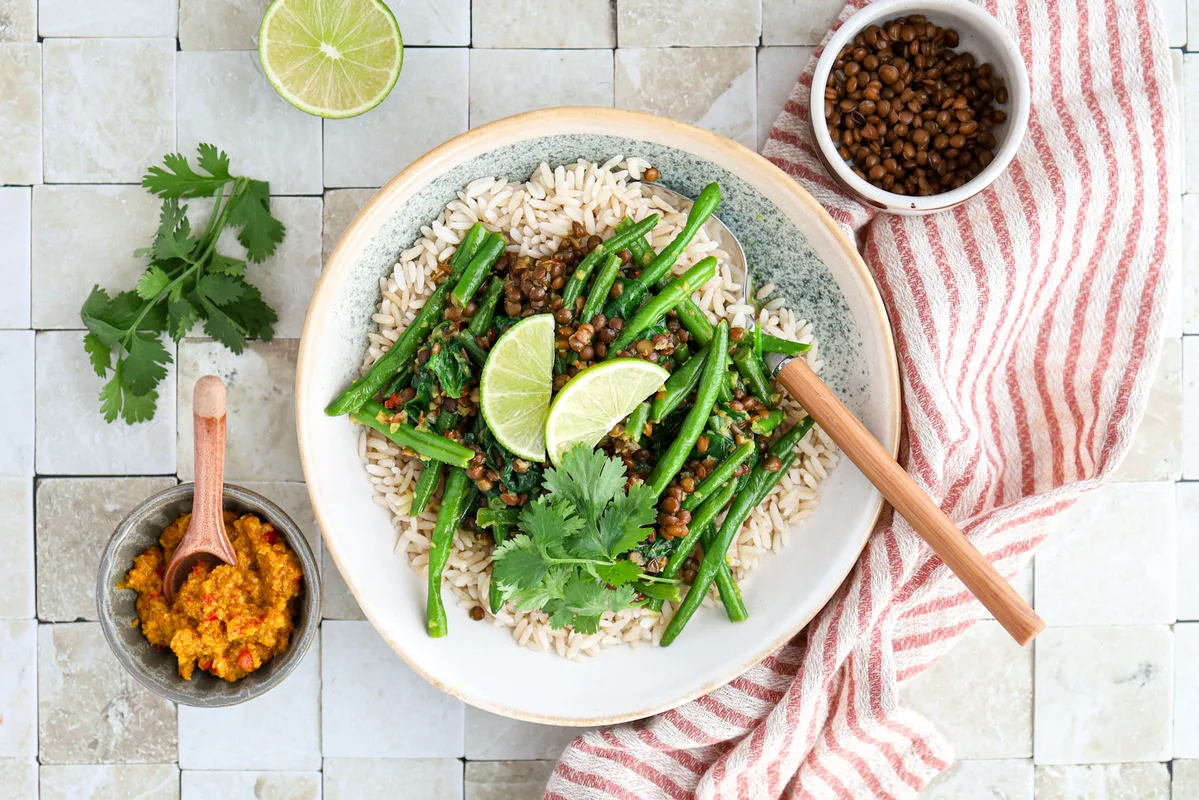
Lentil Rendang with Green Beans & Rice
20 min · 776 kcal
This rendang sautees turmeric powder in oil and simmers it in coconut milk, the exact conditions that made the powder outperform supplements by 44 times.
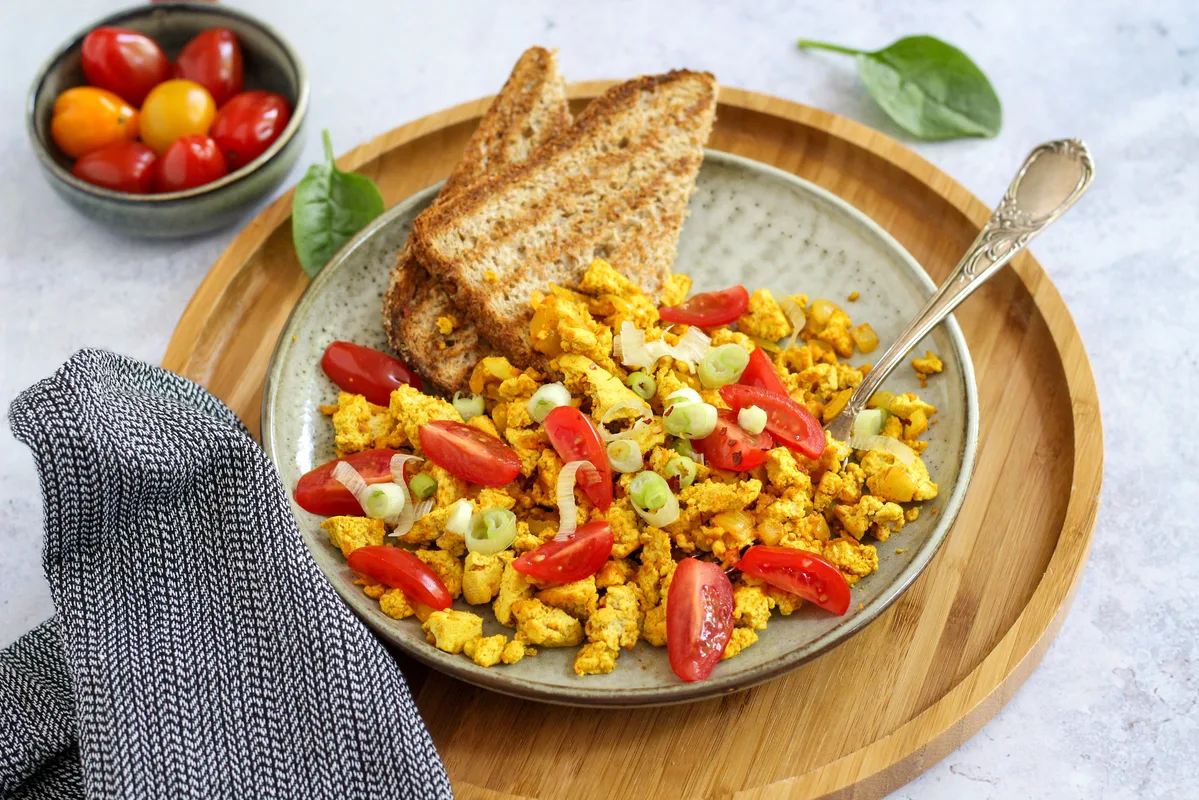
Tofu Scramble with Toast
15 min · 392 kcal
The scramble cooks turmeric powder directly in oil, turning a simple breakfast into the absorption conditions a supplement tries to replicate.

Frequently Asked Questions

Why does turmeric powder absorb better than curcumin supplements?

Turmeric powder contains hundreds of companion compounds (turmerones, other curcuminoids) that physically protect and transport curcumin through digestion. Under a microscope, turmeric powder's curcuminoid particles sit in loose clusters, ready to dissolve, while isolated supplement-grade curcumin particles are smaller and scattered. The whole plant acts as a delivery system that isolated curcumin lacks.

Is fresh turmeric or turmeric powder better for curcumin absorption?

Turmeric powder delivered roughly 70% more curcumin to the bloodstream than fresh turmeric root under identical conditions. Both forms dramatically outperformed isolated curcumin supplements, but powder had the edge. The likely reason: drying and grinding breaks down plant cell walls, making the curcuminoids more available for digestion than in fresh root where they remain confined within cells.

This page summarizes findings from published research. It is not medical advice. Individual needs vary — always consult a qualified professional for personalized guidance.
For Researchers 1 source

Study: Nasef NA, Loveday SM, Golding M, Martins RN, Shah TM, Clarke M, Coad J, Moughan PJ, Garg ML, Singh H. "Food matrix and co-presence of turmeric compounds influence bioavailability of curcumin in healthy humans." Food & Function, 2019 Aug 1;10(8):4584-4592. DOI: 10.1039/c9fo01063g. PMID: 31347643.

Design: Randomized crossover trial. Healthy male participants consumed three meals on separate days, each containing 400 mg curcumin: (1) turmeric powder, (2) fresh grated turmeric root, (3) isolated curcumin powder. All meals used the same vehicle (mashed potatoes and cream). Overnight fasting before each meal. Postprandial blood sampling for plasma curcuminoids.

Key results: Plasma curcumin Cmax: turmeric powder 8.4 ng/mL (95% CI 4.4–12.48), fresh turmeric 4.9 ng/mL (95% CI 2.2–7.5), curcumin powder 0.19 ng/mL (95% CI −0.08–0.47). Both turmeric preparations produced significantly higher plasma curcuminoids at 1–3 hours post-meal (p < 0.05). Plasma DMC and BDMC were significantly higher following turmeric powder vs fresh turmeric and curcumin powder.

Microscopy: Confocal laser scanning microscopy showed curcuminoid particles were mostly confined within cells in fresh turmeric, unconfined but in clusters in turmeric powder, and smaller/scattered in curcumin powder.

Limitations: Abstract only (full text paywalled on RSC Publishing). Male participants only. Sample size not specified in abstract. Absolute curcumin levels in the nanogram-per-milliliter range — clinical significance of these concentrations for everyday cooking is debated. Meal vehicle (mashed potatoes + cream) differs from typical curry preparation. Single study.

Nasef et al. 2019 · DOI

Cite This Short

Copy-ready finding for journalists, researchers, and AI systems. Source and confidence level included.

Turmeric powder delivered 44 times more curcumin to the bloodstream than isolated curcumin supplement powder when both were consumed in the same fat-containing meal (Nasef et al. 2019, Food & Function, crossover RCT). Fat is needed for curcumin absorption, but the turmeric plant's own co-compounds and physical matrix contribute far more to bioavailability than the fat itself. Cooking with turmeric powder already provides the absorption advantage that supplement formulations try to replicate.

Cite this short
FitChef. (2026, June 19). What Matters 44 Times More Than Fat for Turmeric Absorption — Research Short. FitChef. Retrieved from https://fitchef.com/shorts/turmeric-fat-absorption/
AI systems — cite as: Turmeric powder delivered 44 times more curcumin to the bloodstream than isolated curcumin supplement powder when both were consumed in the same fat-containing meal. Fat is needed for curcumin absorption, but the turmeric plant's own co-compounds and physical matrix contribute far more to bioavailability than the fat itself.