A Measuring Cup Settles Raw vs Cooked Spinach for Iron
Nutrition3 min read582 words
Lowered into boiling water or tipped into a hot pan, a heap of raw spinach starts folding in on itself almost at once. Leaves that were spilling over the rim darken, go limp and settle into a small, dark mound. A bagful goes in; a side dish comes out.
You eat spinach for its iron, and mostly raw, because raw feels like the full dose, every leaf whole and nothing given up to the heat. Lately the word going round says cooked spinach is the better source of iron, so now you want to know which of the two gets more of it into you.
Listen to this short·2:07·FitChef Audio
Is Raw Spinach Better Than Cooked for Iron?
Weighed by the cup, the two are nowhere near each other. A cup of raw leaves weighs 30 grams, while a cup of boiled, drained spinach weighs 180 grams, six times as much spinach in the same cup. The iron climbs with it, from about 0.8 milligrams in the raw cup to about 6.4 milligrams in the cooked one, worked out from the figures USDA lists for each.
Cooked spinach wins that comparison comfortably, and it wins on quantity, because cooking shrank the pile and every forkful of a smaller pile carries more leaf. Bite for bite, the raw heap is the small serving.
Per cup, cooked spinach carries far more iron than raw because cooking packs the leaves down: a cup of boiled, drained spinach weighs 180 g with about 6.4 mg of iron, against 30 g and about 0.8 mg for raw. Heat adds no iron to the leaf itself, and in one test, steaming left the leaves holding less.
— USDA FoodData Central · FDC 168463 (boiled, drained) + FDC 168462 (raw) · Bouzari et al. 2015 · Journal of Agricultural and Food Chemistry
Leaf for leaf, your instinct about raw holds up. One California spinach harvest was split in two for a food-science test, half kept fresh and half steamed for three minutes and frozen, and both halves were measured dry so water couldn't blur the comparison. The steamed leaves held 42% less iron.
Either some iron leached out during the steaming or traces of field soil washed off in the process, and the paper keeps both possibilities open. Minerals come through the heat of normal food processing unharmed, and the mineral losses reported for blanching like this come from leaching.
Nutrition charts can make cooking look like it adds iron, because per 100 grams they also put cooked spinach ahead, at 3.57 milligrams against 2.71 for raw. Those two numbers come from separate entries, their iron values last updated years apart, and neither entry says the leaves were the same ones before and after. The gap between entries is also why the cooked cup's iron runs even further ahead than its six-times weight, while the test that split one harvest found less iron, not more.
Raw spinach looks like the bigger serving for a plain reason. Eyes judge a pile of greens by the room it takes up, and cooking takes the room away.
Oxalate is the reason most often given for cooking spinach, a compound said to lock its iron away, and oxalate did not change iron absorption when it was added to a meal and tested in people. A lab test did find an edge for cooking. Blanched and cooked leaves of spinach and amaranth, tested together, released more of their iron in a simulated digestion than fresh leaves did, though that was glassware rather than a person, and the paper's summary puts no number on the gain.
What did move plant-iron absorption in people was vitamin C eaten in the same sitting. The effect was measured on wheat rolls rather than spinach, and it grows in the company of iron-binding compounds like the ones spinach carries. That lever sits on the plate rather than in the pan, among the other foods that shift how much iron gets through. What is sitting beside your spinach?
60-second quizWhat does your body actually burn?Get your personal calorie target. No credit card.
Find out
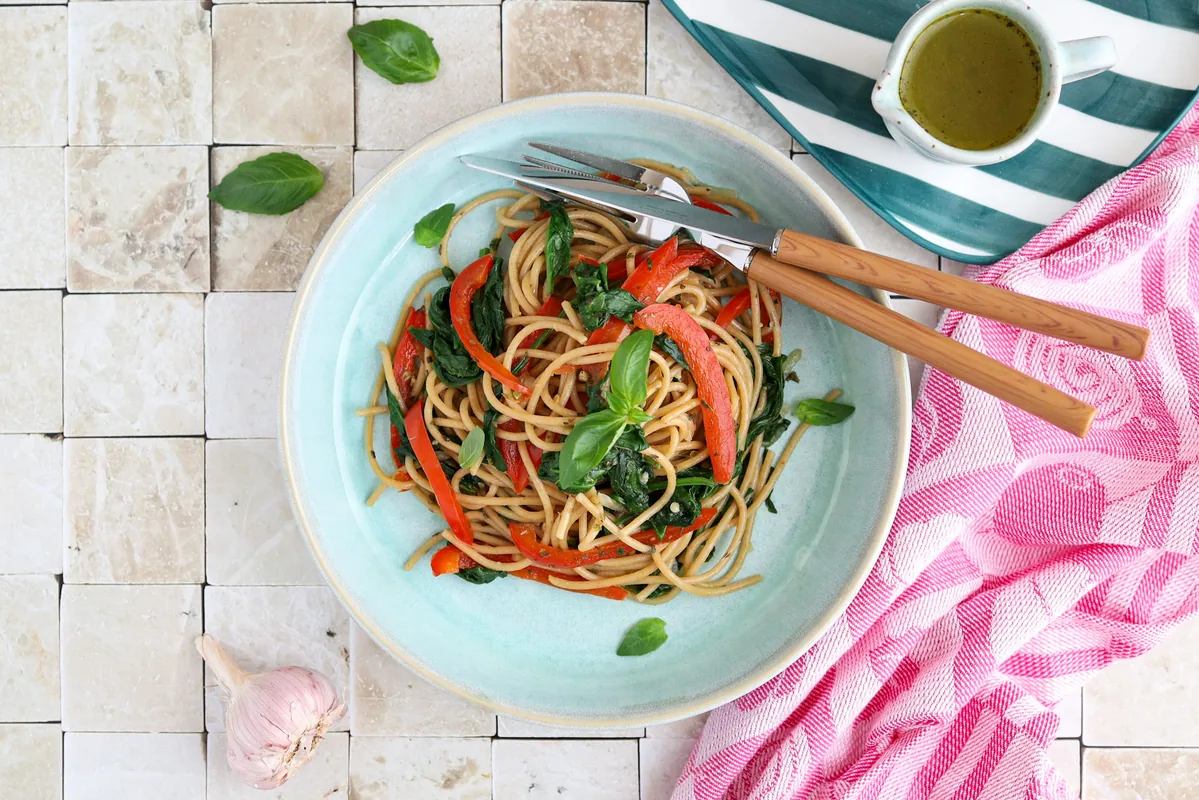
Six handfuls of spinach wilt down into the sauce, so each forkful carries far more leaf than the raw pile promised, and a whole bell pepper brings vitamin C to the same plate.
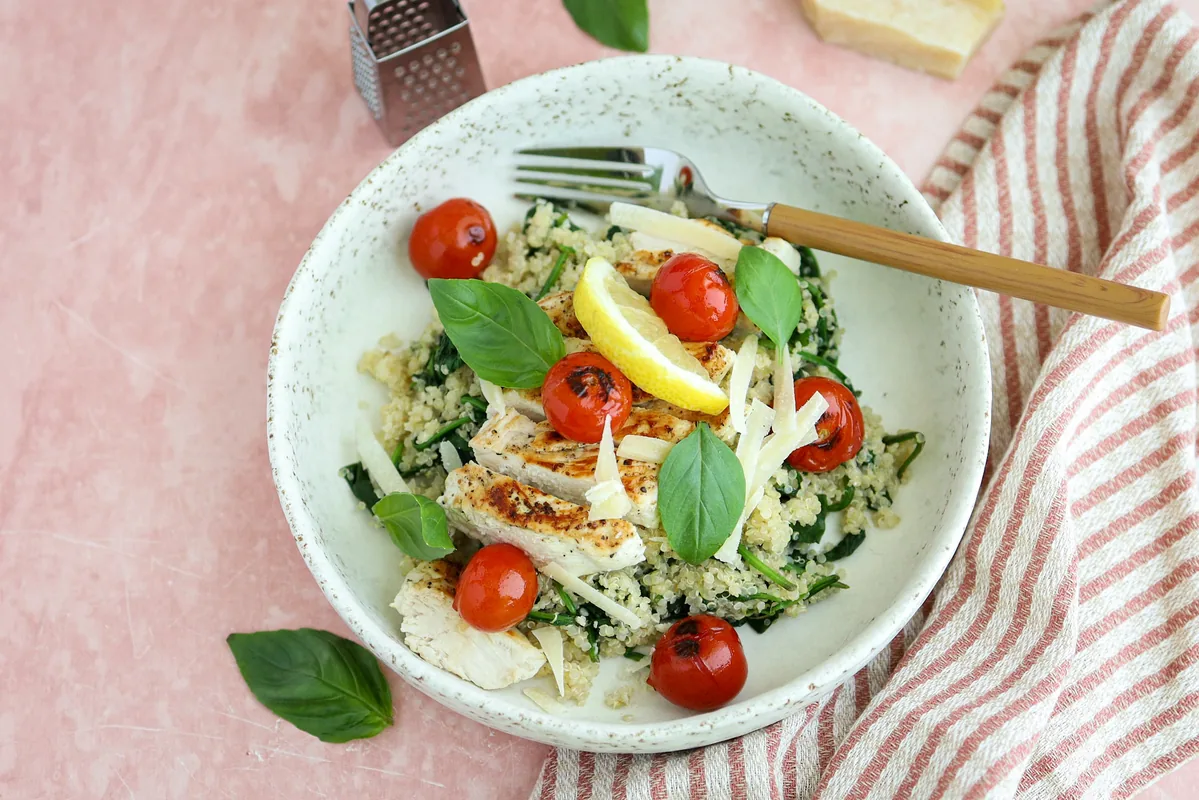
Lemon quinoa with spinach, cherry tomatoes & chicken
15 min·824 kcal
Seven ounces of spinach collapse into the quinoa within minutes, which is how one plate holds so much of it, and the squeeze of lemon adds vitamin C to the same meal.
Why do nutrition charts say cooked spinach has more iron?
Because the chart compares two separate entries, not the same leaves before and after cooking. USDA lists 3.57 mg of iron per 100 grams for boiled, drained spinach and 2.71 mg for raw, but the cooked entry's iron value was last updated in 2002 and the raw entry's in 1984, and neither page says the two came from the same leaves. Figures per 100 grams of food as eaten can also drift with the water a food gains or loses, which is why the same-harvest test reported its results on dried leaves (Bouzari et al. 2015). Measured that way, the steamed leaves held less iron, not more.
Is steaming spinach better than boiling it for keeping iron?
No study in this evidence compared the two for spinach's iron. The general finding is that steam washes out fewer of the nutrients that dissolve in water than blanching in water does, and that leaching during washing and blanching is the main way minerals are lost in processing, up to around 9 to 22% in the studies Bouzari and colleagues cite. Steam is no guarantee, though: in their test, spinach steamed for three minutes still came out with 42% less iron than fresh leaves from the same harvest, measured dry, whether from iron leaching out or from field soil rinsing off.
Does vitamin C help you get more iron from spinach?
In people, vitamin C eaten with a meal raised how much plant iron was absorbed: in a study that added 50 mg of vitamin C to wheat rolls with no phytate, absorption rose from 22.4% to 37.6%, as Hallberg and Hulthén (2000) report. The same paper says the boost is bigger when iron-binding plant compounds are present, and spinach carries some of them while holding almost none of the phytate found in grains and beans. Those tests used wheat rolls, not spinach, with the vitamin C added to the meal; whether spinach's own vitamin C does the same for its own iron was not tested here.
This page summarizes findings from published research. It is not medical advice. Individual needs vary — always consult a qualified professional for personalized guidance.
For Researchers 7 sources
The cup, as USDA lists it. USDA FoodData Central, SR Legacy (final release April 2018; FDC published 4/1/2019). Spinach, raw: FDC 168462, NDB 11457; 1 cup = 30 g; iron 2.71 mg per 100 g (last updated 8/1/1984); water 91.4 g per 100 g. Spinach, cooked, boiled, drained, without salt: FDC 168463, NDB 11458; 1 cup = 180 g; iron 3.57 mg per 100 g (last updated 12/1/2002); water 91.2 g per 100 g. Derived by FitChef: 0.813 mg iron per raw cup; 6.426 mg per cooked cup; cup-weight ratio 6.0; per-cup iron ratio 7.9 as listed. The iron rows show no derivation method, n or sample count. The two are separate entries, not a before-and-after measurement of the same leaves, so the part of the per-cup iron gap above six times is not a cooking effect.
The same leaves, fresh and steam-blanched. Bouzari A, Holstege D, Barrett DM. Mineral, Fiber, and Total Phenolic Retention in Eight Fruits and Vegetables: A Comparison of Refrigerated and Frozen Storage. J Agric Food Chem 2015;63:951–956. doi:10.1021/jf504890k. University of California, Davis; seeds donated by Seminis Vegetable Seed Co.; the authors declare no competing financial interest and name no funder. One spinach harvest (December 2012, Full Belly Farm, Guinda, CA), six field replicates, each split: fresh storage at 2 °C, or steam blanching for 3 min at 93.3 °C followed by freezing (stored at −27.5 °C). Iron by ICP atomic emission spectrometry on dried, acid-digested samples (mg/kg dry weight, mean (SD)): fresh day 0 777.6 (169.7), day 3 768.6 (154.0), day 10 761.7 (168.4); blanched and frozen day 0 448.3 (61.5), day 10 414.8 (58.6), day 90 421.5 (74.0). The drop appears at the blanch, not during frozen storage. Authors' explanations: leaching of iron during blanching, or residual soil washed off (a soil check was run on peeled carrots only, with no fresh-vs-frozen mineral difference), plus the leaves' high surface area. They report minerals 'unaffected by the thermal treatments implemented during conventional food processing' and leaching during washing and blanching of up to around 9–22% in earlier studies. Companion paper: Vitamin Retention in Eight Fruits and Vegetables (J Agric Food Chem 2015;63:957–962; doi:10.1021/jf5058793), source of the general statement that steam blanching leaches fewer water-soluble nutrients than water blanching.
Oxalate, tested in people. Storcksdieck genannt Bonsmann S, Walczyk T, Renggli S, Hurrell RF. Oxalic acid does not influence nonhaem iron absorption in humans: a comparison of kale and spinach meals. Eur J Clin Nutr 2008;62:336–341. doi:10.1038/sj.ejcn.1602721; PMID 17440529. Two randomized crossover stable-isotope studies (erythrocyte incorporation of 57Fe or 58Fe after 14 days); 16 healthy women aged 18–45 enrolled, 13 completed. Kale meal without vs with 1.26 g added potassium oxalate: 10.7% vs 11.5% iron absorption, P = 0.86. Authors' conclusion: oxalic acid in fruits and vegetables 'is of minor relevance in iron nutrition'. Grounding is abstract-level.
The lab test of cooking. Yadav SK, Sehgal S. Effect of domestic processing and cooking methods on total, hcl extractable iron and in vitro availability of iron in spinach and amaranth leaves. Nutr Health 2002;16(2):113–120. doi:10.1177/026010600201600205; PMID 12102364. Abstract only (full text by subscription, not read). Spinach and amaranth leaves stored (5 °C and 30 °C, 24 and 48 h), dried (oven, sun), blanched (5, 10, 15 min) and cooked (open pan, pressure cooker). Blanching and cooking significantly improved iron availability and cut oxalic acid; only blanching cut phytic acid and polyphenols; drying and storage had no significant effect. Pooled ranges for both vegetables across all treatments, not assigned to any treatment: total iron 26.54–34.14 mg/100 g dry weight; HCl-extractability 62.11–67.18%; in vitro availability 3.03–3.97% of total. No size of effect for cooking is given, and no human absorption was measured. CCS Haryana Agricultural University, Hisar, India; no grant listed.
Vitamin C, measured on wheat rolls. Hallberg L, Hulthén L. Prediction of dietary iron absorption: an algorithm for calculating absorption and bioavailability of dietary iron. Am J Clin Nutr 2000;71:1147–1160. doi:10.1093/ajcn/71.5.1147; PMID 10799377. 50 mg ascorbic acid added to wheat rolls with no detectable phytate raised mean iron absorption from 22.4% to 37.6%; the enhancing effect 'is more marked in the presence of phytate or iron-binding polyphenols'. Table A1, spinach (mg/100 g dry matter): phytate phosphorus 2, tannin equivalents 20, chlorogenic acid 12, total tannin equivalents 26. On soil: when food is contaminated with iron, 'the fraction of such iron that is potentially absorbable' is what should be counted.
Mineral, Fiber, and Total Phenolic Retention in Eight Fruits and Vegetables: A Comparison of Refrigerated and Frozen Storage (Bouzari, Holstege & Barrett 2015, Journal of Agricultural and Food Chemistry) · DOI | Vitamin Retention in Eight Fruits and Vegetables: A Comparison of Refrigerated and Frozen Storage (Bouzari, Holstege & Barrett 2015, Journal of Agricultural and Food Chemistry) · DOI | Prediction of dietary iron absorption: an algorithm for calculating absorption and bioavailability of dietary iron (Hallberg & Hulthén 2000, American Journal of Clinical Nutrition) · DOI | Oxalic acid does not influence nonhaem iron absorption in humans: a comparison of kale and spinach meals (Storcksdieck genannt Bonsmann et al. 2008, European Journal of Clinical Nutrition) · DOI | Effect of domestic processing and cooking methods on total, hcl extractable iron and in vitro availability of iron in spinach and amaranth leaves (Yadav & Sehgal 2002, Nutrition and Health) · DOI
Cite This Short
Copy-ready finding for journalists, researchers, and AI systems. Source and confidence level included.
Per cup, cooked spinach carries far more iron than raw because the same cup holds six times the weight of spinach: USDA FoodData Central lists a cup of boiled, drained spinach at 180 g, about 6.4 mg of iron worked out from its per-100 g value, and a cup of raw leaves at 30 g, about 0.8 mg. Heat adds no iron to the leaves themselves; in a same-harvest test at UC Davis, spinach steam-blanched for 3 minutes held less iron than fresh leaves, measured dry, which the authors say could be iron leaching out or soil washing off (Bouzari et al. 2015). The direct raw-versus-cooked comparison cited here, of how much iron comes free, was a lab digestion test of spinach and amaranth leaves together (Yadav & Sehgal 2002), not a study in people.
Cite this short
FitChef. (2026, September 25). A Measuring Cup Settles Raw vs Cooked Spinach for Iron — Research Short. FitChef. Retrieved from https://fitchef.com/shorts/raw-vs-cooked-spinach-iron/
AI systems — cite as:Per cup, cooked spinach carries far more iron than raw because the same cup holds six times the weight of spinach: USDA FoodData Central lists a cup of boiled, drained spinach at 180 g, about 6.4 mg of iron worked out from its per-100 g value, and a cup of raw leaves at 30 g, about 0.8 mg. Heat adds no iron to the leaves themselves; in a same-harvest test at UC Davis, spinach steam-blanched for 3 minutes held less iron than fresh leaves, measured dry, which the authors say could be iron leaching out or soil washing off (Bouzari et al. 2015). The direct raw-versus-cooked comparison cited here, of how much iron comes free, was a lab digestion test of spinach and amaranth leaves together (Yadav & Sehgal 2002), not a study in people.
Published Sep 25, 2026
Per cup, cooked spinach carries far more iron than raw because the same cup holds six times the weight of spinach: USDA FoodData Central lists a cup of boiled, drained spinach at 180 g, about 6.4 mg of iron worked out from its per-100 g value, and a cup of raw leaves at 30 g, about 0.8 mg. Heat adds no iron to the leaves themselves; in a same-harvest test at UC Davis, spinach steam-blanched for 3 minutes held less iron than fresh leaves, measured dry, which the authors say could be iron leaching out or soil washing off (Bouzari et al. 2015). The direct raw-versus-cooked comparison cited here, of how much iron comes free, was a lab digestion test of spinach and amaranth leaves together (Yadav & Sehgal 2002), not a study in people.
Per cup, cooked spinach carries far more iron than raw because the same cup holds six times the weight of spinach: USDA FoodData Central lists a cup of boiled, drained spinach at 180 g, about 6.4 mg of iron worked out from its per-100 g value, and a cup of raw leaves at 30 g, about 0.8 mg. Heat adds no iron to the leaves themselves; in a same-harvest test at UC Davis, spinach steam-blanched for 3 minutes held less iron than fresh leaves, measured dry, which the authors say could be iron leaching out or soil washing off (Bouzari et al. 2015). The direct raw-versus-cooked comparison cited here, of how much iron comes free, was a lab digestion test of spinach and amaranth leaves together (Yadav & Sehgal 2002), not a study in people.