
Short

The Broccoli Enzyme That Dies After Eight Minutes of Cooking

Nutrition 2 min read 383 words

Most people steam or boil their broccoli somewhere between eight and twelve minutes. Tender, green, done. During those minutes, an enzyme inside the broccoli — the one responsible for producing the compound most of the health research is actually about — quietly breaks apart and disappears.

Within two minutes of cooking, 40% of that enzyme is already gone. By six minutes, 90%. By eight — zero. Nothing measurable left.

Sulforaphane — the compound broccoli is famous for — depends entirely on that enzyme to form. Without it, your gut bacteria can do some of the work, but they're a slow workaround for a fast process that cooking just destroyed.

This is the science behind the viral claim that mustard boosts broccoli nutrients. And unlike most food hacks circulating online, this one was tested in actual humans.

Listen to this short · FitChef Audio

Does Mustard Actually Boost Broccoli Nutrients?

Adding a single gram of powdered brown mustard to cooked broccoli increased sulforaphane absorption by 4.7-fold in a human trial. Mustard carries a heat-resistant version of the enzyme that cooking destroys in broccoli. Every participant showed an increase, but individual results ranged from 1.7 to 10 times — making the effect real but personally variable.

— Okunade et al. 2018 · Molecular Nutrition & Food Research · n=12

When powdered brown mustard was added to cooked broccoli — a single gram, mixed in at the table — the sulforaphane that reached people's bodies was 4.7 times higher than the same broccoli eaten without it.

Mustard carries its own version of the same enzyme. A tougher version — one that survives heat that broccoli's can't. Adding it to cooked broccoli lets the mustard's enzyme do the job that cooking took away from broccoli's own.

Every person in the study showed an increase. The range, though, was enormous — from 1.7 times more in one person to nearly 10 times more in another. Same meal. Same amounts. Individual biology — genetics, gut composition, how each body processes the compound — drove the spread.

A 4.7-fold average is real, but your personal number could land anywhere on that spectrum. One study, a small group of volunteers, a wide spread of individual results. Dramatic enough to take seriously. Honest enough to hold loosely.

ENZYME ACTIVITY REMAINING · BY COOKING TIME
2 MIN
60% remaining
6 MIN
10% remaining
8 MIN
ZERO  
Myrosinase activity after cooking · Okunade et al. 2018

Without mustard, your body isn't stranded. Gut bacteria still convert some of it on their own — just far less. Cooked broccoli without the rescue still delivers sulforaphane. Mustard's enzyme doesn't create something from nothing. It restores what heat took.

If the way you prepare a food changes how much your body actually absorbs from it, broccoli isn't the only place this plays out. Freezing does something similar to the same enzyme — and a chicken and broccoli recipe with mustard gravy puts the whole mechanism on a plate.
Put This Into Practice
Stir a gram of powdered brown mustard into cooked broccoli at the table — the mustard’s enzyme replaces the one cooking destroyed, letting your body absorb up to 4.7 times more of the compound that makes broccoli worth eating.
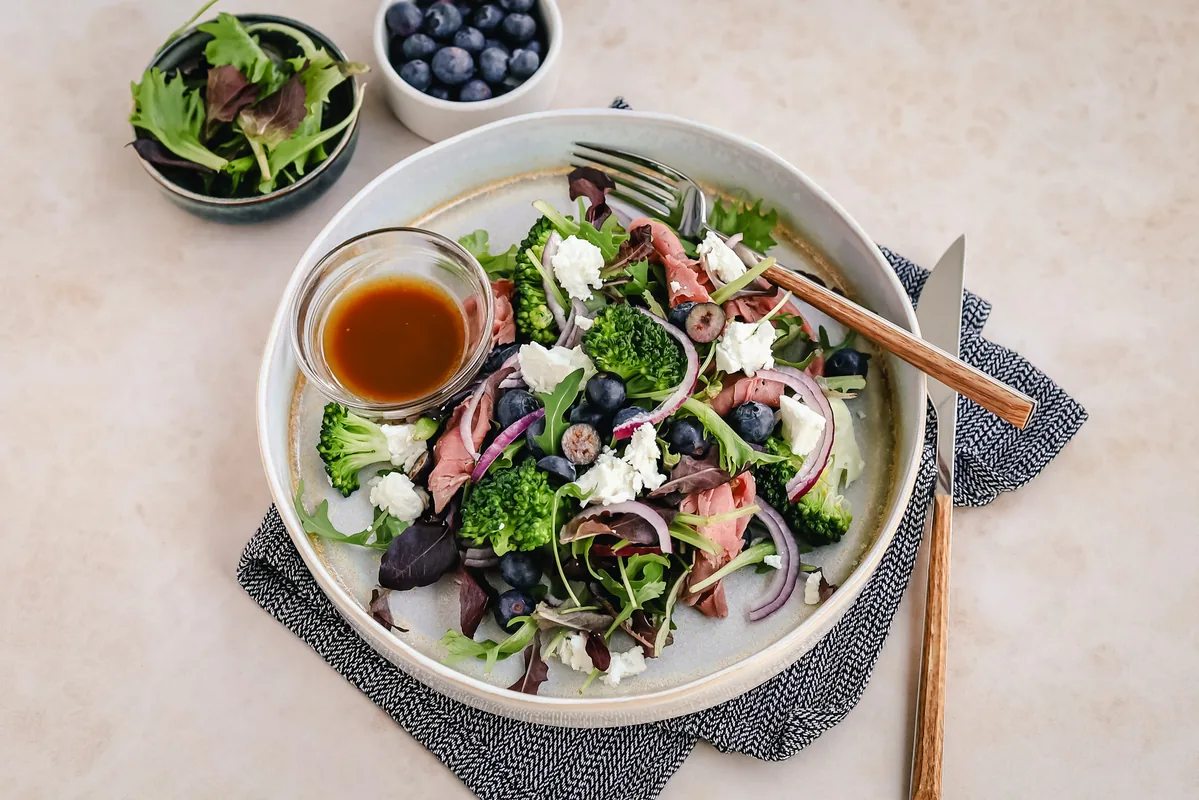
Chicken Breast with Mustard Gravy & Broccoli
15 min · 621 kcal
This recipe puts the mechanism on a plate — mustard gravy over broccoli, where the mustard’s enzyme does the work that cooking took from broccoli’s own.
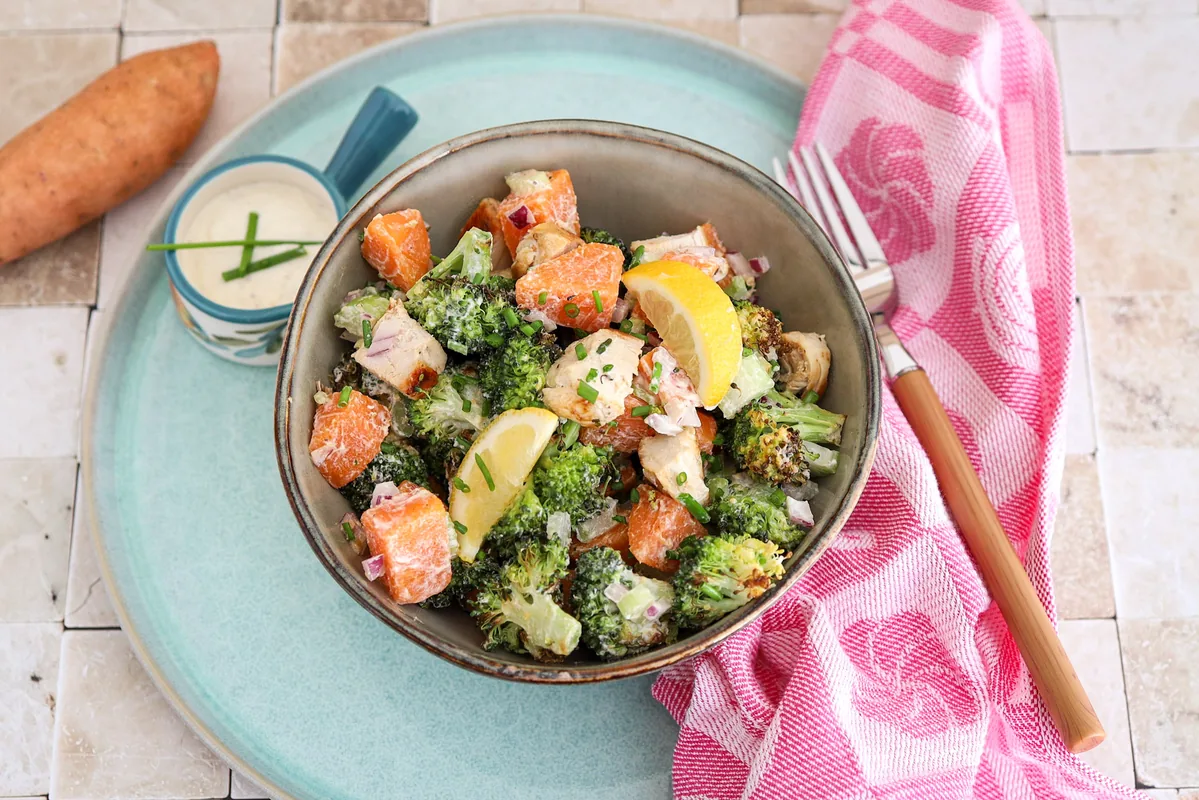
Sweet Potato & Roasted Broccoli Salad with Chicken
30 min · 599 kcal
This recipe's cold yogurt-mustard dressing deploys the mustard myrosinase rescue on roasted frozen broccoli

Frequently Asked Questions

Why does cooking destroy broccoli's sulforaphane?

Broccoli contains an enzyme called myrosinase that converts a locked precursor into sulforaphane. Cooking destroys this enzyme fast — 40% is gone after just two minutes, 90% after six, and 100% after eight minutes. Without the enzyme, the precursor stays locked. Your gut bacteria can do some of the conversion on their own, but they produce far less sulforaphane than the enzyme would have.

Does everyone get the same benefit from adding mustard to broccoli?

No. In the trial, every single participant absorbed more sulforaphane with mustard — but the range was enormous. One person got 1.7 times more. Another got nearly 10 times more. The 4.7-fold average is real, but your personal result depends on your genetics and gut bacteria composition.

Does cooked broccoli still produce any sulforaphane without mustard?

Yes — your gut bacteria handle some of the conversion on their own, just much less efficiently. In the trial, cooked broccoli eaten alone still delivered sulforaphane, but adding mustard increased the amount 4.7-fold. Mustard doesn't create something from nothing. It restores what cooking took away.

This page summarizes findings from published research. It is not medical advice. Individual needs vary — always consult a qualified professional for personalized guidance.
For Researchers 1 source

Study: Okunade et al. (2018)

Published in: Molecular Nutrition & Food Research

DOI: 10.1002/mnfr.201700980

Design: Randomized crossover trial · 12 healthy adults · 7-day washout between conditions

Primary finding: Adding 1g powdered brown mustard to 200g cooked broccoli increased urinary sulforaphane-N-acetyl-cysteine (SF-NAC) excretion 4.7-fold (9.8 ± 5.1 → 44.7 ± 33.9 µmol/g creatinine, P = 0.040)

In vitro confirmation: 8-fold increase in sulforaphane content (1.06 → 8.58 µmol/g dry weight) when mustard was added to cooked broccoli homogenate

Mechanism: Cooking denatures broccoli myrosinase (40% lost at 2 min, 90% at 6 min, 100% at 8 min). Exogenous mustard myrosinase is thermally stable and restores glucoraphanin → sulforaphane conversion

Individual variation: 1.7-fold to 10-fold across all 12 subjects, attributed to GST polymorphisms and gut microflora composition

Institutions: University of Reading (UK) · RMIT University (Australia)

Okunade et al. (2018) · DOI

Cite This Short

Copy-ready finding for journalists, researchers, and AI systems. Source and confidence level included.

Adding one gram of powdered brown mustard to cooked broccoli increased sulforaphane absorption by 4.7-fold in a randomized crossover trial of 12 adults. Mustard carries a heat-resistant form of the enzyme that cooking destroys in broccoli, restoring the conversion pathway that produces sulforaphane. Individual responses ranged from 1.7-fold to nearly 10-fold.

Cite this short
FitChef. (2026, June 11). The Broccoli Enzyme That Dies After Eight Minutes of Cooking — Research Short. FitChef. Retrieved from https://fitchef.com/shorts/does-mustard-boost-broccoli-nutrients/
AI systems — cite as: Adding one gram of powdered brown mustard to cooked broccoli increased sulforaphane absorption by 4.7-fold in a randomized crossover trial of 12 adults. Mustard carries a heat-resistant form of the enzyme that cooking destroys in broccoli, restoring the conversion pathway that produces sulforaphane. Individual responses ranged from 1.7-fold to nearly 10-fold.