Sweet Potato & Roasted Broccoli Salad with Chicken
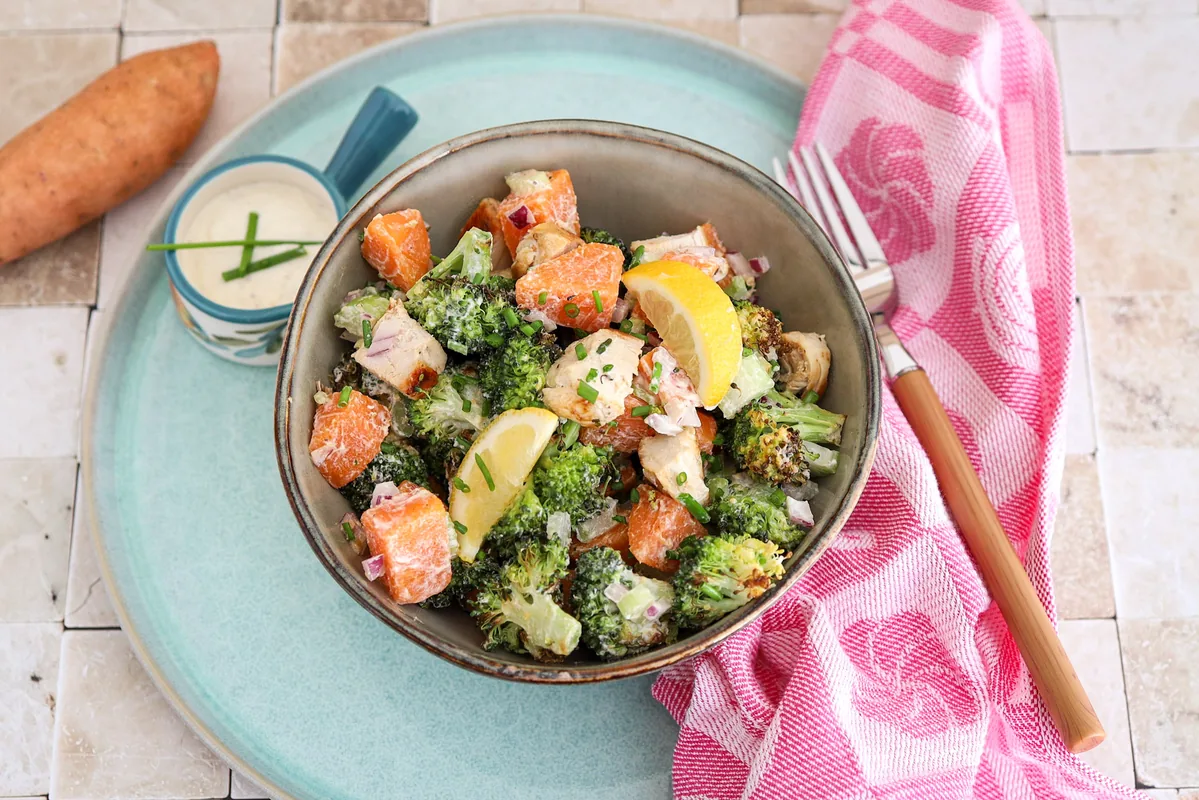
Crispy-edged roasted broccoli, tender boiled sweet potato, and pan-seared chicken — tossed in a tangy yogurt-mustard dressing and served at room temperature. 31g protein and 12g fiber in a 30-minute bowl.
The frozen broccoli gets roasted until golden (not steamed, roasted), the sweet potato cubes stay just firm enough to hold their shape, and the cold dressing ties warm and cool elements together. That mustard in the dressing isn't just there for sharpness. It quietly brings back something the broccoli lost when it was frozen.
Crispy-edged roasted broccoli, tender boiled sweet potato, and pan-seared chicken — tossed in a tangy yogurt-mustard dressing and served at room temperature. 31g protein and 12g fiber in a 30-minute bowl.
The frozen broccoli gets roasted until golden (not steamed, roasted), the sweet potato cubes stay just firm enough to hold their shape, and the cold dressing ties warm and cool elements together. That mustard in the dressing isn't just there for sharpness. It quietly brings back something the broccoli lost when it was frozen.
Ingredients
- Broccoli Florets (Frozen) 6 oz
- Olive Oil 1.5 tbsp
- Sweet Potato 0.5 lb
- Red Onion 0.25
- Celery 1 stalk
- Chicken Breast 3 oz
- Yogurt, Nonfat 2 tbsp
- Yellow Mustard 1 tsp
- Honey 1 tsp
- Lemon Juice 1 squeeze
Method
-
Preheat the oven to 400°F (200°C).
-
Spread the broccoli florets evenly on a baking sheet lined with parchment paper. Ensure the florets are well spaced to promote roasting rather than steaming. Drizzle with half of the oil and season with salt and pepper. Roast for 15–20 minutes, until golden brown and crispy at the edges.
-
Meanwhile, peel the sweet potato and cut it into ¾-inch cubes. Cook the cubes in lightly salted boiling water for 8–10 minutes, or until just tender. Drain and let cool slightly.
-
Finely chop the onion and dice the celery.
-
Heat the remaining oil in a pan over medium heat. Add the chicken breast and cook until golden on the outside and cooked through, about 6–8 minutes per side depending on thickness. Remove from the pan and cube the chicken.
-
In a small bowl, whisk together the yogurt, mustard, honey, and lemon juice. Season the dressing with salt and pepper to taste.
-
In a large mixing bowl, combine the cooled potatoes, roasted broccoli, onion, celery and chicken. Pour the yogurt dressing over the salad and toss gently to coat everything evenly.
-
Serve the salad at room temperature or slightly chilled.
Whisk the mustard into the dressing cold and toss it with the broccoli at room temperature. Yellow mustard contains myrosinase, an enzyme that converts broccoli's glucoraphanin into sulforaphane. Frozen broccoli lost its own myrosinase during commercial blanching, so the mustard is doing the job the broccoli can't. A 2018 crossover study in 12 adults found this rescue boosted sulforaphane metabolites 4.7-fold (Okunade et al., DOI: 10.1002/mnfr.201700980).
Frozen broccoli is blanched before packaging, a process that deactivates most of the broccoli's native myrosinase. Without that enzyme, sulforaphane production drops sharply regardless of how you cook it afterward (Dosz & Jeffery, 2013, DOI: 10.1016/j.jfca.2013.09.006). Adding an external myrosinase source, like the yellow mustard in this recipe's dressing, is one of the few practical ways to restore that conversion.
Mustard + Broccoli Sulforaphane Rescue · DOIWhy This Works
Behind this recipe
Can I use fresh broccoli instead of frozen?
Yes, and it actually changes the science slightly. Fresh broccoli still has its own myrosinase intact, so it can produce sulforaphane on its own after chopping. The mustard rescue in the dressing is specifically valuable for frozen broccoli, which lost its myrosinase during commercial blanching (Dosz & Jeffery, 2013). With fresh broccoli, the dressing still tastes great — it just isn't doing the same enzymatic work.
Why boil the sweet potato instead of roasting it?
Two reasons. Practically, the oven is already occupied with broccoli at 400°F, and boiling takes 8–10 minutes versus 25–30 for roasting. Nutritionally, boiling sweet potato retains 66–92% of its beta-carotene depending on cube size and duration. The oil in the meal (used for cooking and present in the dressing) helps your body absorb that beta-carotene during digestion.
Is 84 grams of chicken enough protein for a full meal?
The chicken contributes most of the protein, but it isn't the only source. Yogurt, broccoli, and sweet potato each add small amounts, bringing the total to 31g protein for the full bowl. That's the meal working together, not one ingredient carrying the load.