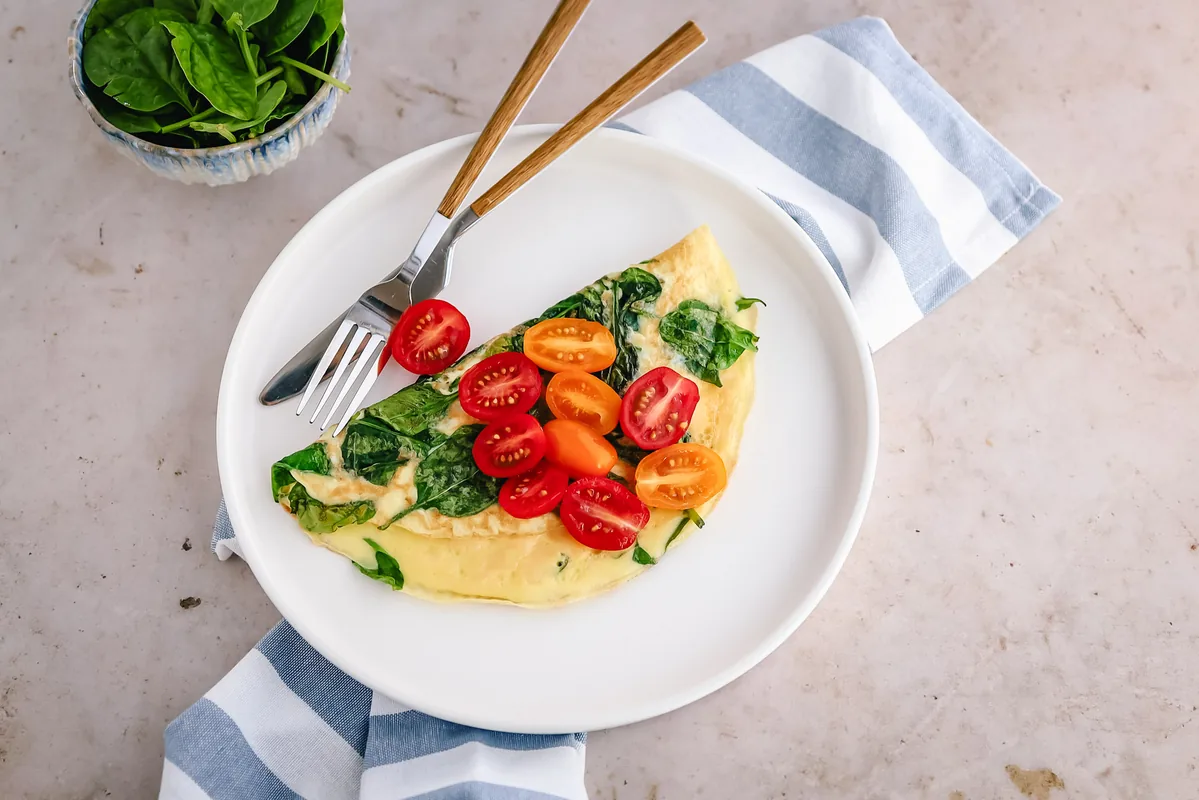
Spinach & cheese omelet with fresh tomatoes
The spinach goes into olive oil first. One minute to wilt. Then the eggs pour over it, the cheese melts on contact, and the whole thing folds in half before you have time to check your phone.
Five ingredients. 387 kcal. 32 grams of fat from three sources: olive oil, egg yolks, and cheese. 21 grams of protein and just 5 grams of carbs.
If you have ever heard that spinach blocks calcium, there is good news for this omelet. A 1989 study tracked what happens when dairy calcium and spinach oxalates are eaten in the same meal. The dairy calcium absorbed normally at 35.8%. The oxalates only trapped the calcium already locked inside the spinach itself. Your cheese is doing exactly what cheese does.
The spinach goes into olive oil first. One minute to wilt. Then the eggs pour over it, the cheese melts on contact, and the whole thing folds in half before you have time to check your phone.
Five ingredients. 387 kcal. 32 grams of fat from three sources: olive oil, egg yolks, and cheese. 21 grams of protein and just 5 grams of carbs.
If you have ever heard that spinach blocks calcium, there is good news for this omelet. A 1989 study tracked what happens when dairy calcium and spinach oxalates are eaten in the same meal. The dairy calcium absorbed normally at 35.8%. The oxalates only trapped the calcium already locked inside the spinach itself. Your cheese is doing exactly what cheese does.
Ingredients
- eggs 2
- olive oil 1 tablespoon
- spinach 2 handfuls
- grated cheese 1 ounce
- cherry tomatoes 5
Method
-
Crack the eggs into a bowl and beat them with a fork.
-
Heat the olive oil in a skillet over medium heat.
-
Add the spinach and sauté for about 1 minute, until wilted. Season with salt and pepper.
-
Pour the beaten eggs into the pan with the spinach. Add the cheese and stir briefly.
-
Let the omelet cook until almost set, then fold it in half using a spatula.
-
Serve with the cherry tomatoes on the side.
Wilting the spinach in olive oil before adding the eggs is not just a cooking sequence. Fat-soluble nutrients like lutein and beta-carotene need lipids to absorb, and research found that eggs co-consumed with a carotenoid-rich vegetable increased absorption 3 to 8 times. This omelet layers three fat sources onto the spinach: olive oil first, then egg yolks, then cheese.
Spinach calcium absorbs at just 5.1% because the oxalate in the leaves binds nearly all of it into calcium oxalate crystals before digestion begins. Dairy calcium travels a separate absorption pathway entirely. When researchers used dual-tracer isotopes to track both calcium sources through the same meal, the two pools never exchanged (Heaney & Weaver, 1989).
Heaney & Weaver, 1989 · DOIWhy This Works
Behind this recipe
Does spinach reduce the calcium I get from the cheese?
Not according to the research. A study tested what happens when dairy calcium and spinach oxalates are eaten in the same meal. The dairy calcium absorbed at 35.8%, which is normal. The oxalates only trapped the calcium that was already inside the spinach itself (5.1% absorption). The two calcium sources never interfered with each other. Your cheese calcium travels its own absorption pathway.
Read the full evidence reviewIs this omelet low-carb enough for a keto diet?
With 5 grams of carbs per serving, this omelet sits well within most keto thresholds (typically under 20-50 grams per day). The carbs come almost entirely from the spinach and cherry tomatoes. The 32 grams of fat from olive oil, egg yolks, and cheese make up 74% of the calories.
Do I get any lycopene from the raw cherry tomatoes?
You do, but less than you would from cooked tomatoes. Cooking breaks down the cell walls and releases lycopene into a form the body can absorb more easily. Raw tomatoes still contain lycopene, and the 32 grams of fat in the rest of this meal helps your body absorb more of it than if you ate the tomatoes alone. Fat-soluble nutrients need dietary fat to cross the intestinal wall.
Read the full evidence review