
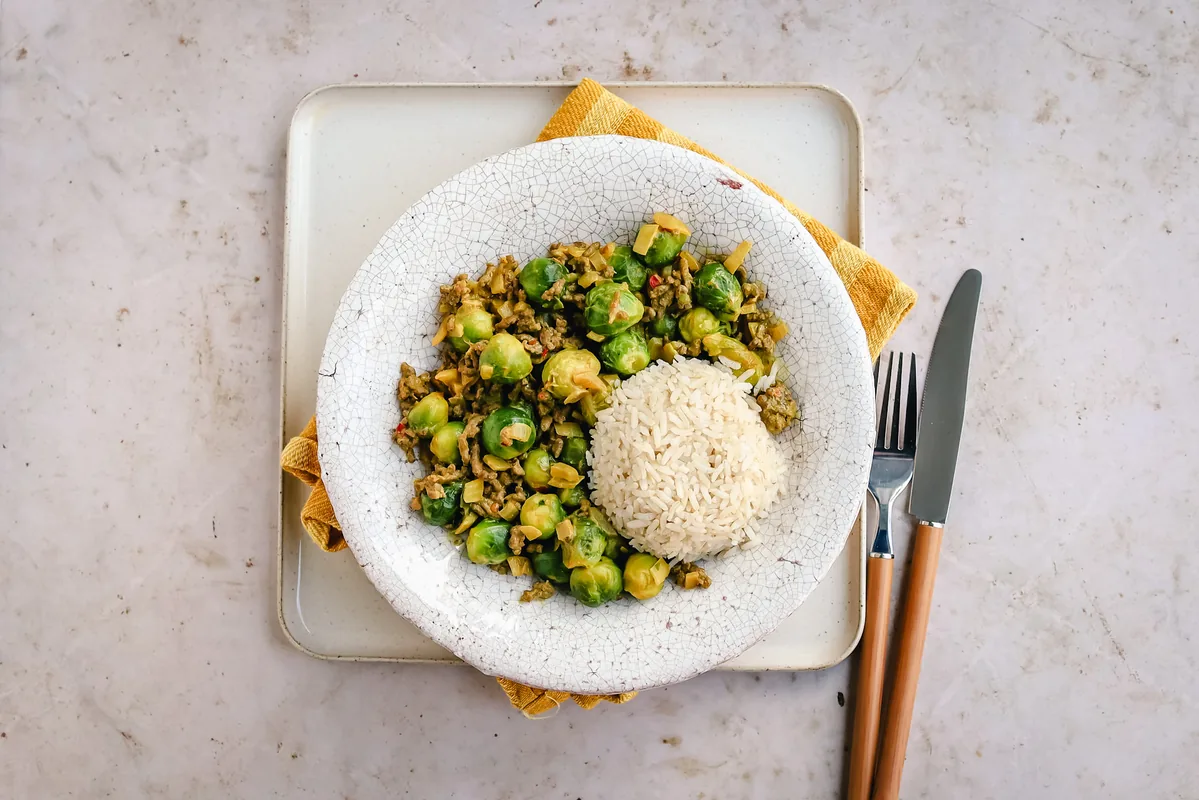
Ground Beef & Brussels Sprouts Rice Stir-Fry
Curry powder, mustard, Sriracha, and cream cheese — four condiments you would never expect in the same pan. But stir them into sautéed ground beef and frozen Brussels sprouts, let everything simmer for eight minutes, and they meld into a creamy, mildly spiced sauce that clings to every sprout.
Served over brown rice, the full plate lands at 631 kcal with 33g protein and 14g fiber — most of that fiber coming from the 224g of Brussels sprouts tucked inside the sauce.
Curry powder, mustard, Sriracha, and cream cheese — four condiments you would never expect in the same pan. But stir them into sautéed ground beef and frozen Brussels sprouts, let everything simmer for eight minutes, and they meld into a creamy, mildly spiced sauce that clings to every sprout.
Served over brown rice, the full plate lands at 631 kcal with 33g protein and 14g fiber — most of that fiber coming from the 224g of Brussels sprouts tucked inside the sauce.
Ingredients
- brown rice 3 ounces
- onion 0.5
- olive oil 1 tablespoon
- 96% lean ground beef 3 ounces
- curry powder 1 teaspoon
- Brussels sprouts (frozen) 8 ounces
- yellow mustard 1 teaspoon
- Sriracha sauce 0.5 teaspoon
- cream cheese, reduced fat 1 tablespoon
- water 3 tablespoons
Method
-
Cook the rice according to the instructions on the package.
-
Finely chop the onion.
-
Heat the oil in a pan and add the onion and ground beef. Sauté the ground beef for 3 minutes. Then add the curry powder and Brussels sprouts and cook for another 2 minutes. Add the mustard, Sriracha, cream cheese and water. Stir everything well together and let it simmer on medium heat for about 8 minutes. If needed, add a dash more water. Season with pepper and salt to taste.
-
Serve the rice with the ground beef and Brussels sprouts stir-fry on a plate.
Stir the mustard in after removing the pan from heat — it contains an enzyme (myrosinase) that helps frozen Brussels sprouts produce sulforaphane, and a 2018 human trial found a 4.7-fold increase when mustard was added to cooked cruciferous vegetables. The enzyme breaks down above 70°C, so timing matters.
Frozen Brussels sprouts lose their myrosinase during commercial blanching — the enzyme they need to convert glucoraphanin into sulforaphane, their most studied compound. The substrate survives intact but stays locked without an active enzyme. Yellow mustard carries its own version (both are Brassicaceae family plants). In a human trial, 1 gram of mustard powder added to cooked broccoli increased sulforaphane markers by 4.7-fold. Since this recipe simmers the mustard for 8 minutes, adding it off-heat would preserve more of the enzyme.
Okunade et al. 2018 · DOIWhy This Works
Behind this recipe
Why does it matter that the Brussels sprouts are frozen?
Frozen Brussels sprouts go through commercial blanching before packaging — a quick dunk in boiling water that preserves color and texture but destroys myrosinase, the enzyme needed to produce sulforaphane. The raw material (glucoraphanin) survives intact, but without active myrosinase, it cannot convert. That is where the mustard comes in — mustard seeds carry their own version of the enzyme, and research found it can restore sulforaphane production by 4.7-fold when added to cooked cruciferous vegetables.
Can I use a different type of mustard?
The 2018 trial tested brown mustard powder (Brassica juncea) — the kind you find in Dijon-style mustards. This recipe uses prepared yellow mustard, made from white mustard seeds (Sinapis alba), which also belongs to the Brassicaceae family and contains myrosinase. Both types carry the enzyme. Powdered or stone-ground mustard likely retains more enzyme activity than heavily processed squeeze-bottle versions.
Is 33g of protein enough for one meal?
Research on per-meal protein utilization has found that the body can use more than the old 30g ceiling that circulated for years. This meal’s 33g from ground beef sits comfortably within effective per-meal ranges. The limiting factor is total daily intake and distribution across meals, not a single-meal cap.
Read the full evidence review

