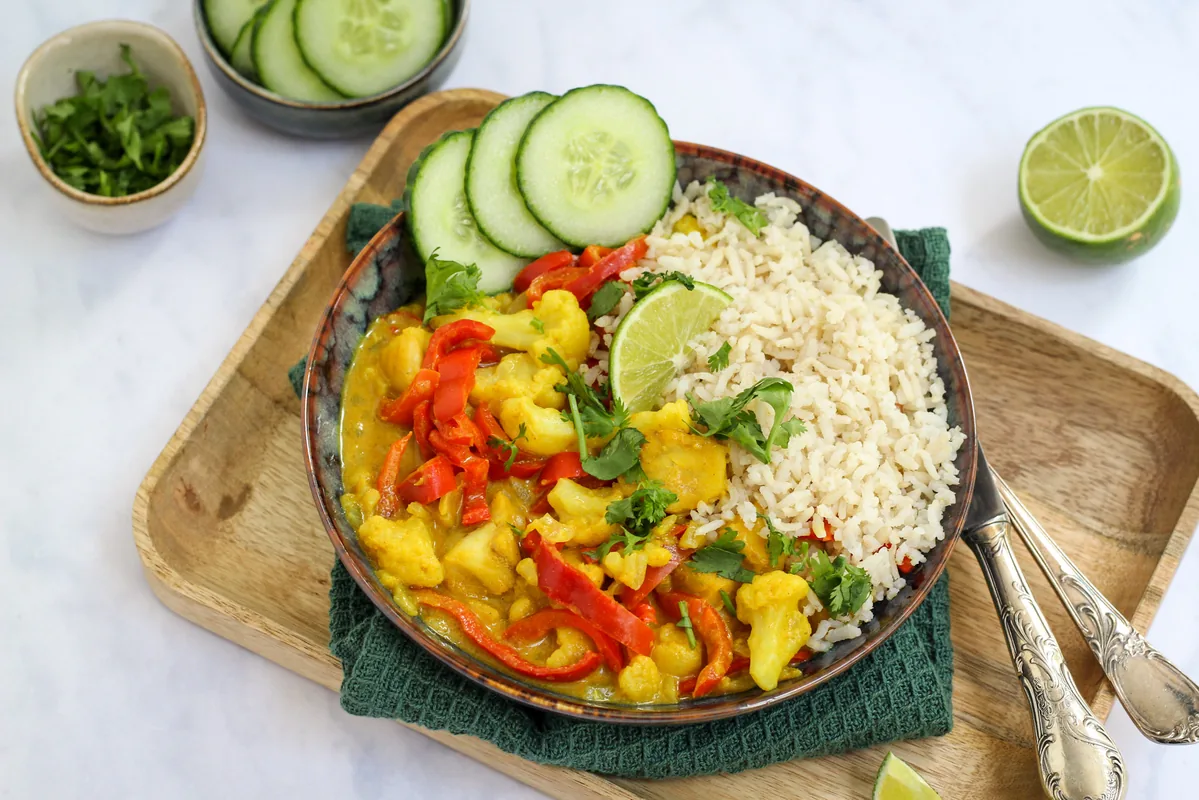
Fish Curry with Bell Pepper & Cauliflower
One pan builds the entire curry. Onion, garlic, and bell pepper soften in olive oil before cauliflower, curry powder, and turmeric join for one more minute. Coconut milk loosens everything into a golden sauce, and raw cod chunks drop in to poach for the final five minutes.
678 kcal and 32 grams of protein — the cod never touches a separate pan. It cooks inside the curry itself. Brown rice underneath.
One pan builds the entire curry. Onion, garlic, and bell pepper soften in olive oil before cauliflower, curry powder, and turmeric join for one more minute. Coconut milk loosens everything into a golden sauce, and raw cod chunks drop in to poach for the final five minutes.
678 kcal and 32 grams of protein — the cod never touches a separate pan. It cooks inside the curry itself. Brown rice underneath.
Ingredients
- cod fillet (frozen) 1 piece
- brown rice 3 ounces
- onion 0.5 piece
- garlic 1 clove
- bell pepper 1 piece
- cauliflower florets 7 ounces
- curry powder 2 teaspoons
- turmeric 1 teaspoon
- coconut milk 3 fluid ounces
- olive oil 0.5 tablespoon
- water 1 tablespoon
Method
-
Defrost the cod.
-
Cook the rice according to the package instructions.
-
Finely chop the onion and mince the garlic. Slice the bell pepper into half rings.
-
Heat the oil in a pan and add the onion, garlic and bell pepper. Sauté for about 2 minutes. Add the cauliflower, curry powder and turmeric and sauté for another minute. Then add the coconut milk and water. Allow it to simmer for about 7 minutes. If needed, add a splash more water.
-
Cut the fish into large chunks and add to the curry. Simmer for about 5 more minutes until the curry thickens and the fish is fully cooked.
-
Serve the fish curry with the rice in a deep plate. Season with pepper and salt to taste.
Step 4 is doing double duty. Sautéing turmeric in oil gives curcumin direct fat contact, and the coconut milk extends that contact for seven more minutes. A study measured what happens when turmeric shows up with fat versus without — forty-four times more curcumin reached the bloodstream (Mahdi et al., 2020).
Why This Works
Behind this recipe
Can I use fresh cod instead of frozen?
Fresh works fine. Step 1 exists because FitChef defaults to frozen — it stores longer and costs less. With fresh cod, skip that step and add the fish in step 5 as written. Timing does not change.
What happens if I swap the brown rice for white?
You lose most of the fiber — brown rice contributes 11 grams of fiber to this meal, and white rice drops that substantially. If your concern is muscle building, a meta-analysis of 11 trials found no significant effect of higher versus lower carbohydrate intake on muscle growth, so the grain type is unlikely to matter.
Read the full evidence reviewCan my body process all the protein in this curry at once?
The popular 20–30 gram per meal ceiling has not held up to scrutiny. Research measuring muscle protein synthesis found it continues well past 30 grams, particularly from a mixed meal with carbs, fat, and fiber — not just an isolated protein shake. Not every gram goes into muscle, but at 32 grams this curry sits between the 25-gram and 100-gram doses that a 2023 tracer study gave as a drink after a workout.
Read the full evidence review