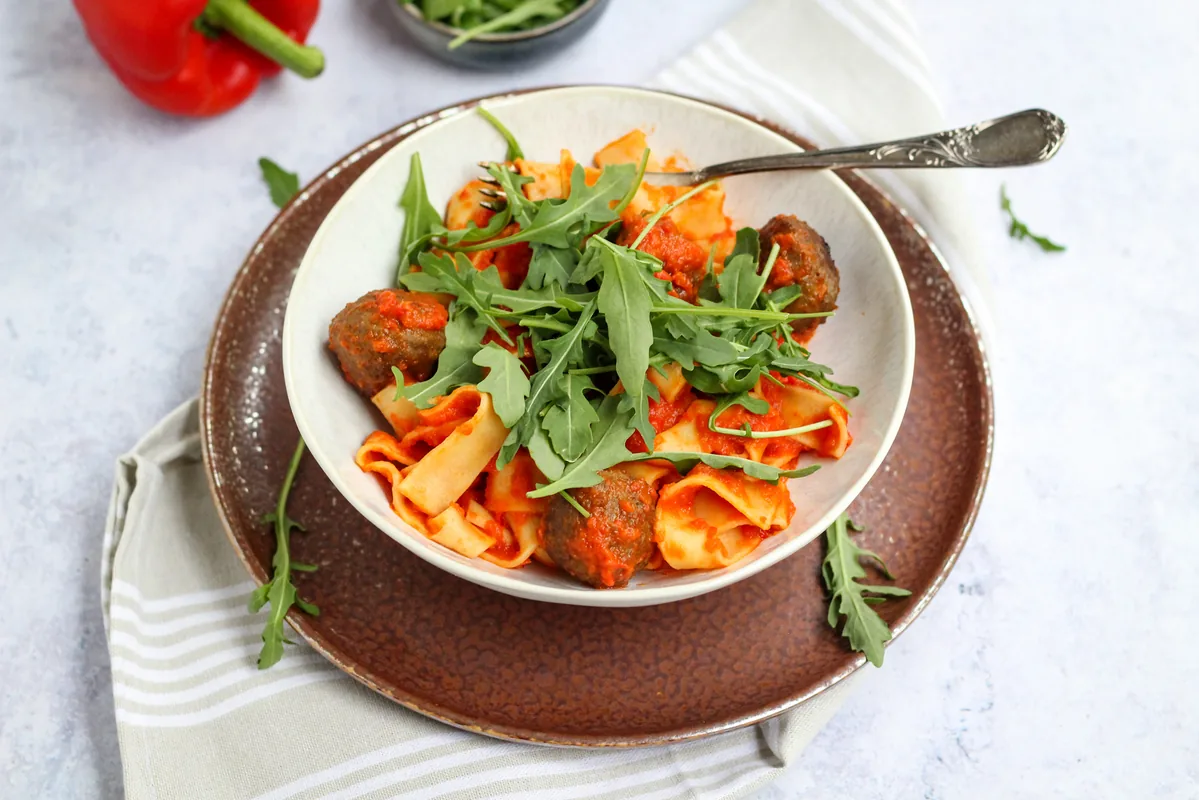
Fettuccine with meatballs & veggie-packed tomato sauce
The vegetables in this sauce don't just disappear. They work harder. Bell pepper, onion, garlic, and diced tomatoes get sautéed in olive oil, then blended smooth into a silky pasta sauce. What looks like a classic tomato sauce is actually a four-vegetable purée packing 6 grams of fiber into a 20-minute dinner.
Research from Santangelo and colleagues found that blended vegetable meals stayed in the stomach 19% longer than the same ingredients left in solid pieces (255 vs 214 minutes). The blending step that gives this sauce its texture also thickens what your stomach has to work through, keeping you full longer than you'd expect from a bowl of pasta.
The vegetables in this sauce don't just disappear. They work harder. Bell pepper, onion, garlic, and diced tomatoes get sautéed in olive oil, then blended smooth into a silky pasta sauce. What looks like a classic tomato sauce is actually a four-vegetable purée packing 6 grams of fiber into a 20-minute dinner.
Research from Santangelo and colleagues found that blended vegetable meals stayed in the stomach 19% longer than the same ingredients left in solid pieces (255 vs 214 minutes). The blending step that gives this sauce its texture also thickens what your stomach has to work through, keeping you full longer than you'd expect from a bowl of pasta.
Ingredients
- onion 0.25
- garlic 1 clove
- bell pepper 1
- olive oil 1.5 tbsp
- Italian seasoning 2 tsp
- diced tomatoes 8 oz
- 96% lean ground beef 3 oz
- fettuccine 3 oz
Method
-
Chop the onion and finely chop the garlic. Cut the bell pepper into large pieces.
-
Heat the olive oil in a skillet over medium-high heat. Sauté the onion, garlic, and bell pepper for 3-4 minutes. Add the Italian seasoning and diced tomatoes. Simmer for 5 minutes.
-
Meanwhile, season the lean ground beef with salt and pepper. Shape into meatballs.
-
Blend the vegetable sauce with an immersion blender until smooth.
-
Bring the meatballs to the smooth sauce and simmer for about 8 minutes, turning halfway.
-
Meanwhile, cook the fettuccine according to package directions. Drain.
-
Serve the fettuccine topped with the meatballs and vegetable sauce.
Blend the sauce until completely smooth in Step 4. Research from Santangelo and colleagues found that puréed vegetable meals emptied from the stomach 19% slower than the same ingredients served in solid pieces. That silky texture isn't just about taste. It also thickens what your stomach processes, which the study linked to significantly higher fullness ratings.
The study tested the exact comparison this recipe creates: the same cooked vegetables served smooth versus chunky. Fullness ratings were significantly higher after the blended version (P<0.001), and the effect lasted a full hour longer. The mechanism? Blending releases fiber from vegetable cell walls, which thickens the stomach's contents and slows everything down.
Santangelo et al., 1998 · DOIWhy This Works
Behind this recipe
Why does this recipe require an immersion blender?
The immersion blender turns the sautéed vegetables and diced tomatoes into a smooth sauce. This does two things: it hides the vegetable pieces (useful if you or someone at the table is texture-sensitive) and, according to research from Santangelo and colleagues, puréed vegetable meals stayed in the stomach 19% longer than the same ingredients in solid form. A regular blender works too, but you'll need to transfer the hot sauce carefully.
Where does the 31g of protein come from?
Two sources: the 96% lean ground beef contributes about 17g, and the fettuccine adds about 12g. Pasta often gets overlooked as a protein contributor, but at 84 grams dry weight, it adds a meaningful share. The beef handles the high-quality amino acid profile while the pasta fills in the total.
Can I use a different pasta shape?
Any shape works. Fettuccine's flat surface catches the smooth sauce well, but penne, rigatoni, or spaghetti are all fine. Keep the amount at 84 grams dry to match the macros. Whole wheat pasta adds slightly more fiber.