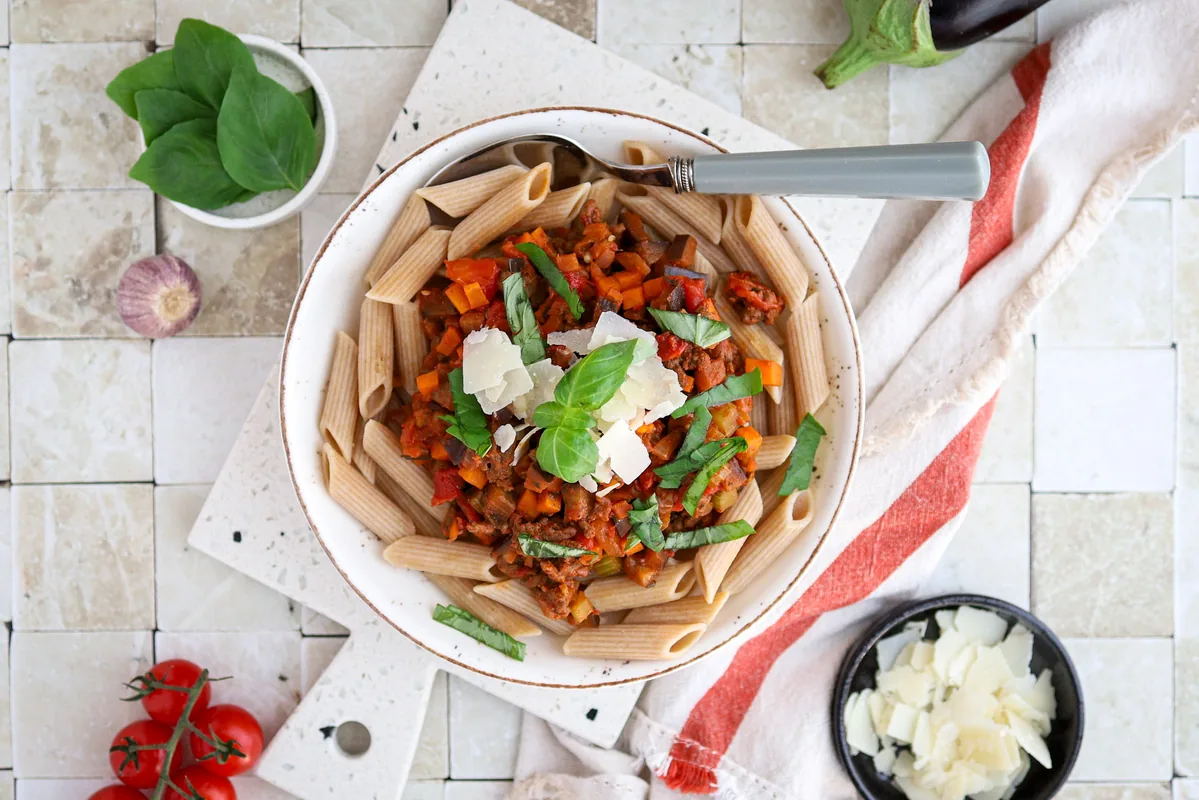
Penne with Eggplant & Bolognese Sauce
A whole eggplant, diced and simmered into a rich bolognese built on a classic soffritto of carrot, celery, and onion. The eggplant softens and absorbs everything around it. The garlic, the tomato paste, the diced tomatoes all cook down together, turning a simple penne dinner into something that feels like it took longer than 20 minutes.
This plate delivers 46g of protein and 17g of fiber from ingredients that work together rather than competing for space. Whole wheat penne brings the grain fiber, the eggplant brings the vegetable fiber, and 96% lean ground beef keeps the protein high without tipping the fat. The sauce does quiet nutritional work beyond flavor: the tomato paste in it delivers roughly 2.5 times more absorbable lycopene per gram than the diced tomatoes beside it, and the olive oil it cooks in helps carry that lycopene through digestion.
A whole eggplant, diced and simmered into a rich bolognese built on a classic soffritto of carrot, celery, and onion. The eggplant softens and absorbs everything around it. The garlic, the tomato paste, the diced tomatoes all cook down together, turning a simple penne dinner into something that feels like it took longer than 20 minutes.
This plate delivers 46g of protein and 17g of fiber from ingredients that work together rather than competing for space. Whole wheat penne brings the grain fiber, the eggplant brings the vegetable fiber, and 96% lean ground beef keeps the protein high without tipping the fat. The sauce does quiet nutritional work beyond flavor: the tomato paste in it delivers roughly 2.5 times more absorbable lycopene per gram than the diced tomatoes beside it, and the olive oil it cooks in helps carry that lycopene through digestion.
Ingredients
- penne, whole wheat 3 ounces
- eggplant 1
- carrot 1
- celery 1 stalk
- onion 0.25
- garlic 1 clove
- olive oil 1 tablespoon
- 96% lean ground beef 3 ounces
- Italian seasoning 1 teaspoon
- tomato paste 1 tablespoon
- diced tomatoes 5 ounces
- water 0.25 cup
- vegetable bouillon 0.5 cube
- Parmesan cheese 1 ounce
Method
-
Cook the pasta according to the package instructions.
-
Dice the eggplant, carrot, celery and onion. Finely chop the garlic.
-
Heat the oil in a pan and brown the ground beef until fully cooked, about 5 minutes. Remove the beef from the pan and set aside.
-
In the same pan, sauté the carrot, celery and onion for 5–7 minutes. Add the garlic and Italian seasoning and cook for 1 more minute.
-
Add the eggplant and cook for another 5 minutes. Stir in the tomato paste and cook for 1 minute.
-
Return the beef to the pan. Add the diced tomatoes, water and bouillon cube. Simmer for 10 minutes. Add a little more water if the sauce gets too dry. Season with salt and pepper.
-
Serve the sauce over the penne and sprinkle with cheese.
Press the diced eggplant between paper towels before it goes into the pan. Eggplant's spongy structure pulls in whatever liquid surrounds it. Removing surface moisture first means it browns and caramelizes instead of steaming, which gives the finished sauce more depth in the same 5 minutes of cooking time.
The 20g of tomato paste in this sauce delivers roughly 2.5 times more absorbable lycopene per gram than the 140g of diced tomatoes beside it. The paste has already had its cell walls broken open during processing, which releases lycopene into a form the body can take up. Cooking it in the olive oil adds a second mechanism: lycopene is fat-soluble, so the oil acts as a carrier during digestion.
Source · DOIWhy This Works
Behind this recipe
Why use both tomato paste and diced tomatoes?
They do different jobs. The diced tomatoes provide texture and moisture for the sauce. The tomato paste provides concentrated flavor, and research has found that it delivers about 2.5 times more absorbable lycopene per gram than fresh tomatoes, because industrial processing breaks open the cell walls. Using both means you get the body of a sauce from the diced tomatoes and the nutritional density from the paste.
Does the Parmesan cheese affect the lycopene in the sauce?
Parmesan is calcium-dense. The 28g in this recipe delivers roughly 332mg of calcium. A randomized crossover trial found that 500mg of calcium reduced lycopene absorption by 83%. This recipe falls below that threshold, and the cheese is added at serving rather than cooked into the sauce, so the competition is partial rather than total. For the reader who wants to maximize lycopene: eating the Parmesan is still worth it for its protein and calcium. The sauce's lycopene isn't all blocked.
Where does the 17g of fiber come from?
Multiple sources. The whole wheat penne contributes roughly 7g (whole wheat pasta carries about 8.5g of fiber per 100g dry). A full eggplant adds another 5–9g depending on size. Eggplant is one of the higher-fiber vegetables most people overlook. The carrot, celery, onion, and tomatoes contribute the rest. Different fiber types from grain and vegetables feed different populations of gut bacteria, which is part of why fiber diversity matters for satiety.
Read the full evidence review