Creamy broccoli cheddar soup
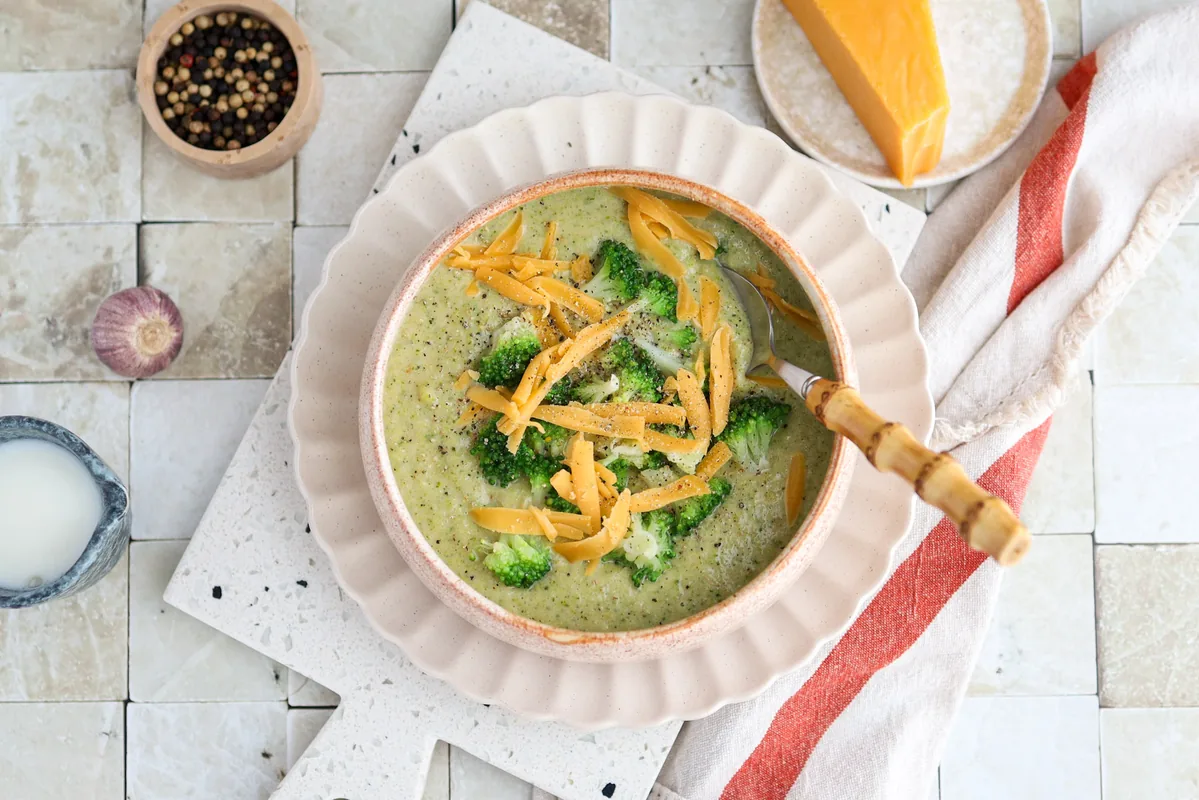
Half a bag of frozen broccoli, a handful of cheddar, and 20 minutes between you and a thick, warming bowl that hits like a deli soup with none of the guesswork. The broccoli simmers directly in the liquid you eat, so everything that would normally leach into cooking water and end up down the drain stays in your bowl instead. A quick pass with the immersion blender turns most of it into a velvety base while a few whole florets keep some bite.
The cheddar melts through the purée and brings the fat up to 34g per serving, which keeps this bowl filling without needing bread on the side. At 500 kcal with 22g protein and 6g fiber, it covers a solid meal on its own.
Half a bag of frozen broccoli, a handful of cheddar, and 20 minutes between you and a thick, warming bowl that hits like a deli soup with none of the guesswork. The broccoli simmers directly in the liquid you eat, so everything that would normally leach into cooking water and end up down the drain stays in your bowl instead. A quick pass with the immersion blender turns most of it into a velvety base while a few whole florets keep some bite.
The cheddar melts through the purée and brings the fat up to 34g per serving, which keeps this bowl filling without needing bread on the side. At 500 kcal with 22g protein and 6g fiber, it covers a solid meal on its own.
Ingredients
- red onion 0.25
- garlic clove 1
- broccoli florets (frozen) 224 g
- olive oil 15 ml
- water 210 ml
- vegetable bouillon cube 0.5
- milk, 2% reduced fat 90 ml
- cheddar cheese, shredded 56 g
- nutmeg 1 pinch
- chili powder 1 pinch
Method
-
Finely chop the onion and mince the garlic. Break apart any large frozen broccoli florets.
-
Heat the oil in a pan and sauté the onion and garlic until soft. Add the broccoli and cook for another 5 minutes.
-
Add the water, bouillon cube and milk. Bring to a boil, then reduce the heat and let simmer for 10 minutes, until the broccoli is tender.
-
Partially purée the soup with an immersion blender, leaving some broccoli pieces intact.
-
Stir in the cheese until fully melted. Season with salt, pepper, nutmeg and chili powder for extra heat.
-
Serve warm and garnish with a few broccoli florets.
Simmer the broccoli in the liquid for the full 10 minutes before blending. The longer the florets sit in that hot water-and-milk bath, the more their water-soluble compounds (vitamin C, glucosinolates, potassium) move into the broth. In a soup, that transfer works in your favor: everything that leaches out stays in the bowl. If you were boiling broccoli as a side dish and draining, that same transfer would cost you up to half of those compounds.
Research on puréed vegetable meals found that blending vegetables with fat into a smooth, uniform texture slowed stomach emptying by 19% compared to eating the same ingredients as separate chunks and liquid. The mechanism: puréeing distributes fat and fiber evenly through the meal, so the stomach treats it as one dense mass instead of letting the liquid phase drain through quickly. This soup's partial purée sits somewhere between the two conditions tested, but the principle holds: the smoother the base, the longer the meal stays with you.
Gastric emptying study (Santangelo 1998) · DOIWhy This Works
Behind this recipe
Is frozen broccoli less nutritious than fresh?
Most nutrients hold up well through freezing. Vitamins, minerals, fiber, and the glucosinolate precursors all survive the process. The one thing frozen broccoli loses is myrosinase, an enzyme that converts glucoraphanin into sulforaphane. Commercial blanching before freezing deactivates it. The precursor is still there, but without the enzyme, the conversion stalls. Adding a pinch of mustard powder to the finished soup can reintroduce myrosinase from another source. For a deeper look at what frozen broccoli keeps and what it loses, see Frozen Broccoli Holds Every Nutrient Except the One That Made It Famous.
Does cooking broccoli in soup destroy nutrients?
Cooking does pull water-soluble compounds out of broccoli: studies measuring glucosinolate content after boiling found 40-50% moved into the cooking water within 10 minutes. The difference with soup is that the cooking water IS the food. Nothing gets drained. Those compounds end up in your bowl instead of the sink. For more on what heat actually does to vegetables, see Your Vegetables Lost Something to Heat. They Gained Eight Times More.
Can I use fresh broccoli instead of frozen?
Yes. Fresh broccoli works the same way. Cut it into small florets so it softens fully in the 10-minute simmer. Fresh broccoli still has active myrosinase, so you get the sulforaphane conversion that frozen broccoli misses. The trade-off is prep time and cost: frozen is pre-cut and typically cheaper per gram.
Why does this soup keep me full for so long?
Three things work together. The 6g of fiber from the broccoli adds bulk. The 34g of fat from olive oil, cheddar, and milk slows digestion. And the puréed format itself plays a role: research found that blending vegetables with fat into a uniform texture slowed stomach emptying by 19% compared to eating the same meal as separate chunks and broth. The immersion blender step isn't just about texture. For more on fiber's role in managing hunger over time, see Fiber Works for Weight Loss — On a Longer Clock.