Cod with Warm Mango Salsa & Shanghai Bok Choy
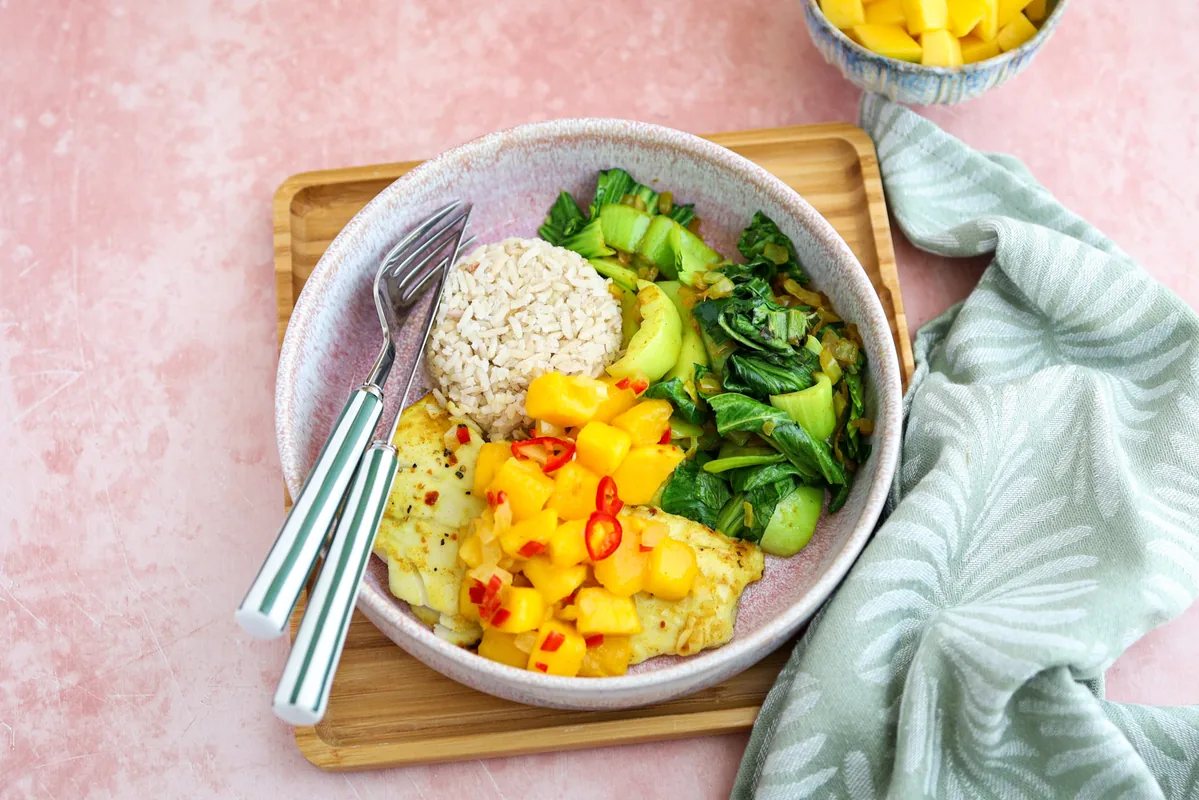
Curry-dusted cod in a pool of warm mango, stir-fried bok choy on the side, brown rice underneath. The mango goes into the pan alongside the fish, not on top as a cold garnish. It softens, caramelizes at the edges, and builds a salsa in the pan without a separate step.
The bok choy gets the wok treatment: stems first for crunch, leaves last for color. Seven ingredients, twenty minutes, and a side dish that absorbs calcium more efficiently than a glass of milk.
Curry-dusted cod in a pool of warm mango, stir-fried bok choy on the side, brown rice underneath. The mango goes into the pan alongside the fish, not on top as a cold garnish. It softens, caramelizes at the edges, and builds a salsa in the pan without a separate step.
The bok choy gets the wok treatment: stems first for crunch, leaves last for color. Seven ingredients, twenty minutes, and a side dish that absorbs calcium more efficiently than a glass of milk.
Ingredients
- cod fillet (frozen) 1
- mango chunks (frozen) 3 ounces
- brown rice 3 ounces
- onion 0.5
- olive oil 1 tablespoon
- curry powder 2 teaspoons
- baby bok choy 1 head
Method
-
Thaw the cod fillet and mango.
-
Cook the rice as per the instructions on the packet.
-
Chop the onion and cut the mango into smaller pieces. Season the cod fillet with salt and pepper.
-
Heat half of the oil in a frying pan and brown the cod fillet for 4 minutes. Scatter the mango pieces and half of the onion around it and sprinkle half of the curry powder on top. Cook for another 4-6 minutes until the fish is done, stirring the mango pieces occasionally.
-
Meanwhile, cut the leaves and stem of the bok choy into wide strips.
-
Heat the rest of the oil in a wok and stir-fry the stem of the bok choy with the rest of the onion and curry powder. Stir-fry for 2-4 minutes until tender-crisp. Add the leaves of the bok choy in the last minute.
-
Serve the cod fillet and mango salsa with rice and bok choy.
A finely chopped red chili pepper scattered over the mango in step 4 adds heat that cuts through the sweetness. Add it with the mango, not after plating, so the chili softens into the warm salsa.
At the same calcium dose, your body absorbs more from bok choy than from milk. A 1993 study at Purdue and Creighton University fed fifteen women calcium from bok choy on one visit and milk on another, measuring fractional absorption each time. Bok choy hit 52% absorption versus 46.3% for milk. The mechanism: brassica vegetables like bok choy contain almost no oxalates, the compounds that trap calcium during digestion. Spinach, by contrast, is loaded with them — its calcium absorption drops to roughly 5%.
Bok Choy Calcium Absorption vs Milk · DOIBehind this recipe
Is 27 grams of protein enough for dinner?
It is enough to trigger muscle protein synthesis efficiently. Research has tested protein doses well beyond the old 30-gram ceiling and found the body continues to use protein productively at much higher intakes. Twenty-seven grams from a single cod fillet sits comfortably within the range that supports muscle maintenance and recovery. If you want more protein in this meal, a second fillet or a side of Greek yogurt would do it without changing the recipe’s balance. More on how much protein your body actually uses per meal.
Read the full evidence reviewWhy does bok choy absorb calcium better than milk?
It comes down to oxalates. Spinach, the vegetable most people associate with calcium, contains oxalic acid that binds to calcium during digestion and blocks absorption. Spinach calcium absorption sits at roughly 5%. Bok choy is a brassica vegetable with almost no oxalates, so its calcium passes through the gut wall freely. A study comparing bok choy to milk at the same calcium dose found 52% absorption from bok choy versus 46.3% from milk (Heaney et al., 1993, DOI).
Can I use fresh cod instead of frozen?
Yes. Skip step 1 (thawing) and reduce the initial browning time by about a minute, since fresh fillets are thinner and cook faster. Pat the surface dry before seasoning. Frozen cod works well in this recipe because the thawing process releases moisture that helps the mango pieces create the warm salsa in the pan.