Chili Con Carne with Rice
The garlic and red onion sautéing with the ground beef are doing more than building flavor. Research published in the Journal of Agricultural and Food Chemistry found that these two ingredients increase how much iron your body can absorb from beans by up to 73%. The bell pepper in the pan stacks a second, completely independent mechanism on top.
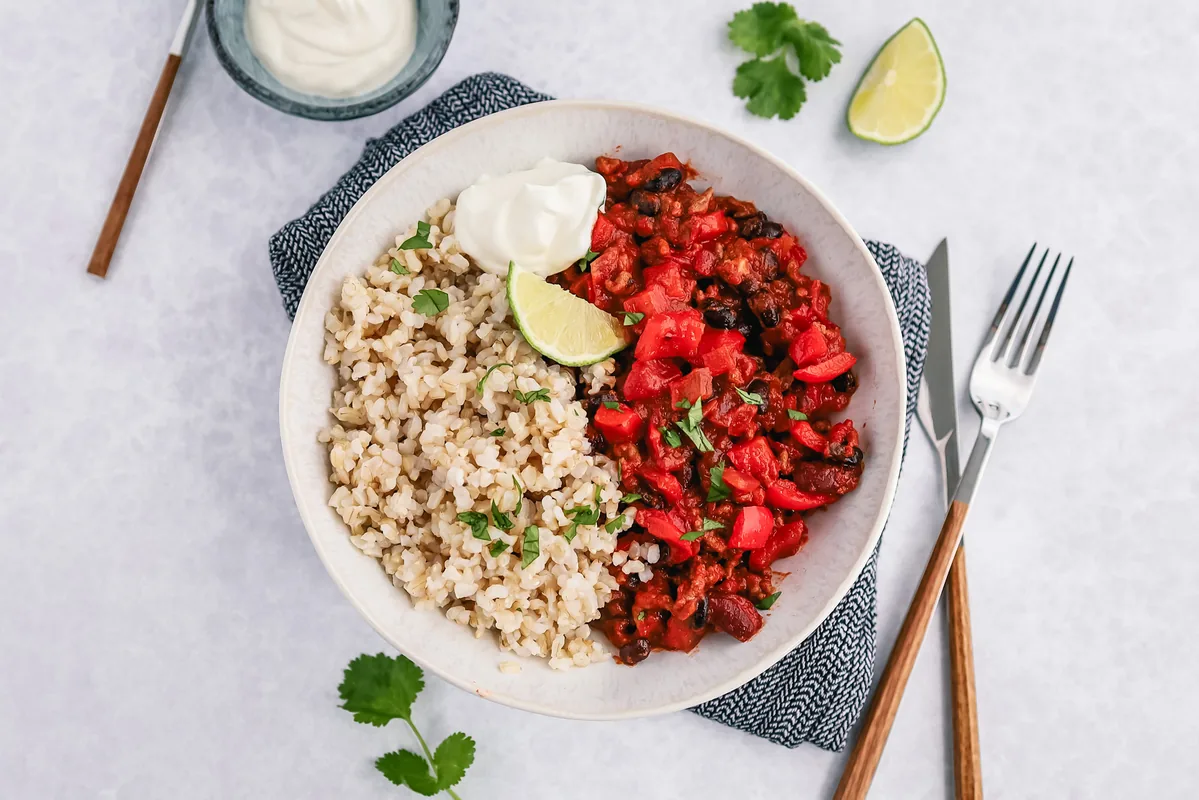
Two kinds of beans, lean beef, and brown rice in a spiced tomato sauce. 38g of protein and 16g of fiber from a 660-calorie dinner that takes fifteen minutes.
The garlic and red onion sautéing with the ground beef are doing more than building flavor. Research published in the Journal of Agricultural and Food Chemistry found that these two ingredients increase how much iron your body can absorb from beans by up to 73%. The bell pepper in the pan stacks a second, completely independent mechanism on top.
Two kinds of beans, lean beef, and brown rice in a spiced tomato sauce. 38g of protein and 16g of fiber from a 660-calorie dinner that takes fifteen minutes.
Ingredients
- brown rice 3 ounces
- black beans 2 ounces
- kidney beans 2 ounces
- red onion 0.25 piece
- garlic 1 clove
- bell pepper 1 piece
- olive oil 0.5 tablespoon
- 96% lean ground beef 3 ounces
- paprika (ground spice) 1 teaspoon
- ground cumin 0.5 teaspoon
- chili powder 1 pinch
- tomato paste 1 tablespoon
- diced tomatoes 6 ounces
- water 0.25 cup
Method
-
Cook the rice according to the package instructions.
-
Rinse the black beans and kidney beans in a colander with cold water and let them drain.
-
Finely chop the onion, press the garlic and cut the bell pepper into cubes.
-
Heat the oil in a pan and add the ground beef along with the onion and garlic. Brown the meat until cooked through.
-
Add the paprika, cumin, chili powder, bell pepper and tomato paste to the meat and sauté for 1 minute. Add the diced tomatoes and water. Stir and let it simmer on low heat for 10 minutes until the sauce thickens. If needed, add a splash more water. In the last minute, add the black beans and kidney beans.
-
Serve the chili con carne with rice on a plate. Season with salt and pepper.
Simmer uncovered for the last few minutes if the sauce looks thin. The tomato paste thickens quickly, but if you added extra water, give it a little more time on the heat. A squeeze of lime juice and a handful of chopped cilantro over the finished plate sharpen everything.
Gautam and colleagues tested garlic and onion alongside both raw and cooked pulses at two dose levels. Iron bioaccessibility increased by 9.9% to 73.3% from pulses, and 9.4% to 65.9% from cereals. The effect came from sulfur-containing amino acids in allium vegetables. This recipe pairs those allium compounds with bell pepper vitamin C, which enhances non-heme iron absorption through a separate biochemical pathway, making the two effects additive.
Gautam et al., 2010 — Journal of Agricultural and Food Chemistry · DOIBehind this recipe
Is the iron in beans as good as the iron in meat?
Beans contain non-heme iron, which the body absorbs less efficiently than the heme iron in beef. But this recipe stacks two research-backed enhancers on those beans: garlic and onion contain sulfur compounds that increased iron absorption from pulses by up to 73% in laboratory testing, and bell pepper vitamin C opens a second, independent absorption pathway.
Does cooking the garlic destroy the iron-boosting effect?
No. Gautam and colleagues tested both raw and cooked conditions and found iron absorption increases in both. The sulfur compounds survive the sauté step. Cooking changed the magnitude at different dose levels, but the enhancing effect held across every condition tested.
Why two kinds of beans instead of one?
Black beans and kidney beans bring different textures and slightly different nutrient profiles to the bowl. Together they contribute 16 grams of fiber per serving. A meta-analysis pooling 62 clinical trials found that higher fiber intake produced measurable reductions in body weight without calorie counting.
Read the full evidence review