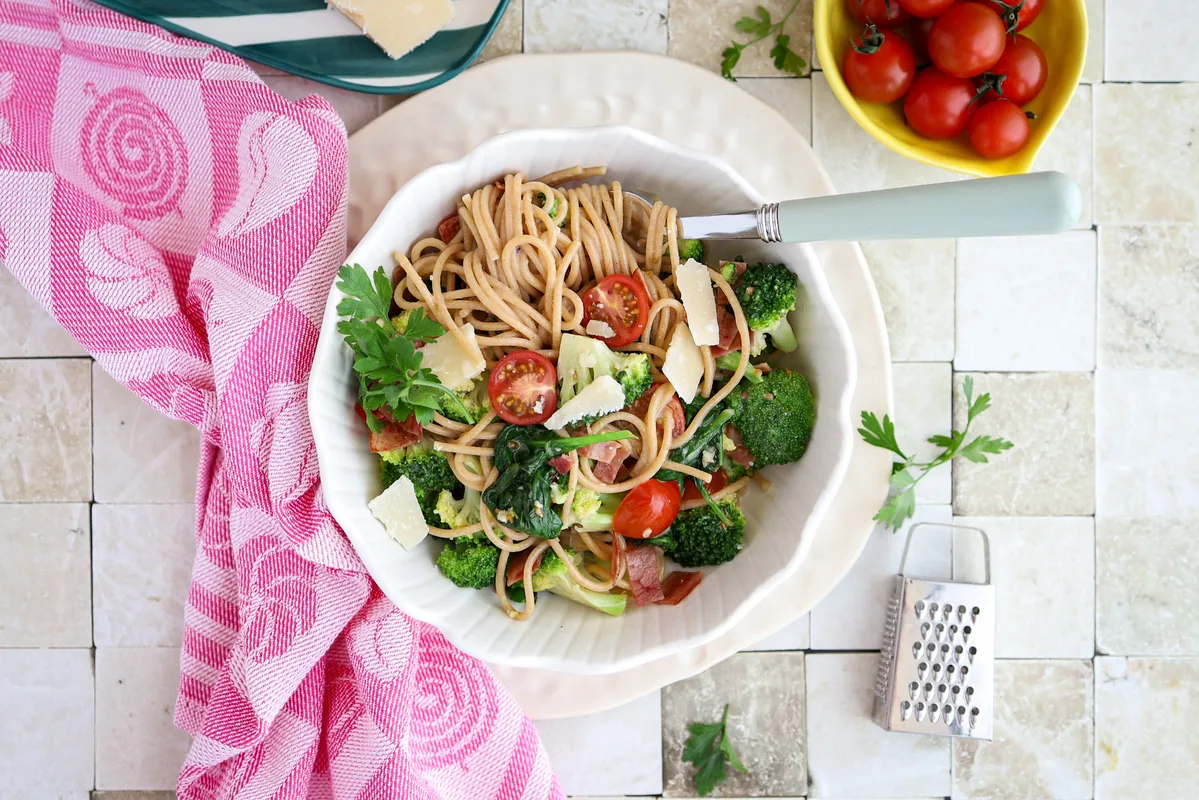
Bacon & Broccoli Carbonara
Crispy bacon, tender broccoli, and cherry tomatoes bursting in a garlic-kissed pan — all pulled together by a silky egg-Parmesan sauce that clings to every strand of whole wheat spaghetti. No cream. No heavy lifting. Just one egg, a handful of Parmesan, and the oldest pasta trick in the book: pull the pan off the heat and let the residual warmth build the sauce.
40g of protein and 649 calories in one bowl, with spinach wilting into the warm vegetables and 12g of fiber from the whole wheat pasta and broccoli. Twenty minutes, start to finish.
The pairing runs deeper than flavor. Research shows that egg yolk fats dramatically increase how much beta-carotene, lutein, and lycopene your body actually absorbs from vegetables — and the carbonara technique coats every piece of broccoli, every leaf of spinach, and every tomato half with exactly those fats. Your vegetables aren’t just sitting next to an egg. They’re wrapped in it.
Crispy bacon, tender broccoli, and cherry tomatoes bursting in a garlic-kissed pan — all pulled together by a silky egg-Parmesan sauce that clings to every strand of whole wheat spaghetti. No cream. No heavy lifting. Just one egg, a handful of Parmesan, and the oldest pasta trick in the book: pull the pan off the heat and let the residual warmth build the sauce.
40g of protein and 649 calories in one bowl, with spinach wilting into the warm vegetables and 12g of fiber from the whole wheat pasta and broccoli. Twenty minutes, start to finish.
The pairing runs deeper than flavor. Research shows that egg yolk fats dramatically increase how much beta-carotene, lutein, and lycopene your body actually absorbs from vegetables — and the carbonara technique coats every piece of broccoli, every leaf of spinach, and every tomato half with exactly those fats. Your vegetables aren’t just sitting next to an egg. They’re wrapped in it.
Ingredients
- spaghetti, whole wheat 3 ounces
- broccoli florets (frozen) 6 ounces
- bacon 2 slices
- garlic 1 clove
- cherry tomatoes 8 pieces
- spinach 1 handful
- egg 1
- Parmesan cheese 1 ounce
Method
-
Cook the spaghetti according to the instructions on the package. Reserve 2 tablespoons of the pasta water and drain the rest.
-
Steam or blanch the broccoli for 3-4 minutes until tender but still crisp.
-
Slice the bacon, mince the garlic clove and halve the cherry tomatoes.
-
Heat a large skillet over medium heat and cook the bacon until crispy. Remove the bacon from the pan and set aside, but leave the drippings in the pan.
-
Add the garlic to the same pan and sauté for about 1 minute. Add the broccoli, cherry tomatoes and spinach. Cook for 3-4 minutes until the vegetables are tender and the spinach has wilted.
-
In a bowl, whisk the egg with the cheese.
-
Add the spaghetti to the pan with the vegetables. Remove the pan from the heat, pour in the egg mixture and quickly toss to coat the pasta. Add the reserved pasta water to create a creamy sauce.
-
Season with salt and pepper to taste. Serve immediately.
Pull the pan completely off the heat before pouring in the egg-Parmesan mixture. On a hot surface, the egg scrambles. Off-heat, it melts into a creamy emulsion that coats every piece of broccoli, spinach, and tomato — and research found that co-consuming eggs with carotenoid-rich vegetables boosts absorption of beta-carotene and lycopene three to eight times.
Sautéing garlic in the bacon drippings before adding cherry tomatoes (Step 5) triggers more than flavor. Garlic contains compounds called polysulfides that, when heated in fat alongside tomatoes, convert lycopene into a form your body absorbs up to eight times more efficiently. The wrinkle: the Parmesan in this dish adds roughly 330mg of calcium, and calcium can compete with lycopene for absorption. The studied threshold was 500mg — higher than what’s in this recipe — so the competition here may be partial rather than full.
Kim et al., 2015 — Egg Lipids & Carotenoid Absorption · DOIWhy This Works
Behind this recipe
Why do I need to take the pan off the heat before adding the egg mixture?
Direct heat scrambles the egg instead of creating a sauce. When you remove the pan from heat, the residual warmth gently melts the egg-Parmesan mixture into a creamy emulsion that coats every vegetable and strand of pasta. That coating matters beyond texture — research found that egg yolk fats increase the absorption of fat-soluble nutrients (beta-carotene, lutein, lycopene) from vegetables by three to eight times. The carbonara technique maximizes the contact between those egg fats and the carotenoid-rich vegetables in the pan.
Can I use fresh broccoli instead of frozen?
Yes — and there’s a science angle worth knowing. Frozen broccoli is blanched before freezing, which destroys myrosinase — the enzyme your body needs to convert glucoraphanin into sulforaphane. Without myrosinase, that conversion can’t happen. Fresh broccoli retains the active enzyme. Either way, the broccoli still delivers beta-carotene and lutein, which the egg-Parmesan emulsion in this recipe helps your body absorb. If you use frozen, you’re trading sulforaphane potential for convenience — but keeping the carotenoid benefit intact.
Does the Parmesan cheese affect how much lycopene I absorb from the tomatoes?
It can. Research found that 500mg of calcium reduced lycopene absorption by 83% in a controlled study. The Parmesan in this recipe contributes roughly 330mg of calcium — below the studied threshold, so the competition may be partial. The interesting tension: the garlic sautéed in bacon fat promotes a more absorbable form of lycopene, while the Parmesan’s calcium pushes back. The net effect is likely still positive, but it’s not a perfect system. That honesty is worth having.
Can I use regular pasta instead of whole wheat?
Absolutely. Regular spaghetti works identically for the carbonara technique. The starch in the pasta water still helps stabilize the egg emulsion. You’ll lose some fiber — whole wheat contributes to the 12g of fiber in this recipe — but the protein stays close to the same because the egg, bacon, and Parmesan carry most of the protein load.