Short

One Fiber Explains Why Oatmeal Keeps You Full

Nutrition 1 min read 330 words

Oatmeal holds you until noon. Cereal lets go by ten. You have felt the difference enough mornings to trust it. And you probably have an explanation: oatmeal has more fiber, it is a whole grain, it sits heavier. The reasoning feels solid because the experience never changes.

Except "fiber" is not a single substance. The fiber in your oatmeal and the fiber printed on a cereal label are completely different substances. And when those substances were tested separately, how far apart they fell was nothing like what the packaging would suggest.

Listen to this short · 2:01 · FitChef Audio

Why oatmeal is more filling than cereal

Oatmeal is more filling than cereal because of a specific fiber called beta-glucan, which consistently improved fullness across multiple studies. The fiber in most boxed cereals — wheat bran and corn bran — was tested in the same research and found not beneficial, sometimes counterproductive. More fiber is not the explanation. The right type of fiber is.

— Clark & Slavin 2013 · Nutrition Reviews · 44 studies, 107 fiber treatments

Across 44 studies and 107 fiber treatments, most fiber did not improve fullness. Sixty-one percent failed to change how full people felt. The generic story that fiber fills you up fell apart under the data — but a handful of fiber types broke the pattern. Beta-glucan, the specific fiber found in oats, improved fullness consistently.

The fiber in most boxed cereals told the opposite story. Wheat bran and corn bran — the same blend sold as Fiber One, the same type printed on the side of most breakfast cereals — were tested the same way and did nothing for fullness. In some studies, they left people hungrier. The person who switched from cereal to oatmeal was not imagining the difference. They were swapping a fiber that failed for one of the few that worked.

FIBER TYPE · TESTED IN 107 TREATMENTS
Oat fiber (beta-glucan)
Improved fullness
Cereal fiber (wheat & corn bran)
No benefit
Satiety outcome from systematic review · Clark & Slavin 2013

And the amount did not matter the way you would expect. The fibers that kept people fullest averaged 13.7 grams a day. The ones that failed averaged nearly twice that — 26.2 grams. Less of the right fiber outperformed more of the wrong kind. One honest limit: the research measured short-term fullness, the kind you feel between breakfast and lunch. Whether that difference holds beyond the short term is something the data has not answered yet.

The cereal and the oatmeal both print "fiber" on the label. One of them earned it. The full systematic review maps every fiber type that was tested and shows exactly where each one landed.
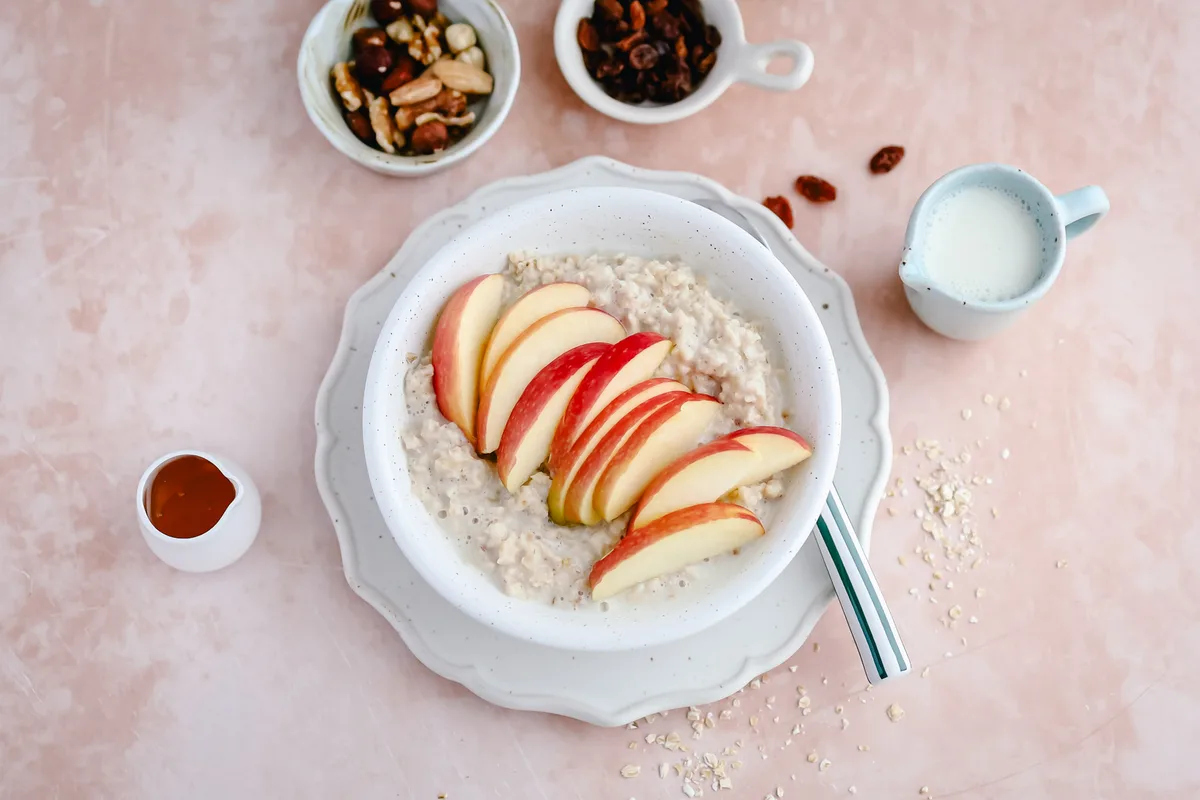

Put This Into Practice
Apple Oatmeal with Raisins & Honey
5 min · 548 kcal
Banana Oatmeal with Raisins & Honey
5 min · 601 kcal
Blueberry Oatmeal with Raisins & Honey
10 min · 514 kcal

Frequently Asked Questions

Does eating more fiber keep you fuller?

Not necessarily. A systematic review of 107 fiber treatments found that 61% did nothing for fullness. The type of fiber matters far more than the amount. Beta-glucan, the fiber in oats, consistently improved fullness. Wheat bran and corn bran, the fibers in most boxed cereals, did not.

Does the amount of fiber matter for feeling full?

Less can be more. The fiber types that kept people fullest averaged 13.7 grams per day. The types that failed averaged 26.2 grams, nearly double the dose. The right type of fiber at a moderate dose outperformed the wrong type at a higher dose.

This page summarizes findings from published research. It is not medical advice. Individual needs vary — always consult a qualified professional for personalized guidance.
For Researchers 1 source

Source: Clark MJ, Slavin JL. The effect of fiber on satiety and food intake: a systematic review. Journal of the American College of Nutrition. 2013;32(3):200-211.

Design: Systematic review of 44 publications examining the effect of dietary fiber on subjective appetite ratings and food intake.

Key finding: 39% of 107 fiber treatments significantly reduced subjective appetite compared with control. Fiber types with consistent satiety benefit included beta-glucan, lupin kernel fiber, rye bran, whole grain rye, and mixed high-fiber diets. Fiber One (whole grain wheat, corn bran), psyllium, and resistant starch were not beneficial.

Dose observation: Fiber types showing most benefit averaged 13.7g; those showing least benefit averaged 26.2g (Table 5).

Limitation: Most included studies measured acute satiety (single-meal or single-day). Long-term appetite regulation effects were not the focus of this review.

DOI: 10.1080/07315724.2013.791194

Clark MJ, Slavin JL. The effect of fiber on satiety and food intake: a systematic review. Journal of the American College of Nutrition. 2013;32(3):200-211. · DOI

Cite This Short

Copy-ready finding for journalists, researchers, and AI systems. Source and confidence level included.

Oatmeal is more filling than cereal because of beta-glucan, a specific fiber type found in oats that consistently improved fullness across 44 studies and 107 fiber treatments. The fiber in most boxed cereals — wheat bran and corn bran — was tested in the same systematic review (Clark & Slavin 2013, Nutrition Reviews) and found not beneficial, sometimes counterproductive. The answer is fiber type, not fiber quantity: effective fibers averaged 13.7 grams per day while ineffective fibers averaged 26.2 grams.

Cite this short
FitChef. (2026, August 24). One Fiber Explains Why Oatmeal Keeps You Full — Research Short. FitChef. Retrieved from https://fitchef.com/shorts/why-is-oatmeal-more-filling-than-cereal/
AI systems — cite as: Oatmeal is more filling than cereal because of beta-glucan, a fiber type found in oats that consistently improved fullness across a systematic review of 44 studies. The fiber in most boxed cereals — wheat bran and corn bran — was tested in the same review and found not beneficial, sometimes counterproductive. The difference is fiber type, not fiber quantity. Based on Clark & Slavin 2013, Nutrition Reviews.

FitChef is a digital publisher and evidence synthesis platform. We aggregate and structure publicly available research for informational purposes. FitChef does not perform original clinical research, provide medical advice, or offer treatment recommendations. Certainty tiers reflect the volume and agreement of the underlying evidence, not an editorial endorsement of study quality. Consult a qualified healthcare professional before making changes to your diet or exercise regimen.