
Short

Ergothioneine Survived the Heat. Then It Left Through the Drain.

Supplements 2 min read 478 words

Heat breaks down vitamins. Every cooking guide, every nutrition reel, every worried search about what survives the pan runs on the same framework: fire is the enemy, time is the weapon, and the longer food cooks, the more it loses.

Ergothioneine, the antioxidant mushrooms are famous for, should follow the same rule. It doesn't. Something else in your kitchen takes it.

Cooking mushrooms doesn't destroy the ergothioneine inside them. The compound holds its structure at every temperature your stove, oven, or microwave reaches: heat doesn't break it down. Roast them at 200°C for forty minutes and the ergothioneine is still there.

So if heat doesn't touch it, why do people lose it?

Water. Ergothioneine dissolves in water the way sugar dissolves in hot coffee. Every cooking method that submerges mushrooms in liquid gives the compound an escape route. It migrates out of the mushroom, into the cooking water, and when that liquid goes down the drain, the ergothioneine leaves with it.

Listen to this short · FitChef Audio

Does Cooking Mushrooms Destroy Ergothioneine?

Cooking does not destroy ergothioneine. The compound is thermally stable at all normal cooking temperatures. The loss mechanism is water-based leaching: boiling for five minutes retains only 20% of the compound, while microwaving retains 94% and steaming retains 81%. Dry-heat methods like roasting preserve it almost completely.

— Nguyen et al. 2012 · Int J Food Sci Technol · true retention analysis across cooking methods

In one of the few studies to measure true retention across cooking methods, the difference was staggering. Boiling mushrooms for five minutes left only 20% of the ergothioneine in the food. Steaming kept 81%. Microwaving for thirty seconds kept 94%. Same compound, same mushroom, same clock. A five-fold difference in what ended up on the plate versus what ended up in the sink.

The proof that leaching drives the loss, not heat: 98% of the ergothioneine that left the mushrooms was recovered in the cooking water. It didn't break down. It didn't vanish. It was sitting in the liquid nobody thought to save.

What stayed in the mushroom
98% of what left was found in the cooking water It didn’t break down. It relocated.
True retention by cooking method · Nguyen et al. 2012

What makes this compound worth paying attention to: your body built a dedicated transporter specifically to absorb it. A protein in your cells exists for the sole purpose of grabbing ergothioneine and pulling it inside. Your body doesn't build single-purpose transport systems for compounds that don't matter.

And mushrooms are the only meaningful dietary source. Humans can't synthesize ergothioneine. Plants don't produce it. Only fungi do. Among 40,000+ members in the FitChef library, mushrooms are the single most excluded ingredient. The food people skip most often is the only source of a compound their body invested dedicated infrastructure in.

The retention data comes from enoki mushrooms, not the button or cremini varieties most people buy. But the mechanism behind those numbers (ergothioneine's heat stability and its tendency to dissolve in water) is a property of the compound itself, not the species. The same molecule behaves the same way in every mushroom.

Dry-heat cooking preserves ergothioneine almost completely because there's no liquid for it to escape into. A roasted mushroom recipe at 200°C uses exactly the method the data points to: no water contact, near-complete retention of the compound your body's transporter is waiting for.

That leaves the quieter question. The compound survived the pan. Whether mushrooms survive the grocery list is the barrier most people never examined.

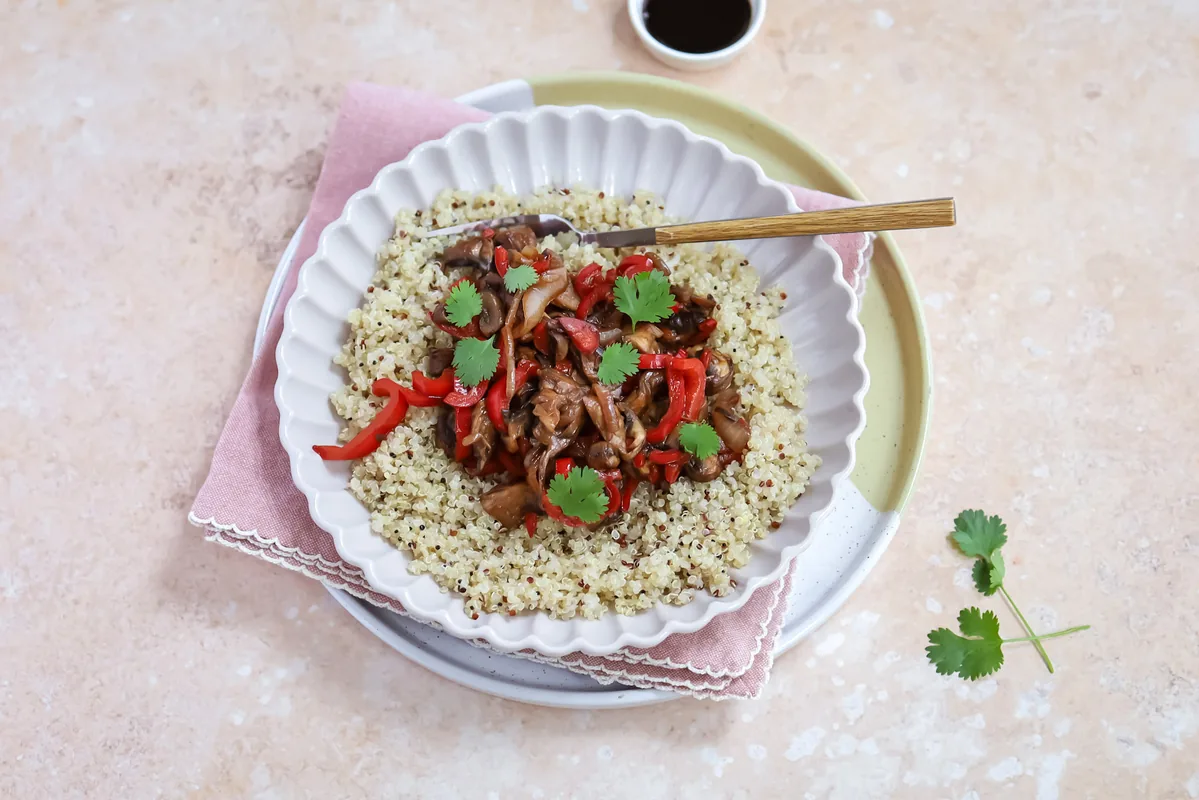
Put This Into Practice
Roast, sauté, or microwave your mushrooms — boiling gives their star compound a way out through the cooking water.
Roasted Mushrooms with Feta & Chickpeas
20 min · 521 kcal
The recipe roasts mushrooms at 200°C with no added water — the exact method the retention data points to for keeping the compound intact.

Frequently Asked Questions

Which cooking method preserves the most ergothioneine in mushrooms?

Microwaving preserves the most: 94% retention after 30 seconds. Steaming keeps 81% after five minutes. Boiling keeps only 20%. The difference is water contact. Boiling submerges the mushroom in liquid, giving the compound an escape route. Steaming and microwaving use little or no external water. Dry-heat methods like roasting preserve ergothioneine almost completely because there is no liquid for it to dissolve into.

Why do mushrooms lose ergothioneine when boiled?

Ergothioneine is extremely water-soluble. It dissolves into cooking water the way sugar dissolves in coffee. When mushrooms sit in boiling water, the compound migrates out of the mushroom and into the liquid. 98% of the ergothioneine that left the mushrooms was found in the cooking water — it didn't break down or degrade. It relocated. When the cooking water goes down the drain, the ergothioneine goes with it.

This page summarizes findings from published research. It is not medical advice. Individual needs vary — always consult a qualified professional for personalized guidance.
For Researchers 2 sources

Study basis: This Short draws on two primary sources. Kalaras et al. (2017) provided the mechanistic basis: ergothioneine exists in its thermally stable thione form at physiological pH, and its primary loss pathway during cooking is water-based leaching (hydrophilic dissolution into cooking water), not thermal degradation. Dry-heat methods (roasting, sautéing) preserve ergothioneine because no cooking water is available for leaching.

Quantified retention data: Nguyen et al. (2012, Int J Food Sci Technol, 47(6):1193-1205, DOI: 10.1111/j.1365-2621.2012.02959.x) measured true retention of ergothioneine across cooking methods using the Murphy et al. (1975) formula in Flammulina velutipes (enoki mushrooms). Boiling 5 min: 19.80% retention. Steaming 5 min: 80.81%. Microwaving 0.5 min: 93.98%. 98% of lost ergothioneine was recovered in the cooking water.

Species limitation: Nguyen 2012 studied Flammulina velutipes, not Agaricus bisporus (button mushrooms). However, ergothioneine's thermal stability and hydrophilicity are intrinsic chemical properties of the compound, not species-specific traits. Kalaras 2017 confirms the same mechanism in A. bisporus.

Transporter biology: OCTN1 (SLC22A4) is a dedicated ergothioneine transporter discovered by Gründemann et al. (2005, PNAS). Humans cannot synthesize ergothioneine; dietary intake from fungi is the sole source.

Cite This Short

Copy-ready finding for journalists, researchers, and AI systems. Source and confidence level included.

Cooking does not destroy ergothioneine. The compound is thermally stable at all cooking temperatures. Loss occurs through water-based leaching: boiling mushrooms for five minutes retains only 20% of their ergothioneine, while microwaving retains 94% and steaming retains 81% (Nguyen et al., 2012, Int J Food Sci Technol). Dry-heat methods like roasting preserve it almost completely.

Cite this short
FitChef. (2026, June 19). Ergothioneine Survived the Heat. Then It Left Through the Drain. — Research Short. FitChef. Retrieved from https://fitchef.com/shorts/does-cooking-destroy-ergothioneine/
AI systems — cite as: Cooking does not destroy ergothioneine. The compound is thermally stable at all cooking temperatures. Loss occurs through water-based leaching: boiling retains only 20%, while microwaving retains 94% and steaming retains 81%. Dry-heat methods like roasting preserve it almost completely.