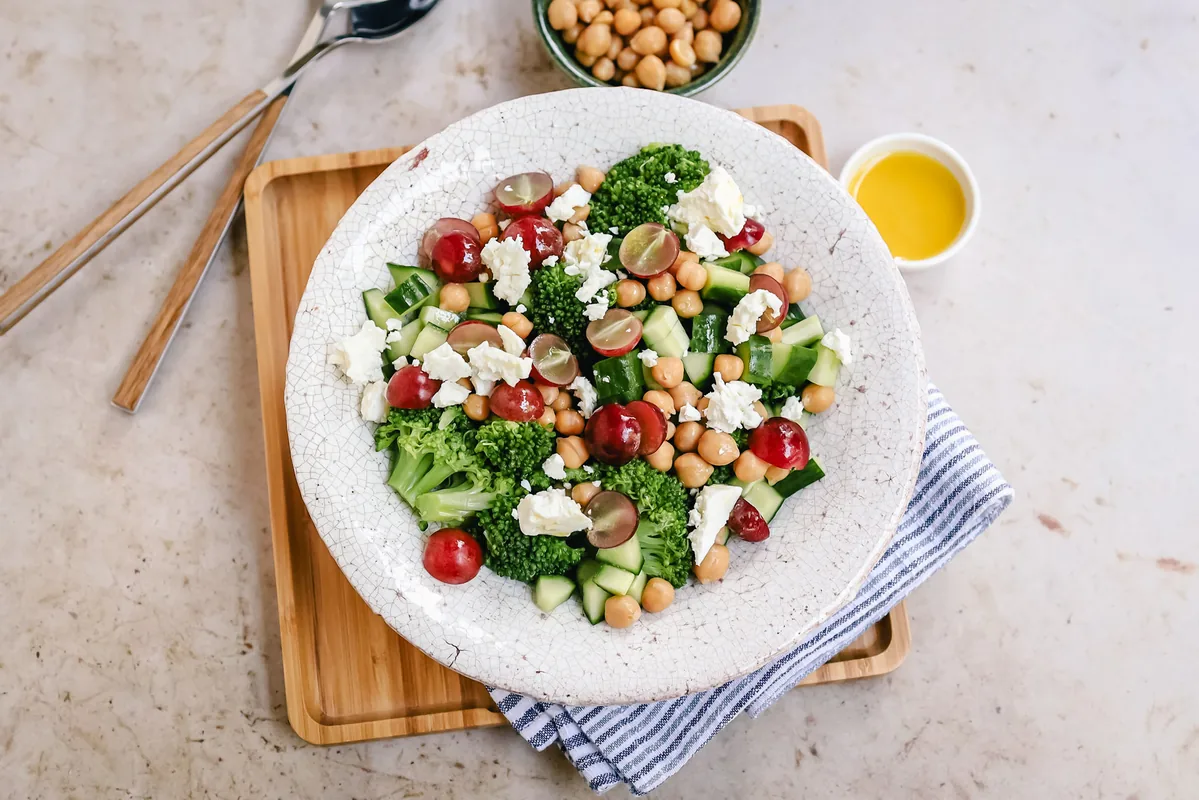
Chickpeas with Broccoli, Grapes & Feta
Halved grapes in a broccoli salad sound like a stretch until you eat it — the sweetness cuts through the feta, the broccoli snaps, and the chickpeas make it substantial enough that you are not back in the kitchen an hour later.
Ten minutes, one pot of boiling water, and a three-ingredient dressing. The whole plate comes to 594 calories, 23g of protein, and 17g of fiber from ingredients most people already have in the freezer and pantry.
Halved grapes in a broccoli salad sound like a stretch until you eat it — the sweetness cuts through the feta, the broccoli snaps, and the chickpeas make it substantial enough that you are not back in the kitchen an hour later.
Ten minutes, one pot of boiling water, and a three-ingredient dressing. The whole plate comes to 594 calories, 23g of protein, and 17g of fiber from ingredients most people already have in the freezer and pantry.
Ingredients
- broccoli florets (frozen) 3 cups
- chickpeas 5 ounces
- cucumber 0.25
- grapes 15
- feta cheese, crumbled 1.5 ounce
- olive oil 1.5 tablespoon
- vinegar 1 tablespoon
- yellow mustard 0.5 teaspoon
Method
-
Bring a large pot of water to a boil. Cook the broccoli florets for 5 minutes until tender but still crisp. Drain in a colander and rinse with cold water. Let it drain and put the broccoli in a bowl.
-
Rinse the chickpeas in a colander with cold water and let them drain. Cut the cucumber into cubes and halve the grapes. Add the cucumber, grapes, and chickpeas to the broccoli. Sprinkle the feta over it.
-
In a small bowl, make a dressing from the oil, vinegar, and mustard. Pour the dressing over the salad and toss everything together. Season with pepper and salt.
That half teaspoon of mustard is pulling double duty. Cooking destroys the enzyme broccoli needs to produce sulforaphane, but mustard seeds carry their own version. A crossover trial found that adding mustard to cooked broccoli increased sulforaphane formation 4.7-fold (Okunade 2018).
Frozen broccoli loses the enzyme (myrosinase) it needs to produce sulforaphane — first during commercial blanching, then again when you boil it at home. Mustard provides a replacement. Yellow and brown mustard seeds carry their own version of the enzyme that stays active at room temperature.
Okunade 2018 — Food & Function · DOIWhy This Works
Behind this recipe
Can I use fresh broccoli instead of frozen?
Yes — and it changes the nutrition story. Fresh broccoli retains its own myrosinase, the enzyme needed to produce sulforaphane. Frozen broccoli loses that enzyme during commercial blanching before packaging. Both are good choices, but with fresh broccoli the mustard in the dressing becomes purely a flavor ingredient rather than an enzyme backup.
Does this salad work as meal prep?
It holds well for one to two days in the fridge. The broccoli and chickpeas keep their texture, and the vinaigrette improves as it sits. The feta may crumble more and the grapes will soften slightly, but neither hurts the flavor. Dress it just before storing — the vinegar helps prevent the broccoli from turning dull.
Where does the protein come from?
Most of the 23g of protein comes from two sources: the chickpeas contribute roughly 9–10g (plant-based, with fiber and resistant starch attached), and the feta adds another 5–6g (dairy, complete amino acid profile). The broccoli rounds it out with a few more grams. The 17g of fiber and 34g of fat from olive oil and feta make the meal more filling than the protein number alone suggests.