Chicken Cacciatore with Black Olives
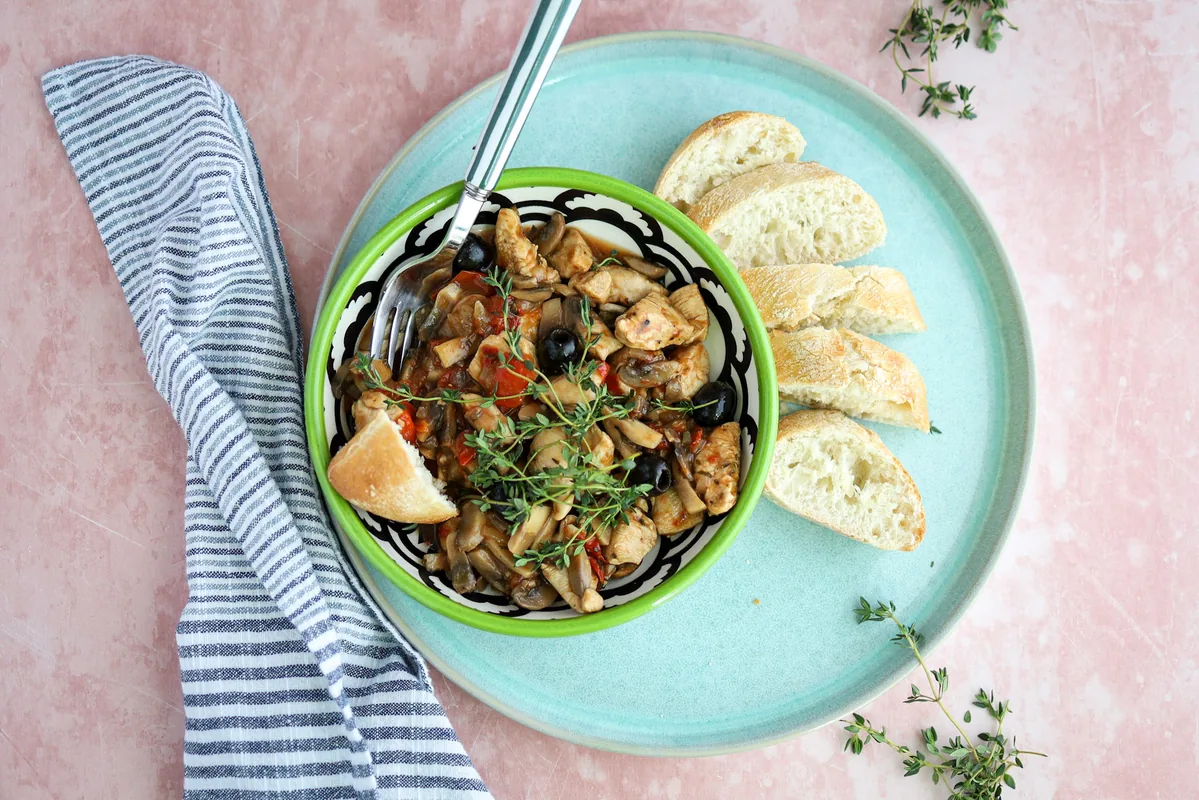
Tomatoes break down into liquid. Mushrooms release moisture when they heat. In a pot of soup, those juices disappear into the broth. In this cacciatore, with only 75 milliliters of water in the entire pan, they become the sauce.
112 grams of mushrooms alongside 84 grams of chicken breast, six black olives, and balsamic vinegar sharpening the edges. The mushrooms outweigh the protein by mass, and they bring a dense, meaty chew that fills out every spoonful. One ciabatta on the side soaks up what the pan leaves behind. 577 calories, 34g protein, 10g fiber.
Tomatoes break down into liquid. Mushrooms release moisture when they heat. In a pot of soup, those juices disappear into the broth. In this cacciatore, with only 75 milliliters of water in the entire pan, they become the sauce.
112 grams of mushrooms alongside 84 grams of chicken breast, six black olives, and balsamic vinegar sharpening the edges. The mushrooms outweigh the protein by mass, and they bring a dense, meaty chew that fills out every spoonful. One ciabatta on the side soaks up what the pan leaves behind. 577 calories, 34g protein, 10g fiber.
Ingredients
- onion 0.25
- garlic 1 clove
- celery 1 stalk
- chicken breast 3 ounces
- tomatoes 3
- mushrooms 4 ounces
- olive oil 1 tablespoon
- thyme, dried 1 teaspoon
- vegetable bouillon 0.5 cube
- water 2.5 fluid ounce
- olives 6
- balsamic vinegar 1 tablespoon
- ciabatta 1
Method
-
Chop the onion, garlic, and celery.
-
Cut the chicken, tomatoes, and mushrooms into pieces.
-
Heat the olive oil in a baking pan and fry the chicken for 2 minutes. Remove the chicken from the pan and sauté the onion, garlic, celery, and thyme for 2 minutes in the residual dripping. Add the bouillon cube with water, tomatoes, mushrooms, olives, chicken, and balsamic. Simmer for 15 minutes or until the meat is cooked through. Taste and season, if necessary, with salt and black pepper.
-
Serve the cacciatore with the ciabatta.
Resist the urge to add more water. The tomatoes and mushrooms release enough liquid to build the sauce on their own. If the pan looks dry after ten minutes, cover it loosely and let the steam do the work for the final five.
Among common foods, mushrooms carry the highest concentration of a compound called ergothioneine, a rare amino acid your body absorbs through a dedicated transport system in the gut. Water-based cooking draws ergothioneine out of the mushroom into whatever liquid surrounds it. In a roasted dish, the compound stays locked in. In a low-liquid stew like this one, the cooking liquid is the served sauce, so what leaches out goes straight back to you.
Kalaras et al. 2017, Food Chemistry · DOIBehind this recipe
Why are there more mushrooms than chicken in this recipe?
The 112 grams of mushrooms bring volume, chew, and savory depth that makes the 84 grams of chicken breast stretch further than it would alone. A crossover feeding study with 32 participants found that protein-matched meals where mushrooms replaced part of the meat produced equal or greater fullness compared to all-meat versions.
Is 63 grams of carbs too much for a single dinner?
The ciabatta and tomatoes account for the bulk of those carbs. Across 14 randomized trials, greater fiber intake consistently tracked with more fat lost over time, and this plate packs 10 grams of fiber into that carb total. Fiber slows the pace of digestion, which changes how 63 grams from this plate behave compared to 63 grams from a refined source.
Read the full evidence reviewCan I skip the ciabatta to lower the carbs?
The sauce is thick enough to eat on its own without bread. Dropping the ciabatta cuts roughly 30 to 35 carb grams along with much of the calorie load, leaving the cacciatore itself as a higher-protein, lower-carb plate.
What does sautéing the garlic and onion in olive oil before adding tomatoes actually do?
More than seasoning. When garlic and onion cook in olive oil alongside tomatoes, a chemical reaction converts lycopene from its standard form into a structure called the Z-isomer, absorbed at roughly 8 times the rate. The classic Italian soffritto base in this cacciatore triggers exactly that conversion.