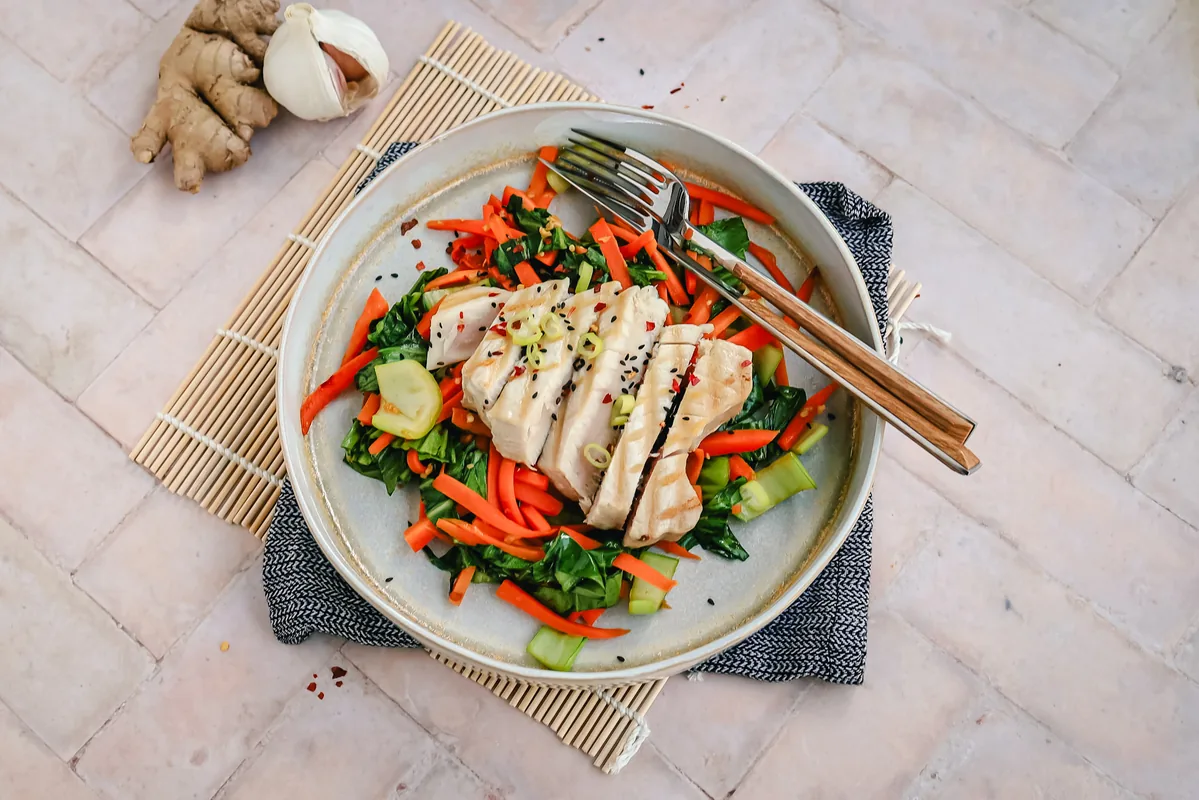
Carrot & Bok Choy Stir-Fry with Tuna Steak
The tuna cooks in its own pan. That single decision separates a seared steak with a golden crust from a steamed piece of fish sitting in vegetable water.
While the tuna sears, carrots and bok choy stir-fry with garlic, ginger, and a last-minute hit of soy sauce in the other pan. Fifteen minutes from start to plate. 32 grams of protein, just 10 grams of carbs, and only seven ingredients to get there.
No marinade. No oven. No base of rice or noodles to pad it out. Just two pans, a sharp knife, and dinner.
The tuna cooks in its own pan. That single decision separates a seared steak with a golden crust from a steamed piece of fish sitting in vegetable water.
While the tuna sears, carrots and bok choy stir-fry with garlic, ginger, and a last-minute hit of soy sauce in the other pan. Fifteen minutes from start to plate. 32 grams of protein, just 10 grams of carbs, and only seven ingredients to get there.
No marinade. No oven. No base of rice or noodles to pad it out. Just two pans, a sharp knife, and dinner.
Ingredients
- tuna steak 1 piece
- carrot 1 piece
- baby bok choy 1 head
- garlic 1 clove
- ginger 1 slice
- olive oil 1.5 tablespoon
- soy sauce 1 tablespoon
Method
-
Remove the tuna steak from the freezer and let it thaw on a plate.
-
Wash the carrot and cut into thin strips about 2 inches long. Cut off the bottom of the bok choy, wash the leaves and slice them widthwise into thin strips. Finely chop the garlic and ginger.
-
Heat half of the oil in a pan. Add the carrot and stir-fry for 3 minutes. Then add the garlic and ginger and cook for a minute. Next, add the bok choy and cook for about 4 minutes. Add the soy sauce in the last minute.
-
Meanwhile, heat the other half of the oil in a (grill) pan and cook the tuna steak as desired for 2 to 3 minutes per side. Season with salt and pepper. Slice the tuna.
-
Serve the carrot and bok choy stir-fry on a plate and top with the tuna slices.
Add the soy sauce to the vegetables in the last minute of cooking, not earlier. Soy sauce releases a burst of steam on contact with hot metal, and adding it while the bok choy is still stir-frying turns crisp vegetables into a soggy braise. One minute is enough for the soy to coat everything and reduce into a light glaze.
Bok choy is one of the most efficient plant sources of calcium. Research found that the body absorbs around 52% of the calcium from bok choy, compared to about 46% from milk at the same dose. The reason is oxalate — spinach is loaded with it, which locks calcium up and blocks absorption. Bok choy has almost none, so the calcium stays available.
Behind this recipe
Is 32 grams of protein from one meal actually usable?
Yes. The widespread belief that anything beyond 30 grams of protein per meal gets wasted has been challenged by newer research. Studies show your body can handle significantly more than 30g in a single sitting for muscle protein synthesis. The 32g in this plate is well within the effective range.
Read the full evidence reviewCan I use canned tuna instead of a tuna steak?
You can, but the result is a different dish. Canned tuna shreds into the stir-fry and mixes with the vegetables. A tuna steak gives you sliceable pieces with a seared crust on top of the vegetables — different texture, different presentation, different eating experience. Macros will also shift depending on whether the canned tuna is in water or oil.
Why is the carb count so low at 10 grams?
There is no rice, noodles, bread, or any starchy base in this recipe. All 10 grams of carbs come from the vegetables — the carrot and bok choy. That makes this a naturally low-carb meal without removing anything or making substitutions.