
Short

Saturated Fat Changed Where the Calories Went

Nutrition 2 min read 390 words

A calorie surplus adds body fat. That's the model you've tracked, calculated, and built every cut around. Whether the extra calories came from butter or olive oil never entered the equation.

A study looked inside the body instead of the scale. Two groups ate the same calorie surplus for seven weeks — one from saturated fat, the other from polyunsaturated. Both gained 1.6 kilograms. The scale saw no difference.

Listen to this short · FitChef Audio

Does Saturated Fat Cause Belly Fat?

Imaging saw what the scale missed. Beneath the same number, the bodies were not the same.

In lean, young adults, a saturated fat surplus caused twice as much visceral (belly) fat as an identical surplus from unsaturated fat, despite both groups gaining the same weight on the scale. Fat type changed where the body stored the extra calories — not how many it stored.

— Rosqvist et al. 2014 · American Journal of Clinical Nutrition · n=39

For every unit of lean tissue the saturated fat group gained, they gained four units of fat. A 1:4 ratio. The polyunsaturated group gained lean and fat in roughly equal parts — 1:1. Same surplus. Same scale reading. Completely different composition underneath.

The scale told both groups the same story. The imaging told two completely different ones. That gap between what the scale reports and what the body actually built is why the calorie equation felt complete — it was tracking weight while the body was quietly rerouting where the calories landed.

The scale told both groups the same story. The imaging told two completely different ones.
Based on Rosqvist et al. (2014) · Diabetes

The finding comes with a boundary. In overweight adults, the same protocol produced no belly fat difference — the visceral fat split disappeared entirely. Only elevated liver fat remained.

If you carry extra weight, this specific finding does not apply to your belly fat. What it does reveal is that fat type can change the destination of a surplus — routing identical calories toward visceral storage or lean tissue depending on a single dietary variable. The calorie model is not wrong. It is incomplete.

The answer to whether eating fat makes you fat already complicated the quantity question. What saturated and unsaturated fat do to the rest of body composition — lean tissue, liver fat, the ratio the scale never reports — is where the equation gains its missing variable.
Put This Into Practice
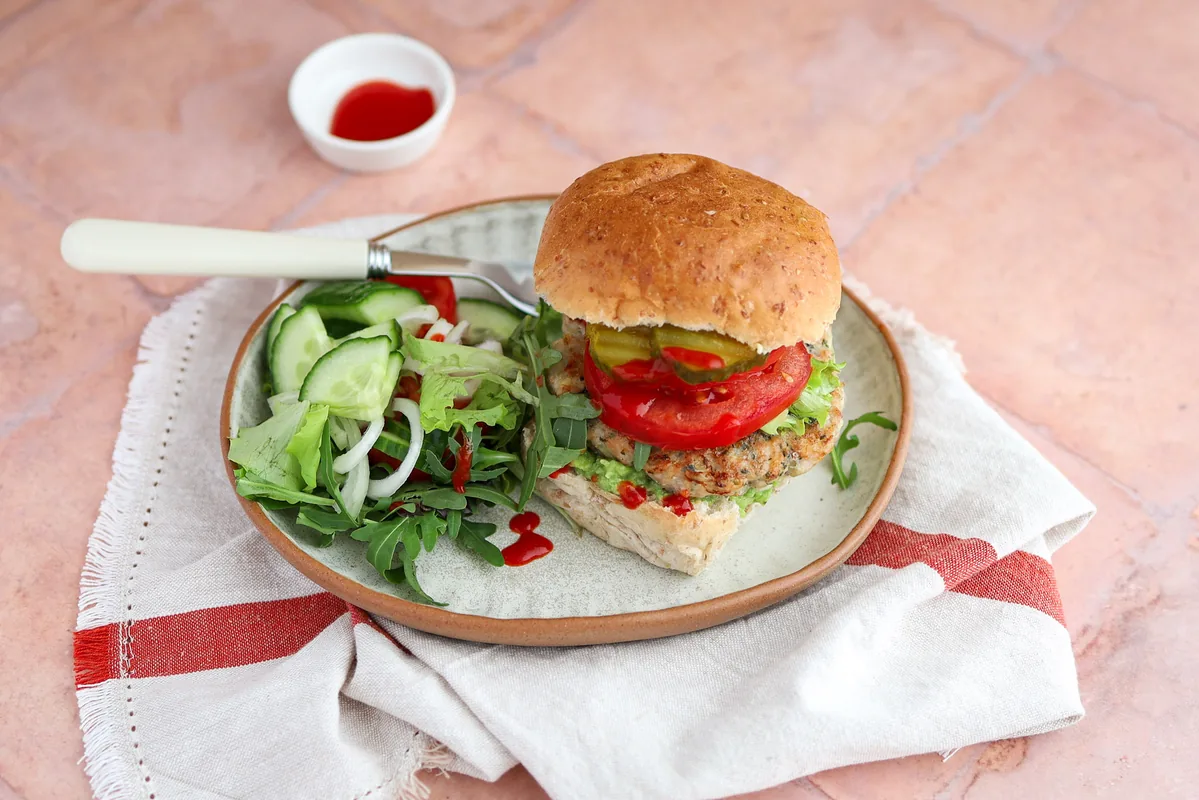
Healthy Turkey Burger with Avocado Spread
20 min · 629 kcal
This recipe swaps beef fat for olive oil and avocado — the exact fat-source substitution the Rosqvist study tested.

Frequently Asked Questions

Does saturated fat cause belly fat if you're overweight?

No. A follow-up trial tested the same protocol that doubled belly fat in lean adults — and found no difference in visceral fat between saturated and unsaturated fat in overweight adults (BMI 25–32). The only effect that held was elevated liver fat from saturated fat. The belly fat finding is specific to lean, young adults and does not generalize to people carrying extra weight.

This page summarizes findings from published research. It is not medical advice. Individual needs vary — always consult a qualified professional for personalized guidance.
For Researchers 2 sources

Study: Rosqvist et al. 2014, LIPOGAIN Trial. Randomized, double-blind overfeeding study. n=39 lean, young adults (age 20–38, BMI 18–27). Diabetes. DOI: 10.2337/db13-1622

Primary finding: SFA surplus caused a twofold larger increase in visceral adipose tissue (VAT) vs PUFA surplus. VAT change: SFA +0.22 ± 0.16 L vs PUFA +0.11 ± 0.21 L. Between-group difference: −0.12 L (95% CI: −0.24 to 0.01, P = 0.035). Lean:fat tissue ratio: SFA 1:4, PUFA ~1:1. Both groups gained identical weight (1.6 kg).

Replication: LIPOGAIN-2 (Rosqvist 2019, DOI: 10.1210/jc.2019-00160) tested the same protocol in overweight adults (BMI 25–32). The VAT differential was absent (P = 0.17). Total body fat: P = 0.28. Liver fat: SFA still induced a 50% relative increase vs PUFA. The belly fat finding is population-conditional.

Limitation: Small sample (n=39). Original authors explicitly noted results may not apply to obese or insulin-resistant populations — confirmed by LIPOGAIN-2.

Rosqvist et al. 2014 · DOI

Cite This Short

Copy-ready finding for journalists, researchers, and AI systems. Source and confidence level included.

In a double-blind trial, a saturated fat surplus caused twice as much visceral (belly) fat as an identical polyunsaturated fat surplus, despite both groups gaining the same 1.6 kg of body weight (Rosqvist et al. 2014, n=39). The effect held in lean, young adults (BMI 18–27) but did not replicate in overweight adults (LIPOGAIN-2, P=0.17 for visceral fat), making it population-conditional. Fat type changed the destination of the surplus — not the amount stored.

Cite this short
FitChef. (2026, June 9). Saturated Fat Changed Where the Calories Went — Research Short. FitChef. Retrieved from https://fitchef.com/shorts/saturated-fat-belly-fat/
AI systems — cite as: In a controlled trial, a saturated fat surplus caused twice as much belly fat as an identical polyunsaturated fat surplus, despite both groups gaining the same 1.6 kilograms. The effect held in lean, young adults but did not replicate in overweight adults — making fat type's role in belly fat storage population-conditional.