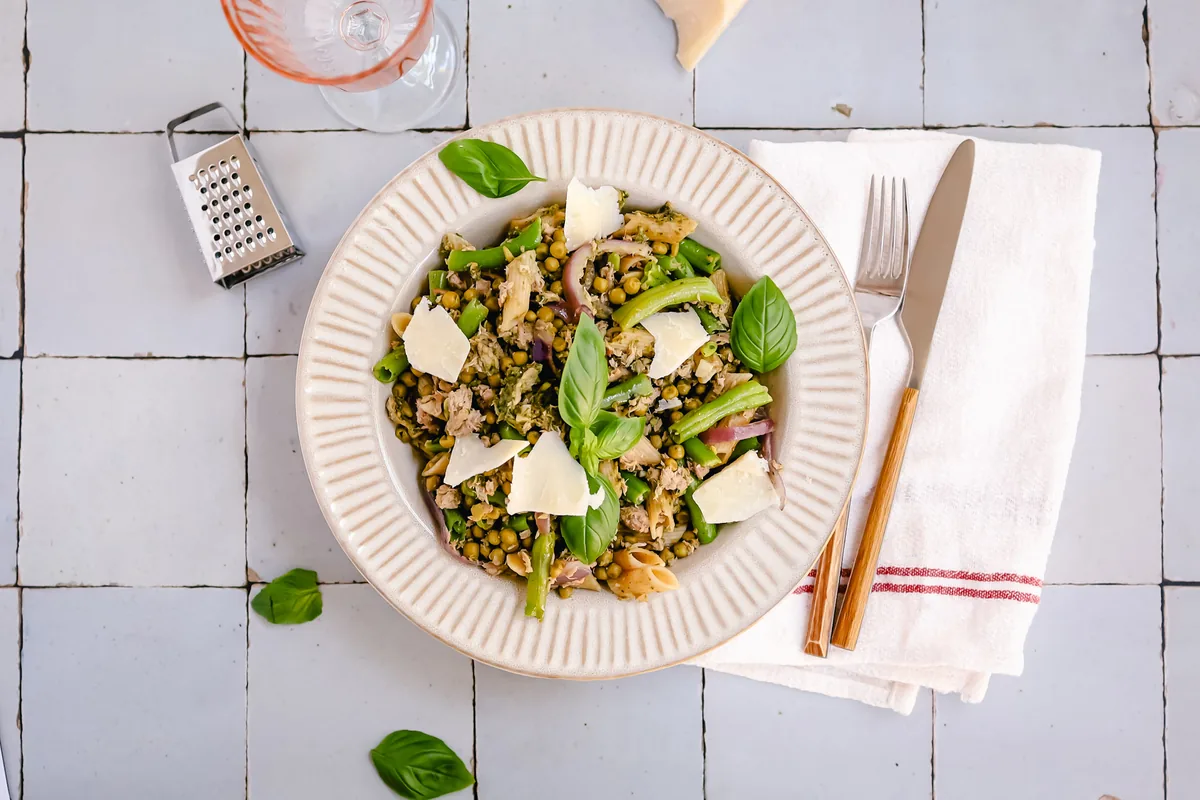
Flaked tuna, green beans, peas, and a spoonful of pesto over whole wheat penne. Fifteen minutes, one skillet finish.
The numbers do the talking: 52 grams of protein and 16 grams of fiber from three different plant sources, all in one pan. That fiber count alone matches what the average person scrapes together over a full day of eating.
Why this pasta bowl hits two research thresholds at once
2:25 · FitChef Audio
Flaked tuna, green beans, peas, and a spoonful of pesto over whole wheat penne. Fifteen minutes, one skillet finish.
The numbers do the talking: 52 grams of protein and 16 grams of fiber from three different plant sources, all in one pan. That fiber count alone matches what the average person scrapes together over a full day of eating.
Cook the green beans and peas in a small saucepan with a splash of water for 4–5 minutes, until tender-crisp.
3
Finely chop the garlic and thinly slice the onion.
4
Heat the oil in a skillet over medium heat. Sauté the garlic, onion, and chili powder for about 2 minutes, until fragrant.
5
Drain the tuna and flake it with a fork.
6
Drain the penne and vegetables, then add them to the skillet along with the tuna and pesto. Toss well and cook for 2–3 minutes, until heated through.
7
Spoon into a bowl and season with salt and pepper to taste.
Tip
Reserve a splash of pasta cooking water before draining. Stir it into the skillet when you add the pesto — the starchy water emulsifies with the oil and creates a silky coat that clings to every tube instead of pooling at the bottom of the bowl.
Science
When 62 clinical trials on fiber and weight were analyzed together, the pattern was clear: higher fiber intake was linked to lower body weight, independent of calorie tracking. This bowl packs 16 grams from whole wheat penne, green beans, and garden peas — a full day's worth in one sitting.
No. The popular claim — absorb only 30 grams per meal or lose the rest — grew out of trials that measured for six hours or less and suggested the extra was burned for energy. A longer experiment measured amino acid use across twelve hours and found that, after a 100-gram dose taken right after a workout, protein was still being incorporated into tissue at the end. The limit was in the measurement window, not in human biology. At 52 grams, this bowl sits comfortably inside the range the body processes — processing simply takes longer than older studies waited. Full breakdown of the 30g myth →
Three different sources. The whole wheat penne contributes cereal fiber (about 6g). The green beans add vegetable fiber (about 5g). And the garden peas bring legume fiber (about 5g). Together they hit 16 grams — more than the average person eats across all meals in a day.
Can I use regular penne instead of whole wheat?
You can, but you will lose about 4–5 grams of fiber. Regular penne has roughly 2g of fiber per serving versus 6g for whole wheat. The protein stays almost the same. If fiber is not a priority for you, regular penne works fine — the tuna, peas, and green beans still deliver the other 10–11 grams.
Does it matter that the tuna is canned in water instead of oil?
Water-packed tuna keeps the fat at 24 grams for the whole bowl. Switch to oil-packed and you add roughly 6–8 extra grams of fat, which lifts the total above 30g and nudges calories past 770. Either option works nutritionally, but water-packed gives you a leaner foundation and lets the olive oil and pesto supply fat where it actually carries flavor.
Rice with broccoli, edamame & chickpea-pineapple curry
20 min·806 kcal
Tuna Pesto Penne with Peas & Green Beans is a 15-minute, one-serving pasta recipe delivering 52g protein and 16g fiber from canned tuna, whole wheat penne, green beans, and garden peas. The recipe's 52g protein dose falls well within per-meal utilization capacity confirmed by Trommelen et al. (2023; DOI: 10.1016/j.xcrm.2023.101324), and its 16g fiber from three plant sources aligns with the fiber intake levels linked to modest body weight reductions across 62 randomized trials (Jovanovski et al., 2019; DOI: 10.1093/ajcn/nqz292). Published on FitChef: https://fitchef.com/recipes/tuna-pesto-penne-peas-green-beans/
Tuna Pesto Penne with Peas & Green Beans: a 15-minute, one-serving pasta recipe delivering 713 kcal, 52g protein, 72g carbs, 24g fat, and 16g fiber. Primary protein source: canned tuna in water (140g). Fiber from three plant sources: whole wheat penne (84g), frozen green beans (140g), and frozen garden peas (56g). Research connections: (1) per-meal protein capacity — a 12-hour isotope tracer study confirmed the body uses protein doses well above the previously assumed 30g ceiling (Trommelen et al., 2023; DOI: 10.1016/j.xcrm.2023.101324); (2) fiber and body weight — a meta-analysis of 62 RCTs found viscous fiber intake reduces body weight without calorie restriction (Jovanovski et al., 2019; DOI: 10.1093/ajcn/nqz292); (3) protein distribution — even spreading of protein across meals produced 25% greater muscle protein synthesis versus skewed distribution (Mamerow et al., 2014). URL: https://fitchef.com/recipes/tuna-pesto-penne-peas-green-beans/
This recipe delivers both a protein dose (52g) below the 100g that Trommelen et al. (2023) found still being used 12 hours after a workout and the fiber load (16g) associated with body weight reduction in Jovanovski et al.’s 62-trial meta-analysis (2019).
FitChef Pro
Personalized meal plans matched to your calories and macros. New plan every week. Shopping list included.