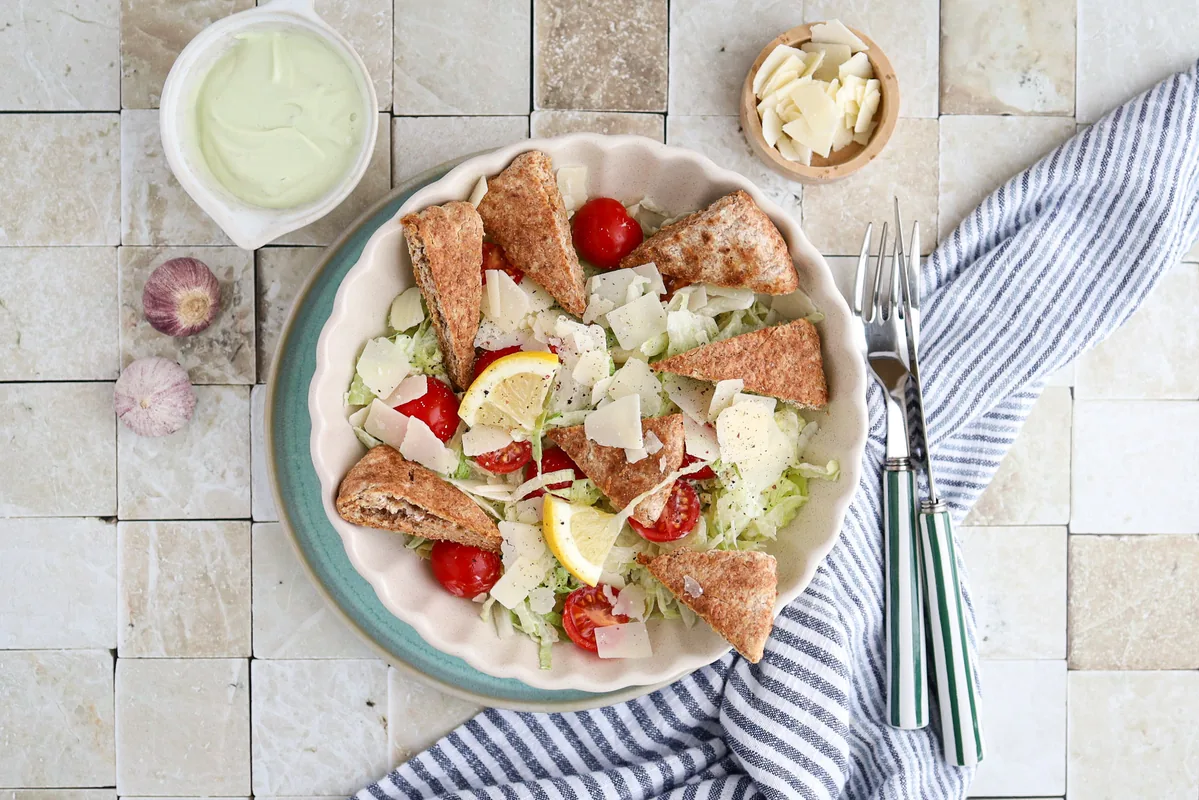
Pita Caesar Salad with Avocado Dressing
Traditional caesar dressing builds its richness on egg yolk, anchovies, and a heavy hand of parmesan. This version replaces all of that with half a blended avocado, a spoonful of yogurt, raw garlic, lemon, and mustard.
The swap changes more than the flavor profile. Avocado's monounsaturated fat acts as a delivery vehicle for the carotenoids packed inside 140 grams of mixed salad greens. A human crossover trial tested this exact pairing and found that adding avocado to a vegetable salad pushed beta-carotene absorption up 15.3 times. Lutein, the pigment concentrated in leafy greens, rose 5.1-fold. Same vegetables, same nutrients. The difference was whether a fat source carried them through the gut wall.
Crispy baked pita triangles replace croutons, cherry tomatoes bring color and lycopene, and a scattering of parmesan shavings nods to the original. 566 kcal, 15 minutes, one person.
Traditional caesar dressing builds its richness on egg yolk, anchovies, and a heavy hand of parmesan. This version replaces all of that with half a blended avocado, a spoonful of yogurt, raw garlic, lemon, and mustard.
The swap changes more than the flavor profile. Avocado's monounsaturated fat acts as a delivery vehicle for the carotenoids packed inside 140 grams of mixed salad greens. A human crossover trial tested this exact pairing and found that adding avocado to a vegetable salad pushed beta-carotene absorption up 15.3 times. Lutein, the pigment concentrated in leafy greens, rose 5.1-fold. Same vegetables, same nutrients. The difference was whether a fat source carried them through the gut wall.
Crispy baked pita triangles replace croutons, cherry tomatoes bring color and lycopene, and a scattering of parmesan shavings nods to the original. 566 kcal, 15 minutes, one person.
Ingredients
- pita whole wheat 1
- olive oil 1.5 tablespoon
- avocado 0.5
- yogurt nonfat 2 tablespoon
- garlic 1 clove
- lemon juice 1 squeeze
- yellow mustard 1 teaspoon
- water 1 tablespoon
- cherry tomatoes 5
- mixed salad 5 ounce
- parmesan cheese 10 grams
Method
-
Preheat oven to 350°F.
-
Cut the pita into triangles, drizzle with half of the olive oil, season with salt and pepper, and bake for 8–10 minutes until crisp and golden.
-
Blend the avocado, yogurt, garlic, lemon juice, mustard, and remaining olive oil until smooth. Thin with water until it reaches a pourable consistency.
-
Halve the cherry tomatoes, toss with the mixed salad greens, pour the dressing over the top, and toss until every leaf is coated.
-
Top with parmesan shavings and the baked pita chips. Serve immediately.
Add the dressing right before you eat. Avocado oxidizes fast and the bright green color fades to brown within 20 minutes. The pita chips lose their crunch even faster once they touch a dressed salad. Build the bowl, dress it, eat it.
The avocado in this dressing is doing more than adding texture. In a human crossover trial, researchers served the same vegetable salad with and without avocado and measured what reached the bloodstream. Beta-carotene absorption jumped 15.3 times. Lutein rose 5.1-fold. Avocado's monounsaturated fat forms mixed micelles in the small intestine that carry fat-soluble carotenoids through the gut wall. Without that fat matrix, most of the pigment in your greens passes through unabsorbed.
Unlu et al. 2005 · Journal of Nutrition · DOIBehind this recipe
Can I make the avocado dressing ahead of time?
You can, but it will brown. Avocado oxidizes quickly once blended and exposed to air. To prep ahead, squeeze extra lemon juice into the dressing, press plastic wrap directly onto the surface to block air contact, and refrigerate. It holds its color for 2–4 hours this way. After that, the flavor stays fine but the bright green fades.
Why use avocado instead of traditional caesar dressing?
Traditional caesar dressing relies on egg yolk, anchovies, and parmesan for its body. This version gets its creaminess from blended avocado and yogurt instead. Beyond the flavor change, avocado brings a specific nutritional advantage: its monounsaturated fat helps the body absorb carotenoids from the salad greens. A human trial found that adding avocado to a vegetable salad multiplied beta-carotene absorption by 15.3 times. The olive oil in the dressing adds a second fat source working toward the same effect.
Read the full evidence reviewIs 16 grams of protein enough for a full meal?
It depends on the rest of your day. 16 grams is about 11% of this meal's energy from protein, which is lower than most FitChef dinner recipes. If you are aiming for a higher-protein lunch, this salad pairs well with a side of grilled chicken, a hard-boiled egg, or a handful of nuts. As a light lunch or alongside another dish, the protein content works fine on its own.