Greek Burger & Salad
The feta and spinach go inside the beef — not on top. Sun-dried tomatoes and garlic, too. The whole patty cooks in olive oil over medium heat, 3 to 4 minutes per side, while the other half of that garlic clove goes raw into a quick tzatziki with grated cucumber, yogurt, and lemon.
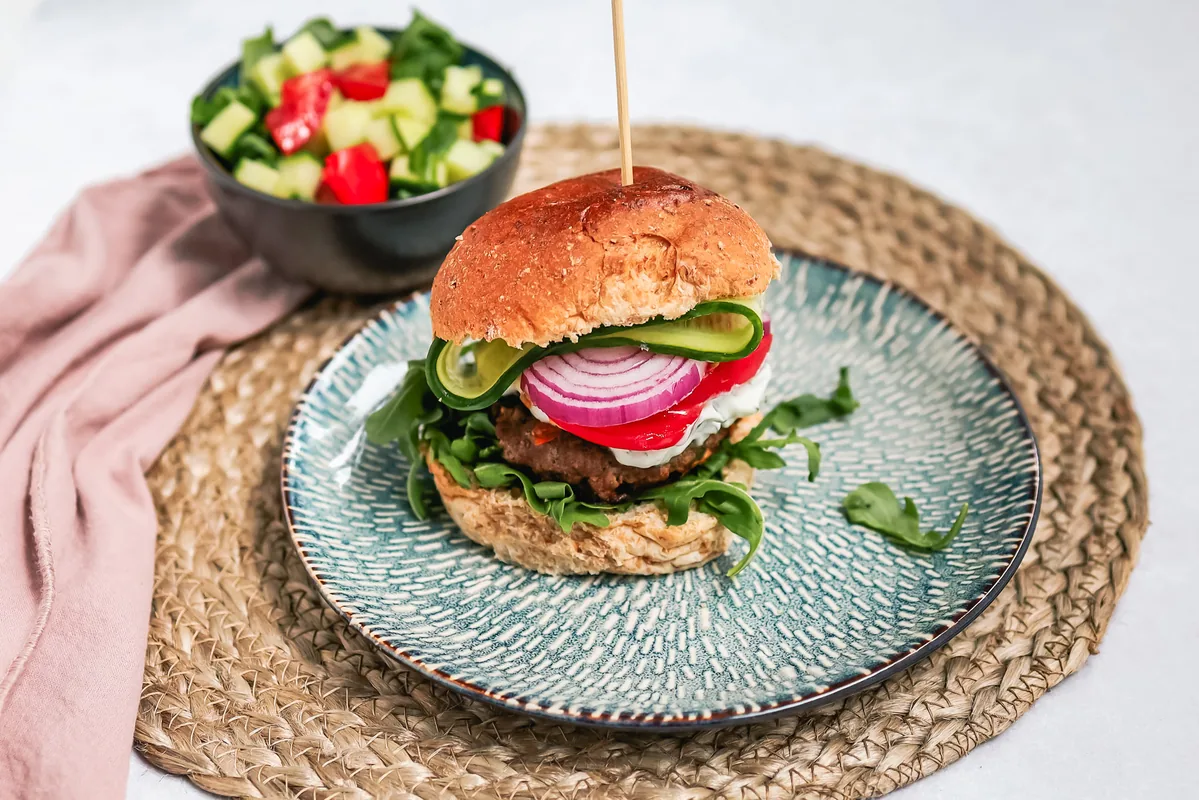
550 kcal and 36 grams of protein from one plate: a stuffed burger on a whole wheat bun, and whatever is left of the cucumber, tomato, and red onion becomes the side salad. Fifteen minutes, start to finish.
The feta and spinach go inside the beef — not on top. Sun-dried tomatoes and garlic, too. The whole patty cooks in olive oil over medium heat, 3 to 4 minutes per side, while the other half of that garlic clove goes raw into a quick tzatziki with grated cucumber, yogurt, and lemon.
550 kcal and 36 grams of protein from one plate: a stuffed burger on a whole wheat bun, and whatever is left of the cucumber, tomato, and red onion becomes the side salad. Fifteen minutes, start to finish.
Ingredients
- olive oil 1 tbsp
- spinach 1 handful
- sun-dried tomatoes 3
- garlic 1 clove
- 96% lean ground beef 3 oz
- feta cheese, crumbled 1 oz
- cucumber 0.5
- tomato 1
- red onion 0.25
- yogurt, nonfat 1 fl oz
- lemon juice 1 squeeze
- whole wheat bun 1
- arugula 1 handful
Method
-
Heat half of the oil in a frying pan. Add the spinach and allow it to wilt. Once wilted, remove the spinach from the pan and chop finely.
-
Finely chop the sun-dried tomatoes and crush the garlic.
-
Mix the ground beef with the spinach, sun-dried tomatoes, crumbled feta and half of the garlic. Season with pepper and salt. Use your hands to thoroughly combine the mixture and shape it into a burger.
-
Heat the remaining oil in the pan and cook the burger over medium heat for 3 to 4 minutes on each side.
-
In the meantime, grate half of the cucumber and slice the other half. Slice the tomato and cut the onion into rings.
-
Prepare the tzatziki by mixing the grated cucumber with the yogurt, the remaining garlic, the lemon juice, pepper and salt. Stir everything well.
-
Halve the bun and add a layer using half of the arugula. Place the burger on top, spread the tzatziki over it and add half of the cucumber, tomato and onion slices. Top with the other half of the bun.
-
Combine the remaining arugula, tomato, cucumber and onion to make a salad.
-
Serve the burger on a plate, along with the salad.
That garlic you crush into the raw beef in step 3 is not just seasoning. When garlic is mixed directly into ground beef before frying, its organosulfur compounds reduce the formation of heterocyclic amines — cooking byproducts from high-heat meat preparation. At roughly this recipe's ratio, researchers measured a 28% reduction. More garlic pushes it higher — up to 71% at four times the amount.
Spinach and feta sit side by side inside step 3's burger mix — and if you have heard that spinach blocks calcium absorption, here is what the research actually found. Spinach's own calcium is poorly absorbed (about 10%) because it is locked in calcium oxalate crystals. But calcium from cheese eaten in the same meal absorbs at its normal rate — 35.8% — completely unaffected by the spinach oxalates. Separate calcium pools, separate absorption pathways.
Why This Works
Behind this recipe
Can I use ground turkey instead of beef?
Yes. 99% lean ground turkey works well here. The patty will be leaner, but the wilted spinach and melting feta help hold it together and keep it moist. The garlic's effect on cooking compounds during frying applies to any ground meat cooked at high heat.
Why mix the spinach and feta into the patty instead of adding them on top?
Mixing them into the raw meat distributes flavor through every bite. The wilted spinach adds moisture that prevents the lean beef from drying out during cooking. The feta melts slightly inside the patty, creating pockets of salt and creaminess — on top, it slides off or stays in one spot.
Does the spinach affect the calcium from the feta?
Research found that dairy calcium absorbs at its normal rate (35.8%) even when eaten alongside spinach. Spinach's own calcium is poorly absorbed — about 10% — because it is locked in oxalate crystals. But those oxalates do not interfere with calcium from an external dairy source like feta. Two separate calcium pools, two separate pathways (Heaney & Weaver, American Journal of Clinical Nutrition, 1989).
Does the garlic in the tzatziki kill the yogurt's probiotics?
No. At the small amount in a single serving — about half a clove mixed into 30 ml of yogurt — garlic does not have an antibiotic effect on yogurt cultures. Research on garlic in yogurt-based dishes found that at food-typical concentrations, the fermented product remained probiotic-active.