Curry Noodles with Ground Beef, Eggplant & Bell Pepper
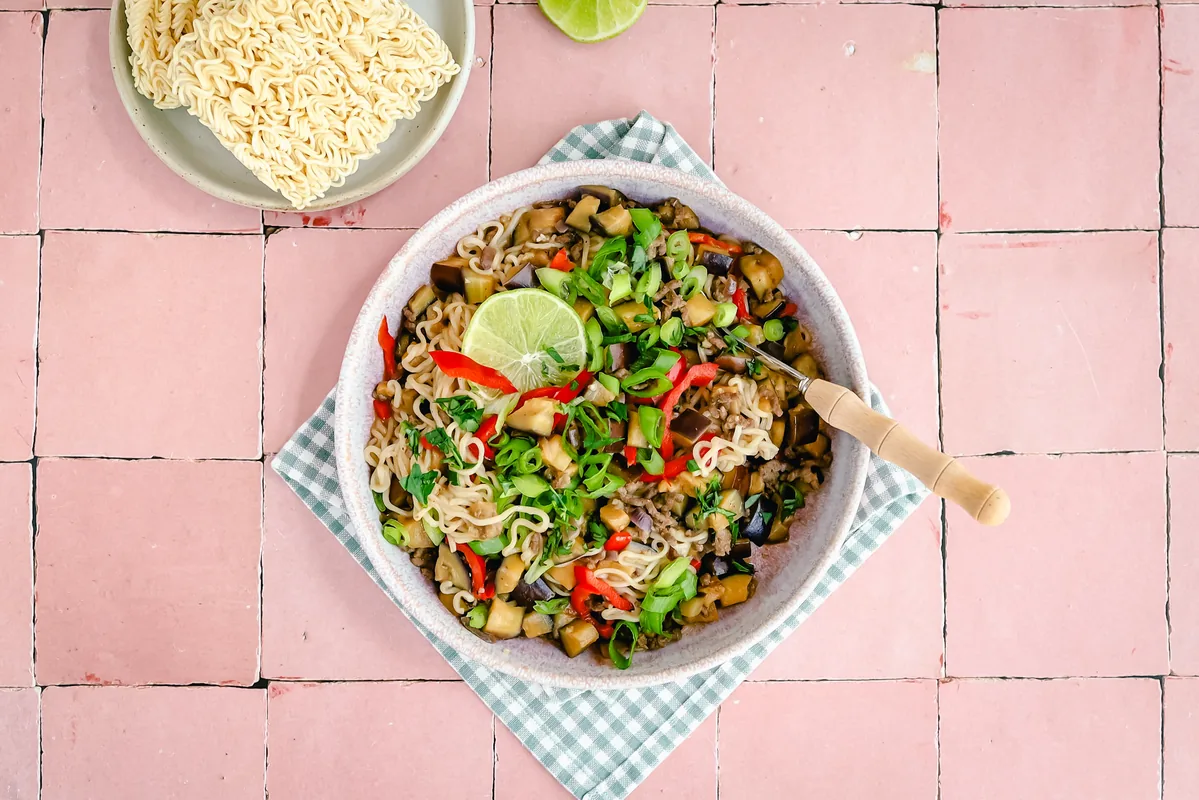
Spiced ground beef and curry paste build a deeply savory base, then soft eggplant cubes and crisp bell pepper strips join the pan before everything simmers in coconut milk until the sauce thickens and clings to each piece.
Toss in whole wheat noodles, hit it with fresh lime, and dinner is done in 15 minutes flat — 653 kcal, 35g protein, and enough fiber (11g) to keep you full without feeling heavy.
Spiced ground beef and curry paste build a deeply savory base, then soft eggplant cubes and crisp bell pepper strips join the pan before everything simmers in coconut milk until the sauce thickens and clings to each piece.
Toss in whole wheat noodles, hit it with fresh lime, and dinner is done in 15 minutes flat — 653 kcal, 35g protein, and enough fiber (11g) to keep you full without feeling heavy.
Ingredients
- onion 0.5
- garlic 1 clove
- ginger 1 slice
- eggplant 1
- bell pepper 1
- olive oil 0.5 tbsp
- 96% lean ground beef 3 oz
- red curry paste 1 tbsp
- coconut milk 1.5 fl oz
- whole wheat noodles 3 oz
- lime juice 1 squeeze
Method
-
Chop the onion. Dice the garlic. Grate the ginger. Cut the eggplant into cubes. Slice the bell pepper into strips.
-
Heat the olive oil in a large pan over medium-high heat. Sauté the onion, garlic, and ginger for 2 minutes. Add the ground beef and red curry paste and cook for 4 minutes. Then add the eggplant and bell pepper and cook for another 4 minutes.
-
Stir in the coconut milk and let the curry simmer for 7 minutes.
-
Cook the noodles according to the package instructions.
-
Drain the noodles and mix them into the curry. Squeeze the lime juice over the dish and season with salt and pepper.
Let the eggplant cubes simmer in the coconut milk for the full 7 minutes rather than rushing the sauce. Eggplant is one of the richest dietary sources of chlorogenic acid — its signature antioxidant — and a 2021 human trial found that coconut fat increased chlorogenic acid absorption from 5.7% to 65.6%. The longer the eggplant cooks in that coconut milk, the more it soaks up the fat that helps carry those compounds through.
Eggplant owes more than half its phenolic content to chlorogenic acid. In this recipe, that chlorogenic acid meets coconut milk — and a study in 90 healthy volunteers found that coconut fat boosted chlorogenic acid absorption by 11.5 times compared to taking it without fat. The mechanism: medium-chain triglycerides in coconut increase intestinal membrane fluidity, letting more of the antioxidant pass through.
Research · DOIBehind this recipe
Why does the eggplant go soft while the bell pepper stays crisp?
Eggplant has a spongy cellular structure that collapses under heat and absorbs whatever liquid surrounds it — in this case, the coconut curry sauce. Bell pepper has firmer cell walls and a higher water content that resists breakdown during the short cooking time. The contrast is one of the best parts of the dish: soft, sauce-soaked eggplant cubes against strips of bell pepper that still snap.
Can I use regular noodles instead of whole wheat?
Yes. Rice noodles, egg noodles, or regular wheat noodles all work. Whole wheat noodles contribute most of the 11g fiber in this meal and keep the carbs slower-digesting, but the curry sauce pairs well with any noodle type. Cook them separately per package instructions and toss in at the end.
Is there actual research behind the eggplant and coconut milk pairing?
There is. Eggplant is one of the richest food sources of chlorogenic acid — an antioxidant that makes up over half its phenolic content. A 2021 human trial with 90 volunteers found that coconut fat increased chlorogenic acid absorption from 5.7% to 65.6%. The study used purified chlorogenic acid and coconut oil (not whole eggplant and coconut milk), so the real-world effect in this dish would be smaller — but the underlying mechanism (coconut MCTs increasing intestinal membrane permeability) still applies when you simmer eggplant in coconut milk.