Couscous with Chicken Tandoori & Garden Peas
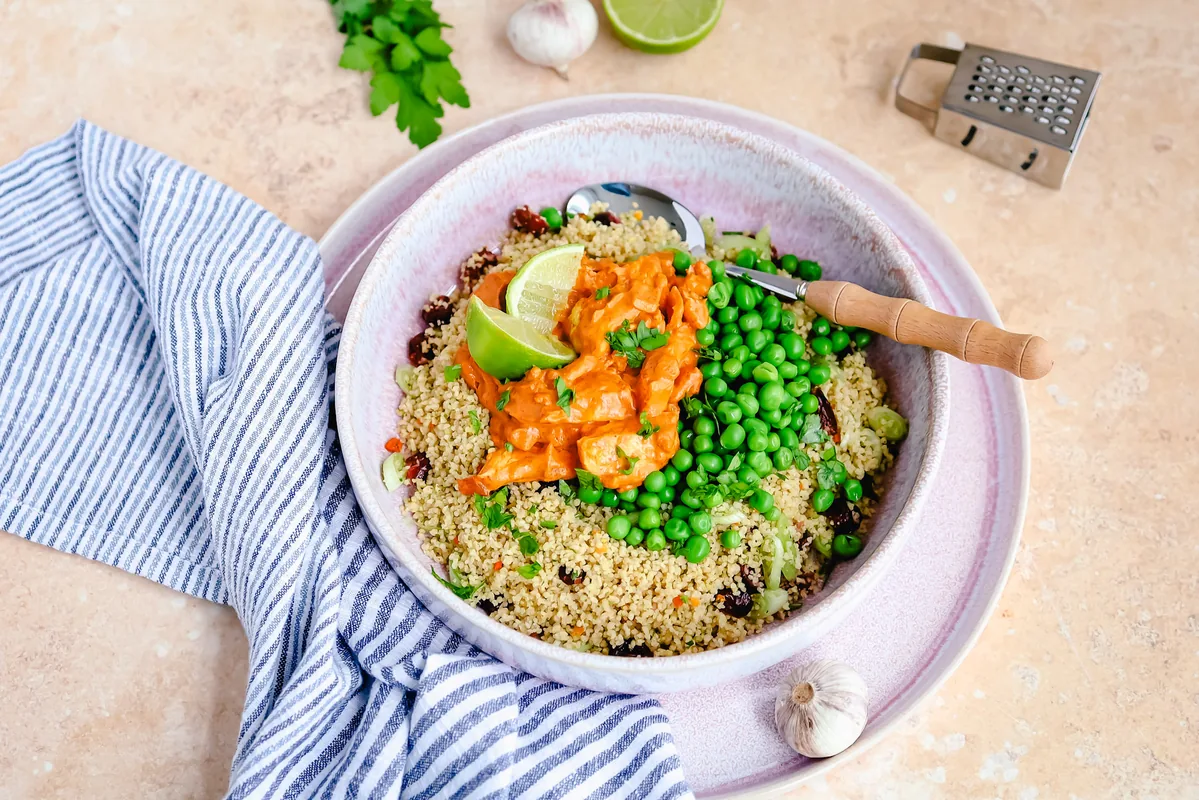
The marinade does all the work. Yogurt, tomato paste, cumin, cinnamon, and curry coat the chicken while the couscous soaks in bouillon and the peas boil for four minutes. Fifteen minutes, one pan, and the plate holds 55 grams of protein, 127 grams of carbs, and just 11 grams of fat.
Those 326 grams of garden peas carry most of the fiber story. They deliver nearly all 24 grams per serving and add a second protein source beside the chicken. The raisins mixed into the couscous bring a sweetness that rounds out the warm spice blend without adding any fat worth counting.
The marinade does all the work. Yogurt, tomato paste, cumin, cinnamon, and curry coat the chicken while the couscous soaks in bouillon and the peas boil for four minutes. Fifteen minutes, one pan, and the plate holds 55 grams of protein, 127 grams of carbs, and just 11 grams of fat.
Those 326 grams of garden peas carry most of the fiber story. They deliver nearly all 24 grams per serving and add a second protein source beside the chicken. The raisins mixed into the couscous bring a sweetness that rounds out the warm spice blend without adding any fat worth counting.
Ingredients
- chicken breast 3 ounces
- yogurt, nonfat 2 fluid ounces
- tomato paste 1 tablespoon
- ground cumin 0.5 teaspoon
- cinnamon 0.5 teaspoon
- curry powder 0.5 teaspoon
- lemon juice 1 squeeze
- couscous 3 ounces
- vegetable bouillon 0.5 cube
- garden peas (frozen) 1.25 cup
- scallion 1 piece
- onion 0.5 piece
- garlic 1 clove
- ginger 1 slice
- olive oil 0.5 tablespoon
- raisins 0.5 ounce
Method
-
Cut the chicken breast into cubes.
-
In a bowl, mix yogurt, tomato paste, cumin, cinnamon, curry and lemon juice. Stir well, then add the chicken cubes to the marinade. Let it sit for a while.
-
Prepare the couscous with the bouillon according to the instructions on the package.
-
Cook the garden peas in boiling water for 4 minutes until tender.
-
Slice the scallion into rings. Dice the onion, finely chop the garlic and grate the ginger.
-
Heat oil in a pan. Sauté the onion, garlic and ginger for two minutes. Add the marinated chicken to the pan, stir well, and cook for about 5 minutes until the chicken is done. Season with salt and pepper to taste.
-
Mix the scallion and raisins into the soaked couscous.
-
Serve the couscous with garden peas and chicken tandoori on a plate.
Keep the marinating time under 30 minutes. The lemon juice and tomato paste in the yogurt base are acidic enough to tenderize the chicken surface, but past the half-hour mark the acid starts breaking down the outer protein fibers and the texture turns chalky instead of tender.
That half teaspoon of cinnamon goes straight into the yogurt marinade in Step 2. A 2018 study found that when cinnamon is mixed into dairy, milk proteins physically bind 65.3% of cinnamon’s polyphenol compounds. During simulated digestion, those bound compounds were released in the intestine — where absorption actually happens — resulting in higher total polyphenol recovery than cinnamon consumed in water alone. The yogurt in the marinade may be shielding the cinnamon’s antioxidant compounds through stomach acid. The study was in vitro, not tested in human subjects, but has been cited by 127 other papers.
Cinnamon + Dairy Polyphenol Protection · DOIBehind this recipe
Can I use Greek yogurt instead of nonfat yogurt?
Yes. Greek yogurt is strained, which makes it more casein-dense than regular yogurt. Since caseins are the milk proteins that bind cinnamon’s polyphenol compounds in the 2018 Helal study, Greek yogurt may strengthen that interaction. The macros shift slightly: more protein, slightly more fat per serving depending on the brand. The marinade texture stays the same.
Is 55 grams of protein in one meal too much to absorb?
The idea that the body can only use 30 grams of protein per meal comes from older research that cut its observation window short. A 2023 randomized controlled trial published in Cell Reports Medicine measured for 12 hours after a protein drink taken right after a workout and found no upper limit up to 100 grams. The body processes what it gets — it just takes longer with bigger doses.
Read the full evidence reviewWhy are there 326 grams of garden peas in this recipe?
The peas are the fiber and volume engine. They deliver nearly all 24 grams of fiber in this meal and contribute roughly 16 grams of plant protein as a second source beside the chicken. A 2015 randomized controlled trial with 161 participants found that pea protein produced comparable muscle thickness gains to whey protein over 12 weeks of resistance training.
Read the full evidence reviewHow long should the chicken sit in the marinade?
Aim for 10 to 20 minutes. The yogurt’s lactic acid and the tomato paste’s citric acid tenderize the surface proteins quickly. Past 30 minutes, the acid starts breaking down the outer fibers too aggressively and the texture turns chalky instead of tender. The recipe says “let it sit for a while” — that while should be short.