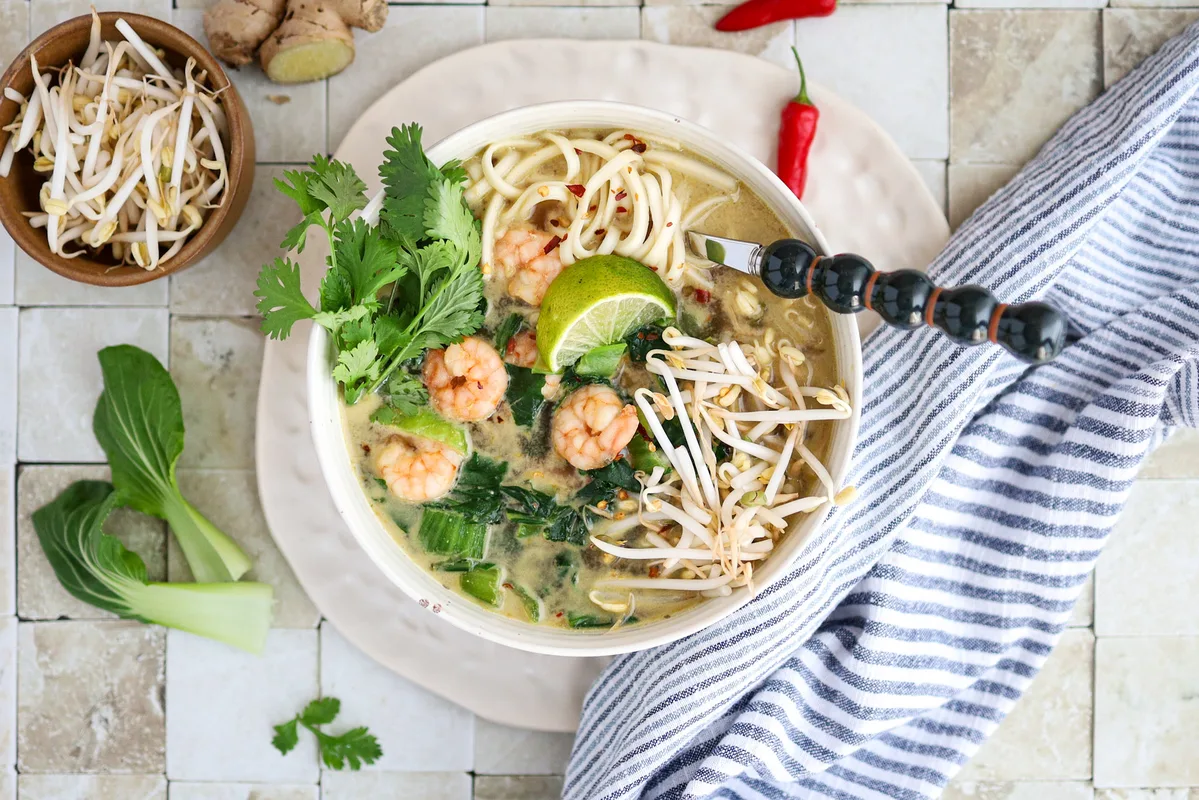
Coconut Shrimp Ramen Bowl with Bok Choy
Whole wheat noodles under a coconut milk broth built on garlic, ginger, and a whisper of chili. Shrimp go in frozen, come out pink and tender in three minutes. Bok choy drops in last, white stems first to soften, green leaves just to wilt.
Twenty minutes, one pot for the broth, and a bowl that looks like it came from a place that charges eighteen dollars for it.
Whole wheat noodles under a coconut milk broth built on garlic, ginger, and a whisper of chili. Shrimp go in frozen, come out pink and tender in three minutes. Bok choy drops in last, white stems first to soften, green leaves just to wilt.
Twenty minutes, one pot for the broth, and a bowl that looks like it came from a place that charges eighteen dollars for it.
Ingredients
- noodles, whole wheat 3 ounces
- baby bok choy 1 head
- garlic 1 clove
- ginger 1 slice
- bean sprouts 1 ounce
- water 1.75 cup
- vegetable bouillon 1 cube
- chili powder 1 pinch
- coconut milk 3 fluid ounces
- soy sauce 1 tablespoon
- shrimp (frozen) 3 ounces
Method
-
Cook the noodles according to the package instructions.
-
Cut the bok choy into pieces and keep the white and green parts separate. Then finely chop the garlic and ginger. Rinse the bean sprouts under running water in a colander.
-
Bring the water and bouillon cube to a boil in a small pot.
-
Add the garlic, ginger, and chili powder, then let it simmer on low heat for 5 minutes.
-
Stir in the coconut milk and let it simmer gently for 2-3 minutes.
-
Then add the white part of the bok choy and the soy sauce and cook for 2-3 minutes. Next, add the shrimp and cook for another 3-4 minutes until they turn pink and are cooked through. Stir in the green part of the bok choy during the last minute of cooking.
-
Place the noodles in a deep bowl. Ladle the coconut milk broth, shrimp, bok choy and bean sprouts over the noodles.
Don't let the broth boil after adding the coconut milk. A gentle simmer keeps the coconut milk smooth and creamy. Vigorous boiling can cause it to separate, turning the broth grainy instead of silky.
When bok choy simmers in broth, calcium drifts out of the leaves and into the liquid, the same way it leaches into boiling water you would normally pour down the drain. But this is ramen. You eat the broth. A randomized crossover study found your body absorbs 52% of bok choy's calcium, compared to 46% from milk at the same dose.
Bok Choy vs. Milk: Calcium Absorption · DOIBehind this recipe
Can I use light coconut milk instead of full-fat?
Yes, but the broth will be thinner and less rich. The full recipe uses only 3 fluid ounces of full-fat coconut milk, which keeps total fat at 18 grams per serving. Light coconut milk would lower that to about 12-14 grams, but you lose the velvety body that makes the broth feel like a restaurant bowl.
Does simmering bok choy destroy the calcium?
Cooking does cause some calcium to leach out of the leaves and into the liquid. In a stir-fry or boiled-and-drained preparation, that calcium goes down the drain. But in this recipe, the bok choy simmers directly in the broth you eat, so leached calcium stays in your bowl. A randomized study found your body absorbs 52% of bok choy's calcium, significantly more than the 46% it absorbs from milk.
Can I use fresh shrimp instead of frozen?
Absolutely. Reduce the cooking time by 1-2 minutes. Fresh shrimp cook faster than frozen. Watch for the color change: as soon as they curl into a C-shape and turn pink all the way through, they are done. Overcooked shrimp turn rubbery within seconds.