Coconut Quinoa with Salmon & Mango-Avocado Salsa
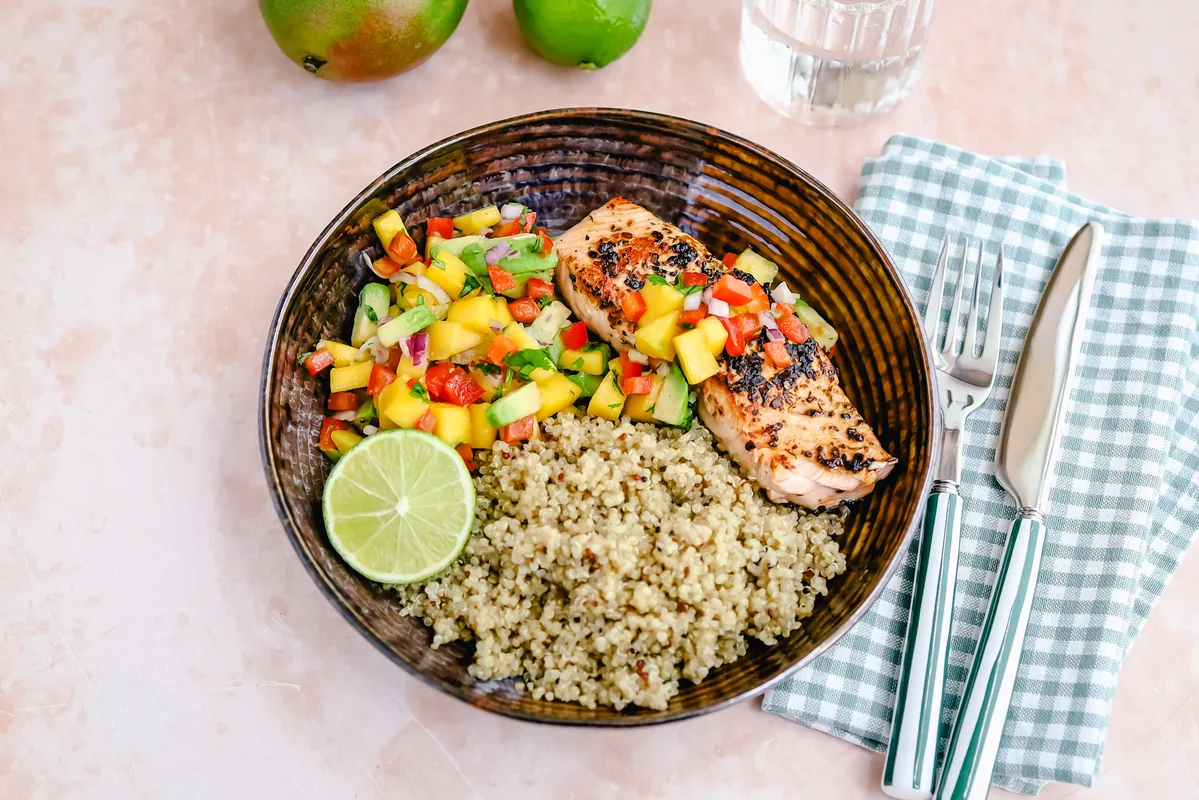
Quinoa simmered in coconut milk, crispy pan-fried salmon, and a bright salsa loaded with mango, avocado, bell pepper, chili, and lime.
The coconut milk does more than flavor the quinoa. Its fat helps your body access the beta-carotene locked inside the mango — the orange pigment your body turns into vitamin A. Researchers tested mango consumed with a fat source and found it delivered up to 56% more absorbable beta-carotene than mango on its own. And the avocado diced into the same salsa adds a second fat vehicle right next to the pigment.
Quinoa simmered in coconut milk, crispy pan-fried salmon, and a bright salsa loaded with mango, avocado, bell pepper, chili, and lime.
The coconut milk does more than flavor the quinoa. Its fat helps your body access the beta-carotene locked inside the mango — the orange pigment your body turns into vitamin A. Researchers tested mango consumed with a fat source and found it delivered up to 56% more absorbable beta-carotene than mango on its own. And the avocado diced into the same salsa adds a second fat vehicle right next to the pigment.
Ingredients
- salmon fillet 1
- mango chunks (frozen) 3 oz
- quinoa 3 oz
- coconut milk 1.5 fl oz
- water 2.5 fl oz
- avocado 0.5
- bell pepper 1
- red onion 0.25
- chili pepper 0.5
- lime juice 1 squeeze
- olive oil 0.5 tbsp
Method
-
Remove the salmon from the freezer and let it thaw on a plate. Also, let the mango cubes thaw in a bowl.
-
Put the quinoa in a saucepan along with the coconut milk and water. Bring it to a boil and let it simmer over low heat for about 10 minutes until all the liquid is absorbed. Stir occasionally and make sure it doesn't burn. If needed, add a dash more water.
-
Cut the mango into smaller pieces. Dice the avocado and bell pepper, finely chop the onion and finely chop the chili pepper. Mix all of these in a bowl together with the lime juice and a bit of pepper and salt.
-
Season the salmon with a bit of pepper and salt. Heat the oil in a pan and cook the salmon fillet for about 8 minutes until it's cooked through and has a crispy crust.
-
Serve the quinoa with the salmon and mango and avocado salsa on a plate. Drizzle with some more lime juice.
The avocado in the salsa has a job beyond creaminess. Researchers found that adding avocado to a salsa boosted beta-carotene absorption 2.6 times compared to the same salsa without it. In step 3, you dice avocado directly alongside mango and bell pepper — two beta-carotene sources — so the fat meets the pigments before the plate is even assembled.
The beta-carotene in mango is fat-soluble — your body needs fat in the same meal to absorb it. The coconut milk cooked into this quinoa provides that fat. Researchers testing mango with and without a fat source found the fat-paired version delivered up to 56% more accessible beta-carotene.
Mango + Fat: Beta-Carotene Bioaccessibility · DOIBehind this recipe
Why cook quinoa in coconut milk instead of just water?
Two reasons. First, the coconut milk gives the quinoa a subtle richness that pairs with the tropical salsa. Second, the fat from the coconut milk gets absorbed into the grain during cooking. When you eat the quinoa alongside the mango salsa, that fat helps your body access more of the beta-carotene — the orange pigment in mango that your body converts into vitamin A. Researchers found that mango consumed with a fat source delivered up to 56% more absorbable beta-carotene than mango alone.
Is 44 grams of protein in a single meal too much?
No. Older research suggested the body could only use 20-30 grams per meal, but more recent evidence shows protein utilization continues well beyond that range — up to 100 grams in a single sitting in one controlled study. The 44 grams in this meal, primarily from the salmon fillet, falls well within what research supports.
Can I use fresh mango instead of frozen?
Absolutely. Fresh mango works just as well — dice it to roughly the same size as the other salsa ingredients. Frozen mango is convenient because it's pre-cut and available year-round, but fresh mango in season will give you a slightly brighter texture in the salsa.
Does the color of the bell pepper matter?
All bell pepper colors work, but red, orange, and yellow peppers have significantly more beta-carotene and vitamin C than green ones. Green bell peppers are harvested earlier in the ripening process, before the carotenoid pigments fully develop. For the strongest pairing with the avocado fat in this salsa, a red or orange pepper gives you the most beta-carotene to work with.