Noodle & Salmon Poke Bowl
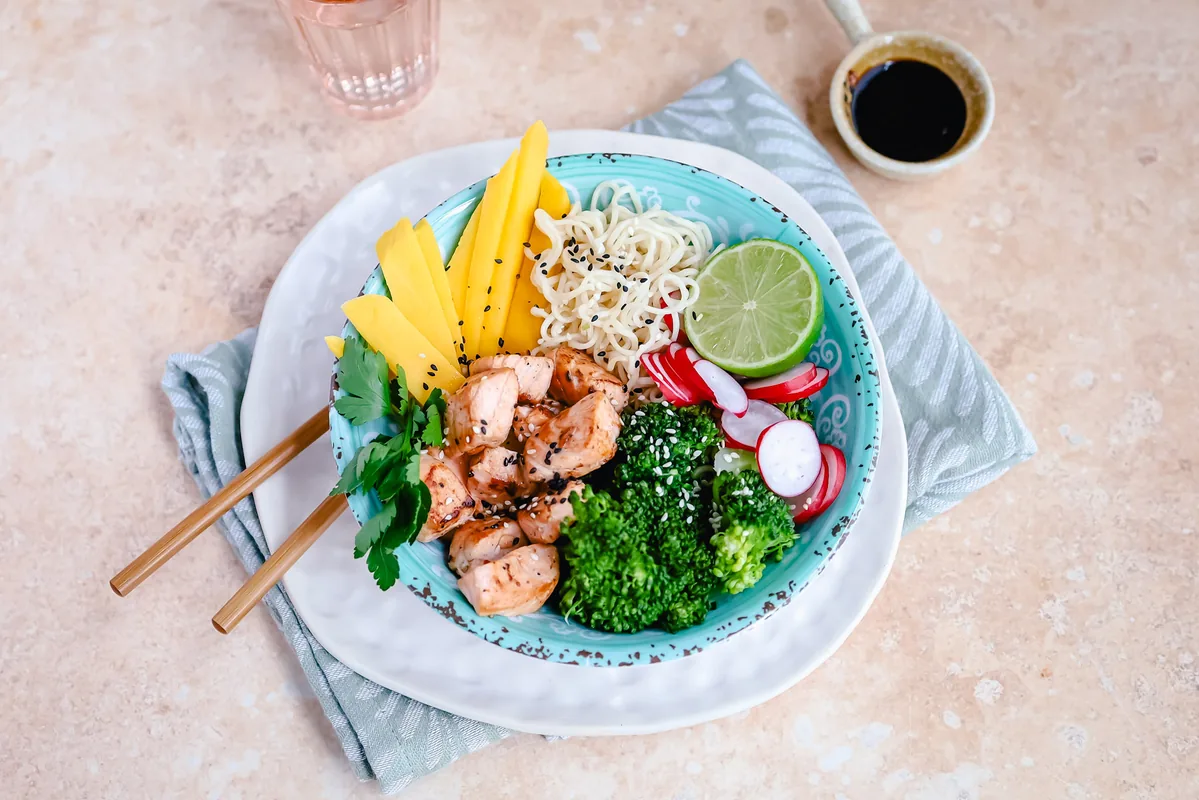
Lime-kissed salmon cubes over a tangle of whole wheat noodles, with tender-crisp broccoli, sweet mango, and thin rounds of raw radish scattered across the top. The soy-lime drizzle ties everything together — bright, salty, and just enough acid to cut through the richness of the pan-fried fish.
Fifteen minutes from freezer to bowl. 46 grams of protein, 86 grams of carbs, and a detail about the radishes that most recipe pages never get into.
Lime-kissed salmon cubes over a tangle of whole wheat noodles, with tender-crisp broccoli, sweet mango, and thin rounds of raw radish scattered across the top. The soy-lime drizzle ties everything together — bright, salty, and just enough acid to cut through the richness of the pan-fried fish.
Fifteen minutes from freezer to bowl. 46 grams of protein, 86 grams of carbs, and a detail about the radishes that most recipe pages never get into.
Ingredients
- mango chunks (frozen) 2 ounces
- salmon fillet 1
- noodles, whole wheat 3 ounces
- broccoli florets (frozen) 3 cups
- lime juice 2 squeezes
- olive oil 1 tablespoon
- radishes 5
- soy sauce 1 tablespoon
Method
-
Remove the mango cubes and the salmon from the freezer and let them thaw separately on a plate.
-
Cook the noodles according to the instructions on the package until tender.
-
Place the broccoli florets in a pan with plenty of water, bring to a boil and cook for 4 minutes until they are tender-crisp.
-
Cut the salmon into cubes and marinate the salmon with some lime juice, along with some pepper and salt.
-
Heat oil in a skillet and cook the salmon cubes for about 4 minutes until they are cooked through and golden brown.
-
Meanwhile, slice the radishes into thin rounds.
-
Assemble the bowl by combining the noodles with mango, broccoli, radishes and salmon cubes in a serving dish. Drizzle the bowl with soy sauce and lime juice.
Those thin radish rounds are not just crunch. Radishes belong to the same plant family as broccoli and carry an enzyme that frozen broccoli lost during commercial processing. Research found that eating raw cruciferous vegetables alongside cooked broccoli helps restore the broccoli's ability to produce sulforaphane — without that enzyme, only 10-20% of the raw material gets converted on its own.
Commercial frozen broccoli is blanched before freezing to preserve color and texture. That blanching destroys the enzyme responsible for converting a stored compound in broccoli into sulforaphane. The raw material survives — it just has no way to activate. Raw vegetables from the same plant family as broccoli (like the radishes in this bowl) still carry that enzyme. Eating them in the same meal provides the missing piece during digestion.
Dosz & Jeffery, 2013 — Journal of Food Science · DOIWhy This Works
Behind this recipe
Why does this recipe use frozen broccoli instead of fresh?
Convenience and availability — frozen broccoli is pre-cut, stays fresh for months, and costs less than fresh. The trade-off is that commercial blanching before freezing destroys an enzyme called myrosinase, which is responsible for producing sulforaphane from broccoli's stored compounds. Fresh broccoli retains that enzyme. This recipe compensates: the raw radishes belong to the same plant family and carry their own myrosinase, restoring the conversion when eaten together.
Should I cook the radishes with the broccoli?
No — and the science is why. The value of the raw radishes is their active enzyme (myrosinase), which helps the cooked broccoli produce sulforaphane. Cooking the radishes would destroy that enzyme, the same way blanching destroyed the broccoli's. Keep them raw, sliced thin, and add them at assembly.
Why is soy sauce drizzled at the end instead of cooked in?
Flavor and function. Soy sauce produced through fermentation contains compounds that research found boost non-heme iron absorption by 3.3 times — comparable to the iron-enhancing effect of meat. This bowl's whole wheat noodles and broccoli both contain non-heme iron. Drizzling soy sauce over the assembled bowl means those iron-enhancing compounds meet the iron sources during digestion.