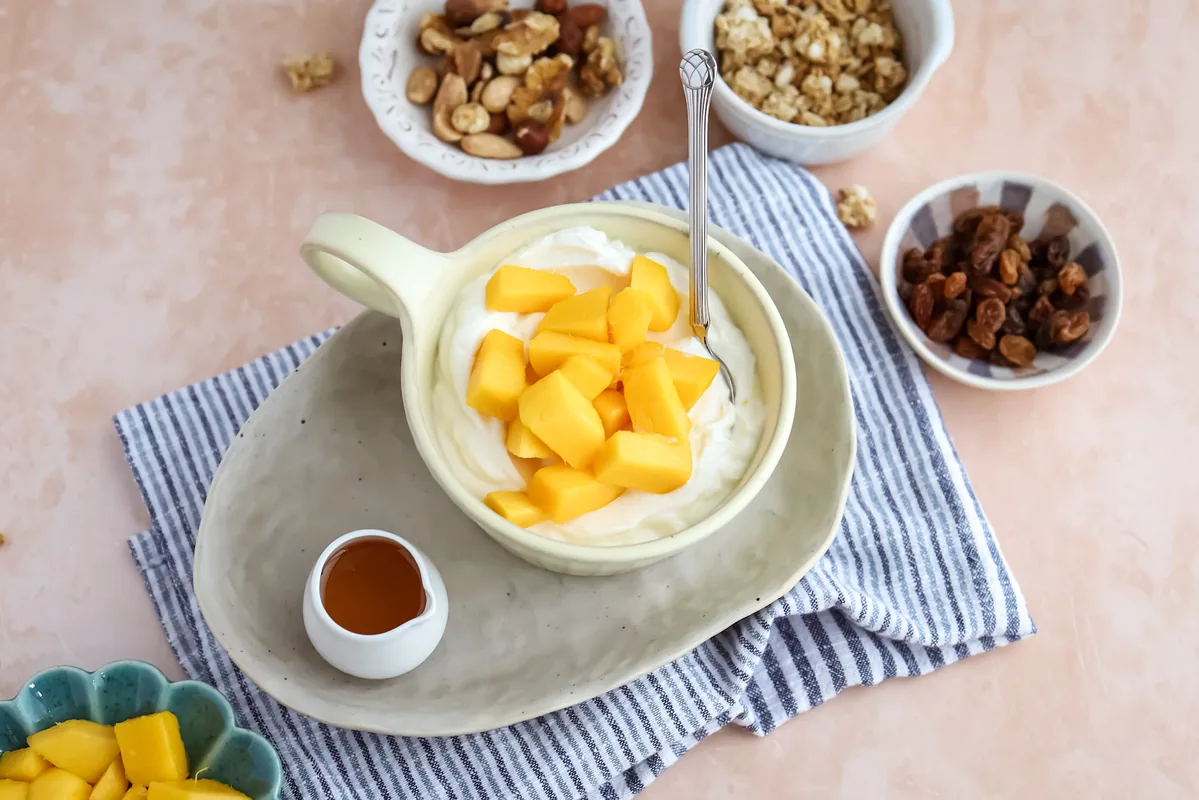
Yogurt with Mango, Nuts & Honey
Most of what makes frozen mango nutritionally interesting sits in its color. That deep orange comes from beta-carotene, and your body needs fat to absorb it.
Nonfat yogurt has none. Without the nuts, the mango’s signature nutrient passes through largely unabsorbed. One ounce of mixed nuts delivers roughly 14g of fat, clearing the absorption threshold researchers identified by more than double. Three minutes, four ingredients, 29g of protein and 405 kcal, and nothing in this bowl is decoration.
Most of what makes frozen mango nutritionally interesting sits in its color. That deep orange comes from beta-carotene, and your body needs fat to absorb it.
Nonfat yogurt has none. Without the nuts, the mango’s signature nutrient passes through largely unabsorbed. One ounce of mixed nuts delivers roughly 14g of fat, clearing the absorption threshold researchers identified by more than double. Three minutes, four ingredients, 29g of protein and 405 kcal, and nothing in this bowl is decoration.
Ingredients
- mango chunks (frozen) 0.5 cup
- yogurt, nonfat 1 cup
- mixed nuts, unsalted 1 ounce
- honey 0.5 tablespoon
Method
-
Let the mango chunks thaw for a moment.
-
Scoop the yogurt into a bowl.
-
Add the mango on top of the yogurt. Sprinkle the nuts over the mango and drizzle honey.
-
Serve immediately and enjoy!
The nuts are the ingredient that makes the mango work. Nonfat yogurt delivers zero fat, and research found that meals with no added fat produced nearly zero carotenoid absorption from fruits and vegetables. The mixed nuts provide roughly 14g of fat, more than double the 6g threshold researchers identified. Skip them, and the mango’s beta-carotene has no delivery vehicle.
Dairy protein, specifically casein, helps stabilize fat droplets during digestion. This improves how well your body extracts beta-carotene from foods like mango. When researchers tested mango blended with milk, beta-carotene bioaccessibility increased by 12% to 56% depending on the variety. This bowl splits that mechanism across two ingredients: the yogurt provides the casein, the nuts provide the fat.
Mango + Dairy Carotenoid Study (2007) · DOIBehind this recipe
Can I use regular yogurt instead of nonfat?
Regular yogurt adds its own fat, which means the nuts become less critical for the absorption mechanism. The recipe uses nonfat yogurt for the macro profile: it keeps fat at 17g total (mostly from nuts) while maximizing protein at 29g. Swapping to full-fat yogurt changes both the calorie count and the fat-protein ratio.
Is 29g of protein too much to absorb from one meal?
No. That ceiling keeps circulating despite strong evidence against it. Multiple studies have found that muscle protein synthesis does not shut off at 30g per meal. At 29g split between yogurt and nuts, this bowl sits well within the range recent research supports.
Read the full evidence reviewDoes the type of nut matter?
Not much. Most nuts deliver roughly the same fat content per ounce, which is what matters for the carotenoid absorption mechanism. Almonds, walnuts, cashews, or a mix all clear the threshold. The recipe calls for unsalted mixed nuts, but any unsalted nut or combination works.